![[등록] 2026-09-01 15:48:31](/support/_updata/banner2/tl181982910_6749.png)


(C) Francezone Aiphotos
To survive, we must farm. Since what grows naturally in the mountains and fields is insufficient, we must till the soil, plant, and cultivate. Our representative foods were the "five grains," and it was said that we could eat "all kinds of fruits," leading to the phrase Ogok-baekgwa (five grains and a hundred fruits). The word ongat (all kinds) is a contraction of on-gaji (a hundred kinds), meaning "one hundred" or simply "many." Generally, the "five grains" we refer to are the five staples of the Korean diet: rice, barley, proso millet, soy beans, and red beans—the ingredients for the five-grain rice (ogok-bap) eaten on the first full moon of the lunar year. Korea has a monsoon climate with heavy summer rains and high temperatures, making it ideal for rice farming. Thus, we ate rice and worked with the "strength of rice."
Globally, the five major grains differ: corn, wheat, rice, soybeans, and barley. Corn is grown in astonishingly large areas in the U.S., Brazil, and Northeast China. When thinking of wheat—used for bread, noodles, and pasta—the Chornozem (black soil) regions of Ukraine come to mind; it is heartbreaking to see them suffering under the Russian invasion. Rice is cultivated in monsoon regions like India, Southeast Asia, Japan, and Korea. Only after the development of improved varieties like Tongil-byeo (unification rice) did yields increase enough to solve the history of poverty. Soybeans, called "beef from the field" for their high protein and fat content, are primarily used to make tofu or extracted for oil, making them a high-quality food. The fifth, barley, is not as popular but is used as an ingredient for beer or as livestock feed.
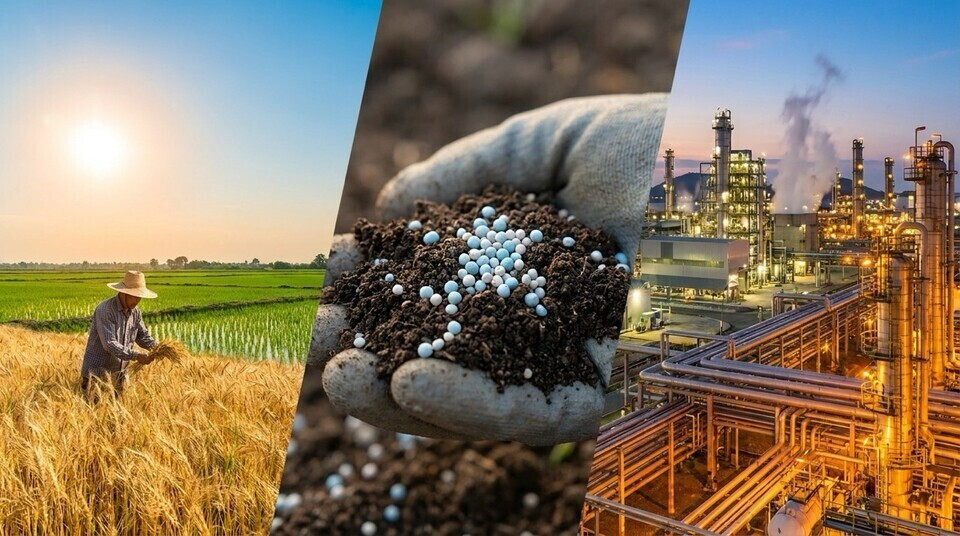
For farming, the soil in rice paddies and fields must have proper nutrients. Fertilizer (biryo), meaning "material that fattens the land," must be applied, and most of it is produced in factories. After liberation, fertilizer plants were built in Chungju and Naju to improve farming, producing nitrogen (urea), phosphoric acid, and potash (potassium). Nitrogen (N), Phosphorus (P), and Potassium (K) are learned as the "three elements of fertilizer" and the three essential nutrients for plant growth. For humans, the essential nutrients are carbohydrates, proteins, and fats.
Nitrogen is a key component in cell division and the creation of protein and chlorophyll; it promotes the growth of stems and leaves, increasing the plant's size and turning leaves green. This is crucial for photosynthesis. Nitrogen fertilizer is made by reacting nitrogen from the air with hydrogen, which is extracted from methane (natural gas) or naphtha from oil refining. Phosphorus plays a decisive role in flowering and fruiting. It aids root development, makes flower colors vivid, and improves fruit quality. Potassium regulates water and physiological functions, strengthening roots and increasing resistance to cold, pests, and diseases. Phosphorus and potassium are obtained by dissolving phosphate rock with sulfuric acid, which is made from sulfur—a byproduct of refining oil or natural gas.
Combining these three components into "composite fertilizer" allows for a balanced supply of nutrients in a single application, saving labor. Some are coated to release nutrients slowly over time. Customized composite fertilizers are also made for specific crops. Ultimately, producing fertilizer requires crude oil and thermal power plants fueled by oil; thus, the blockade of the Strait of Hormuz affects us. It is said that if you do not sow in spring, you will have nothing to reap in autumn. Since seeds do not grow on bare land without help, we must apply fertilizer. If the oil supply is cut off, the lack of fertilizer could make it difficult to sustain our lives.
Besides chemical fertilizers, there is "manure" (dueom) to enrich the soil. This compost (toebi) is obtained from livestock sheds. It is made by fermenting rice husks or straw mixed with animal waste. When spread on fields, it allows air to circulate in the soil and promotes microbial growth. It also improves drainage, which is good for root development. While fermented oil cake or chicken manure is excellent, they are not produced in large quantities, so most rely on chemical fertilizers.
While our food includes livestock meat alongside the "five grains and a hundred fruits," the base of the food chain is the grass and feed they consume. Feed is ultimately grain, and grain is the nutrient accumulated through carbon assimilation (photosynthesis) using sunlight. When less sunlight hits the Earth's surface, it is winter; when it hits more, it is summer. The Artemis satellite has seen the far side of the moon, but we are like Icarus, having escaped the Labyrinth. To avoid melting and dying, I do not know how we should cool down this "Earth star" that has been heated by our indiscriminate consumption.
[Copyright (c) Global Economic Times. All Rights Reserved.]