![[등록] 2026-09-01 15:48:31](/support/_updata/banner2/tl181982910_6749.png)


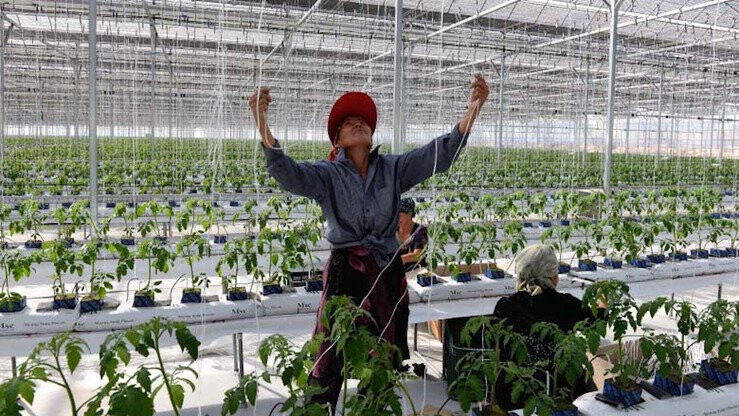
Fergana Valley – Farmers in Uzbekistan's fertile Fergana Valley, a key region for cotton and wheat production, are appealing for help, claiming they are being forcibly dispossessed of their land by Chinese companies under the guise of government-led development. They express deep concern that thousands of hectares of valuable agricultural land are being transferred from local farmers to Chinese entrepreneurs.
While official documents state that the land transfers are based on voluntary agreements, dozens of farmers, speaking on condition of anonymity, told Radio Free Europe/Radio Liberty (RFE/RL) about coercion, intimidation, and threatening behavior by Uzbek law enforcement officers acting on the instructions of local officials, revealing a reality contrary to official announcements.
"The regional governor said, 'This is the president's order. Either give up your land or go to prison,'" one anonymous farmer recounted, describing the pressure they faced.
The Shadow of 'Chinese Influence' Over Central Asia
The land transfer issue in the Fergana Valley, which spans Uzbekistan, Kyrgyzstan, and Tajikistan, is emerging as a major source of growing anti-Chinese sentiment across Central Asia. This sentiment stems not only from land disputes but also from concerns about excessive debt dependence, conflicts in the labor market, and a deep unease about China's expanding influence.
According to Uzbekistan's agricultural law, farmers can lease state-owned land for up to 49 years, and neither local governments nor prosecutors can seize it without a court decision. However, farmers claim that land acquisitions are being forcibly carried out under the verbal directives of the regional head, Shukhrat Abdurakhmonov.
"I didn't want to give up my land and resisted, but in response, the regional governor called more than 20 police officers and National Guard members to the administrative building and ordered them to arrest me and my wife," a farmer from the Kurgan-Tepe district told RFE/RL, adding, "That's why no farmer resists anymore. Otherwise, you could end up in prison, and it's uncertain if you'll ever get out."
The relevant regional administrations have remained silent, offering no response to RFE/RL's requests for comment.
Concerns About China's Influence Expanding Beyond Agriculture
Concerns about large-scale land acquisition by Chinese capital are spreading beyond the agricultural community to society as a whole. Through its ambitious economic initiative, the Belt and Road Initiative, China's economic influence has rapidly expanded in Central Asia in recent years.
As of early 2025, China has become Uzbekistan's largest trading partner, with bilateral trade reaching $12.5 billion. The number of Chinese companies operating in Uzbekistan exceeds 3,400, surpassing the number of Russian companies. Similar patterns are emerging in other Central Asian countries, including Kazakhstan.
While Chinese investment promises infrastructure development, job creation, and technology transfer, experts warn of a darker side. Nargiza Murataliyeva, a political analyst from Uzbekistan, points out that Central Asian countries are increasingly falling into China's "economic trap." This refers to the risk that easy loans offered under opaque conditions could eventually make weaker nations vulnerable to political pressure or asset forfeiture.
Murataliyeva highlighted the 2011 case where China obtained over 1,100 square kilometers of territory from Tajikistan in exchange for debt relief, illustrating the potential consequences of this "economic trap." Currently, China is Uzbekistan's largest creditor, with a total outstanding loan of $3.8 billion.
"The general characteristics of Chinese loans to all countries in the region are easy access to credit, difficult repayment terms, and a lack of transparency in procedures and specific conditions," Murataliyeva analyzed.
Debt repayment, land transfers, and the strengthening of China's economic control are further fueling local perceptions of "neocolonialism," especially when local communities are excluded from decision-making processes.
The Chinese government's repressive crackdown on Uyghurs and other non-Han ethnic minorities in China's Xinjiang Uyghur Autonomous Region resonates deeply with Central Asians who share linguistic, cultural, and religious ties. Regardless of whether it is propaganda or fact, the fear that China might one day treat Kazakhs or Uzbeks the same way is amplifying resentment towards Beijing's growing influence.
"It seems the Chinese really like our land. They are trying to take other farmers' land as well. Of course, we are against it, but the regional governor, the prosecutor, and the chief of police keep pressuring us," a farmer from the Andijan region in western Uzbekistan told RFE/RL. He added, "Our biggest worry is that they will eventually take over our country and do to us what they did to the Uyghurs in Xinjiang," expressing deep anxiety.
While Central Asian countries may gain short-term benefits from economic cooperation with China, concerns are growing that opaque transaction terms and forced land acquisitions could, in the long run, amplify local discontent and anxiety, contributing to a negative perception of China.
[Copyright (c) Global Economic Times. All Rights Reserved.]