• 2025.12.07 (Sun)
  • All articles
  • LOGIN
  • JOIN
Global Economic Times
APEC2025KOREA가이드북
  • Synthesis
  • World
  • Business
  • Industry
  • ICT
  • Distribution Economy
  • Well+Being
  • Travel
  • Eco-News
  • Education
  • Korean Wave News
  • Opinion
  • Arts&Culture
  • Sports
  • People & Life
  • Column
    • Cho Kijo Column
    • Lee Yeon-sil Column
    • Ko Yong-chul Column
    • Cherry Garden Story
  • Photo News
  • New Book Guide
MENU
 
Home > Column > Ko Yong-chul Column

Overcoming the 'Battery Risk' Determines the Success of Advanced Industries

KO YONG-CHUL Reporter / Updated : 2025-09-30 05:52:43
  • -
  • +
  • Print


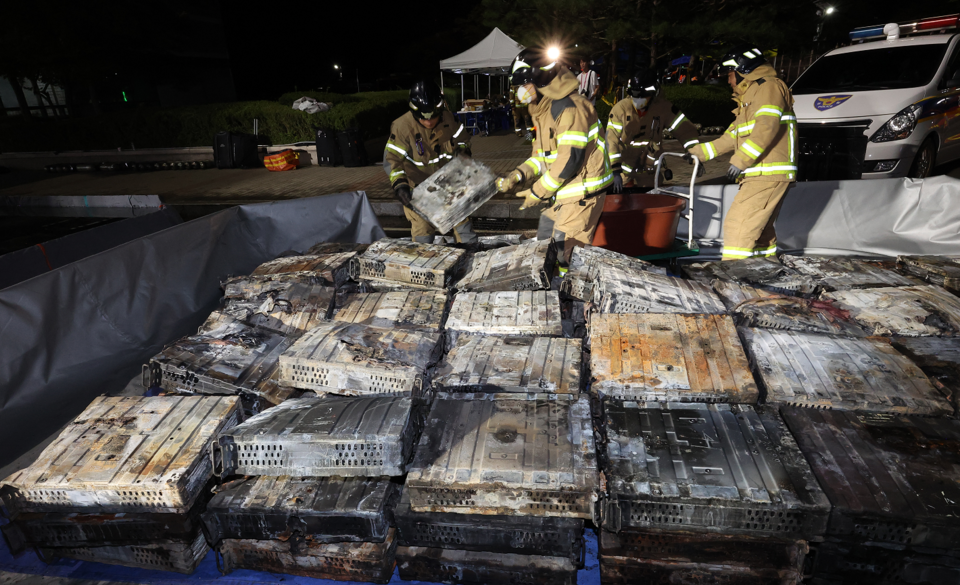
The fire at the National Information Resources Service (NIRS) in Daejeon on the 26th was more than a simple paralysis of a computing system; it clearly demonstrated how vulnerable the core infrastructure of advanced civilization is. The fire, which started from an Uninterruptible Power Supply (UPS) equipped with a lithium-ion battery, instantly disabled 647 government administrative systems and even led to the comical, yet real, spectacle of civil servants manually preparing approval documents.

This is the result of a dangerous lack of safety awareness, failing to learn lessons from similar past incidents, such as the fire at the SK C&C data center in Pangyo in 2022. The distance between the batteries and the servers was only 60cm, falling short of the international standard (minimum 90cm), and there were no firewalls. Furthermore, there are suspicions that batteries past their 10-year lifespan were being used, and the fire was triggered by work performed while the power was connected.

Lithium-ion batteries are essential for modern civilization, from smartphones and electric vehicles to UPS and Energy Storage Systems (ESS). However, their critical flaw is their susceptibility to fire. There have been 2,439 battery fires from 2021 to June of this year, and the 'thermal runaway' phenomenon—which occurs at high temperatures or due to damage—can cause the battery temperature to soar to nearly 1,000∘C, making it difficult to extinguish even with water.

Following the 2022 'Kakao service outage' incident, the government established a fire prevention manual, ordering private data centers to install partitions between batteries and servers, ensure sufficient spacing, and adopt batteries with built-in fire suppressants. However, the problem lies with aging data centers like the National Information Resources Service. Safety investments are being deprioritized due to budget shortages and complacency—the attitude of 'surely an accident won't happen'—resulting in the postponement of remodeling work.

While the aftermath of the fire has fueled widespread lithium-ion battery anxiety and distrust toward data centers, we cannot simply stop using lithium-ion batteries. That would be akin to saying we’ll live without smartphones. Data centers are the core infrastructure of the Artificial Intelligence (AI) era and the foundation supporting the future of mobility. Advanced devices like self-driving cars, UAM (Urban Air Mobility), and AI robots operate by constantly communicating with data centers. If a data center is incapacitated, a massive catastrophe—where moving cars stop and robots become tangled—cannot be avoided.

Until a definitive replacement for lithium-ion batteries, such as solid-state batteries, is commercialized, the rigorous adherence to safety manuals is the only solution. Specifically, urgent priority must be given to the safety remodeling of aging data centers that are vulnerable to fire. Furthermore, the relevant industries must accelerate the development of next-generation battery technologies with lower fire risk and hasten the adoption of batteries equipped with built-in fire suppressants.

It must be remembered that if South Korea fails to overcome the 'battery risk,' it will be unable to secure competitiveness in the future mobility and AI industries. The most pressing challenge left by this incident is not mere recovery, but the establishment of fundamental safety measures to support advanced systems.

[Copyright (c) Global Economic Times. All Rights Reserved.]

  • #globaleconomictimes
  • #micorea
  • #mykorea
  • #Lifeplaza
  • #nammidonganews
  • #singaporenewsk
  • #Samsung
  • #Daewoo
  • #Hyosung
  • #A
KO YONG-CHUL Reporter
Reporter Page

Popular articles

  • Takaichi Affirms Commitment to Historical Apologies, Signaling Policy Continuity

  • First Lady Kim Keon-hee Faces Fourth Charge: Alleged Promise of Proportional Representation Seat to Unification Church

  • Kim Keon-hee Faces Dior Gift Allegation Amid Presidential Residence Favoritism Probe

I like it
Share
  • Facebook
  • X
  • Kakaotalk
  • LINE
  • BAND
  • NAVER
  • https://www.globaleconomictimes.kr/article/1065559937637636 Copy URL copied.
Comments >

Comments 0

Weekly Hot Issue

  • JAPAN’S RISING PREDICAMENT: RECORD BEAR ATTACKS STRIKE FEAR ACROSS NATION
  • Trump NSS Declares Europe Faces 'Civilizational Erasure,' Vows to Aid Anti-Immigration Right-Wing Parties
  • Meta's Strategic U-Turn: The AI Race Re-Elevates Real-Time News
  • Gapyeong's Petit France and Italian Village Illuminate Winter with 'Starlight Festival'
  • Grand Opening: Gwangju Museum's Ceramics Culture Center Offers Comprehensive Look at Ceramic History
  • Choi Bun-do, Chairman of PTV Group, Assumes Presidency of the Korean Chamber of Commerce and Industry in South Central Vietnam

Most Viewed

1
Korean War Ally, Reborn as an 'Economic Alliance' Across 70 Years: Chuncheon's 'Path of Reciprocity,' a Strategic
2
A Garden Where the City's Rhythm Stops: Dongdaemun's 'Cherry Garden', Cooking Consideration and Diversity
3
The Sudden Halt of Ayumi Hamasaki's Shanghai Concert: Unpacking the Rising Sino-Japanese Tensions
4
Farewell to a Legend: South Korea Mourns the Passing of Esteemed Actor Lee Soon-jae
5
China’s Anti-Starlink Strategy: Simulation Suggests 2,000 Drones Needed for Taiwan Disruption
광고문의
임시1
임시3
임시2

Hot Issue

EU Unveils €90 Billion Ukraine Aid Plan Backed by Frozen Russian Assets

Seoul's 'Insane Rent' Warning: Why $30,000 Monthly Rent is a Looming Threat Residential Crisis Deepens as Tourist Housing Conversion Hits Supply

Seo Min-kyu Wins Gold at Junior Grand Prix Final... First Korean Since Kim Yuna 20 Years Ago

2026 Overseas Koreans Agency Budget Confirmed at 112.7 Billion Won... 5.3% Increase Year-on-Year

Let’s recycle the old blankets in Jeju Island’s closet instead of incinerating them.

Global Economic Times
korocamia@naver.com
CEO : LEE YEON-SIL
Publisher : KO YONG-CHUL
Registration number : Seoul, A55681
Registration Date : 2024-10-24
Youth Protection Manager: KO YONG-CHUL
Singapore Headquarters
5A Woodlands Road #11-34 The Tennery. S'677728
Korean Branch
Phone : +82(0)10 4724 5264
#304, 6 Nonhyeon-ro 111-gil, Gangnam-gu, Seoul
Copyright © Global Economic Times All Rights Reserved
  • 에이펙2025
  • APEC2025가이드북TV
  • 세종시
Search
Category
  • All articles
  • Synthesis
  • World
  • Business
  • Industry
  • ICT
  • Distribution Economy
  • Well+Being
  • Travel
  • Eco-News
  • Education
  • Korean Wave News
  • Opinion
  • Arts&Culture
  • Sports
  • People & Life
  • Column 
    • 전체
    • Cho Kijo Column
    • Lee Yeon-sil Column
    • Ko Yong-chul Column
    • Cherry Garden Story
  • Photo News
  • New Book Guide
  • Multicultural News
  • Jobs & Workers