![[등록] 2026-09-01 15:48:31](/support/_updata/banner2/tl181982910_6749.png)


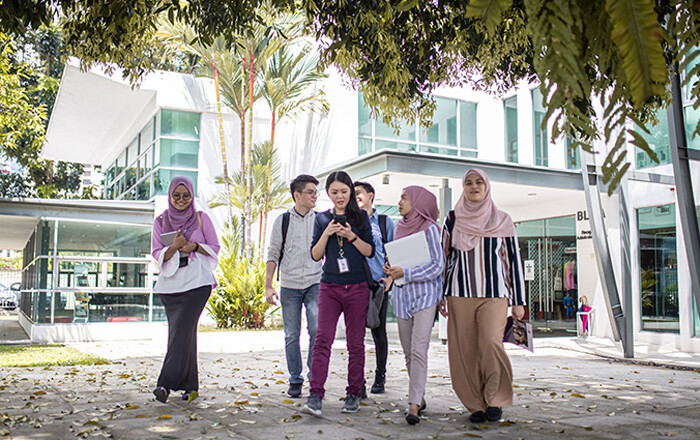
Malaysia has been gaining popularity as a study abroad destination among Japanese high school students who are planning to pursue further studies after graduation. Compared to Europe and North America, where the cost of living and tuition fees have skyrocketed due to the weakening yen, Malaysia offers significantly lower costs. Additionally, with its education system modeled on the British system, it provides students with a smooth pathway to transfer to British universities.
On October 12th, 11 Malaysian universities and language schools opened booths at the Malaysian Study Abroad Fair held at Otemon Gakuen Otemae High School in Osaka's Chuo Ward.
Jiehan Wong, a professor at IMU University, stated, "We want more Japanese students for diversity. We want to have a balance. We want to build a community there." Approximately 250 participants were seen actively inquiring about the required English proficiency levels and other details.
According to Global Hub Japan Ltd., a Tokyo-based company that supports Malaysian students, annual tuition fees in Europe and North America range from 2.5 million to 7 million yen, while in Malaysia, they range from 500,000 to 1.5 million yen. Living expenses and housing costs are also about one-third lower. In the West, studying abroad for 3-4 years costs between 15 million and 40 million yen, whereas in Malaysia, it costs between 4 million and 9 million yen.
University education in Malaysia is modeled on the British education system, the country's former colonial ruler, and undergraduate programs are three years long and taught in English. Malaysia also has many branch campuses of British or Australian universities, allowing students who achieve a certain level to transfer to the main campus.
The number of high school students and graduates who have enrolled in Malaysian universities through Global Hub has more than doubled in recent years, although it was less than 100 per year until 2019.
"My values changed through interacting with students from various ethnicities," said Akari Hayashi, 23, who studied at Monash University Malaysia and is now working for a foreign company. "Because the barriers of cost and language proficiency are relatively low, you can do it if you set your mind to it."
According to a Ministry of Education survey, 1,424 Japanese high school graduates who graduated in March 2022 enrolled in foreign universities. By country, Malaysia ranked sixth with 73 students, following the United States, Taiwan, South Korea, Canada, and the United Kingdom.
While the official language of Malaysia is Malay, English is not the first language. The United States and other English-speaking countries are good choices for those who want to improve their English, but perspectives are changing.
Takehiko Kariya, a specially appointed professor at Sophia University and an honorary professor at Oxford University, said, "Studying abroad is no longer just for top students but has become a powerful option for anyone who wants overseas experience."
Kariya, who is well-versed in overseas education environments, said that the stereotype of "learning English from native speakers" is beginning to break down.
Another factor contributing to its popularity is that Malaysia's political situation is relatively stable among Asian countries, and several Malaysian universities have begun to rise in world university rankings.
Momoyama Gakuin High School (St. Andrews School) in Osaka's Abeno Ward has been recommending overseas partner university studies to students since last year and has designated six schools in Malaysia along with six schools in the United Kingdom, Ireland, and the United States. Over 100 people attended an information session this spring, and many inquired about Malaysia.
Tsukuba University opened a branch campus in Malaysia in September and established a Faculty of Integrated Science and Design. Classes are mainly conducted in Japanese and English, and a total of 13 students are enrolled, including seven Malaysians and six Japanese.
The university aims to foster global human resources and enhance the university's international reputation.
"Western universities are using branch campuses to attract talented individuals to their home countries," said Maki Tsujimura, the faculty head. "I hope that by establishing a branch campus this time, we can stand shoulder to shoulder with leading overseas universities."
[Copyright (c) Global Economic Times. All Rights Reserved.]