![[등록] 2026-09-01 15:48:31](/support/_updata/banner2/tl181982910_6749.png)


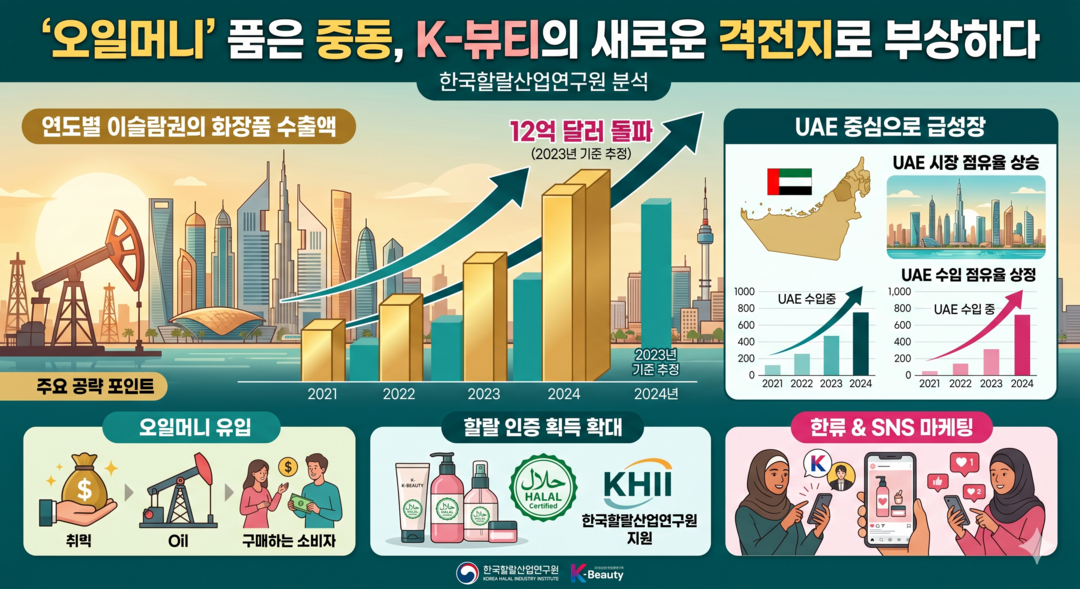
The South Korean cosmetics industry is entering a new era of leap forward, establishing an unprecedented milestone in the global market. Following the breakthrough of $10 billion in cosmetics exports for the first time in history in 2024, the sector achieved $11.42719 billion in 2025, a significant increase of 11.5% compared to the previous year, firmly solidifying its status as a core export-driving industry. At the heart of this explosive growth lies the remarkable performance of the Middle East and Islamic markets, which have emerged as new frontiers beyond the traditional mainstay markets. Boasting formidable purchasing power and a substantial young consumer base, the Middle East region has rapidly risen as the new battleground for K-beauty, drawing intense attention from the industry.
According to the 'Analysis of 2025 K-Beauty Import Performance' conducted and released by the Korea Halal Industry Institute (President Jang Geon) targeting the 57 member states of the Organisation of Islamic Cooperation (OIC), the total volume of Korean cosmetics imported by Islamic nations last year was recorded at $1.22608 billion. This represents a staggering 33.3% increase compared to $919.45 million in 2024. Furthermore, the market share of the Islamic world within South Korea's total cosmetics export volume expanded noticeably from 9.0% in 2024 to 10.7% in 2025, reaching double digits. The fact that this market share has surged 2.5 times over the past five years proves that exports to the Islamic world have bypassed temporary trends and entered a structural growth trajectory.
What warrants the utmost attention in this study is that the Middle East accounted for 45.7% of total exports to the Islamic world, emerging as the core region. Based on its immense economic strength, the Middle East has positioned itself as a massive axis driving consumption trends across the entire Islamic world. An examination of export trends over the past three years reveals this market upheaval even more clearly. Until 2023, the Southeast Asian region, centered on Malaysia and Indonesia, held the core leadership in exports to the Islamic world; however, starting from 2024, that dominance began to shift rapidly toward the Middle East.
Overtaking Malaysia, which previously held the position of the largest export destination in the Islamic world, the United Arab Emirates (UAE) has become the largest importer of Korean cosmetics in the Middle East and the wider Islamic bloc. Exports to the UAE showed a steep upward trend starting in 2024 and proudly claimed the top spot in 2025, reaching $290.76 million. Following closely, Indonesia ranked second with $168.19 million, while Malaysia slipped to third with $162.14 million. Concurrently, the traditional Arab market centered on Saudi Arabia and the non-Arab Middle Eastern market led by Türkiye are also growing exponentially as new export destinations, contributing significantly to the territorial expansion of K-beauty.
The Korea Halal Industry Institute analyzed this shift in the Islamic export map as a positive signal, demonstrating that the market, which had been heavily concentrated in Southeast Asia, is successfully diversifying into the Middle East and Central Asia. Jang Geon, President of the Korea Halal Industry Institute, explained, "Exports of Korean cosmetics to Islamic nations, led by the UAE, are showing unprecedented growth rates." He further evaluated, "In particular, the UAE serves as an optimal hub for entering the entire Middle Eastern market as well as surrounding continents, functioning as a geopolitical choke point connecting Europe, Asia, and Africa."
President Jang also emphasized the unique nature of the Middle Eastern market and the necessity of a strategic approach. He stated, "The Middle East is a region that maintains highly conservative cultural traditions even within the Islamic world, yet demand for Korean cosmetics has surged exponentially due to the recently widespread Korean Wave (Hallyu) and K-content." He then advised, "However, to achieve long-term success in the Middle East and the broader Islamic market, a multifaceted strategy is indispensable—one that thoroughly understands and prepares for the unique local business culture, rigorous legal systems, religious regulations, and constantly changing Halal certification trends."
Experts project that the 'oil money' of the Middle East combined with its young demographic structure will generate a massive synergy when aligned with K-beauty's high-value-added strategy. Considering the characteristics of Middle Eastern consumers, who have a high proportion of youth and an exceptional interest in appearance and beauty, the outstanding quality and innovative functionality of Korean cosmetics will serve as a powerful weapon to further expand market share. Anticipation is mounting over how Korean companies equipped with thorough localization and regulatory compliance capabilities will write a new chapter of history in this massive battleground of the Middle East.
[Copyright (c) Global Economic Times. All Rights Reserved.]