![[등록] 2026-09-01 15:48:31](/support/_updata/banner2/tl181982910_6749.png)


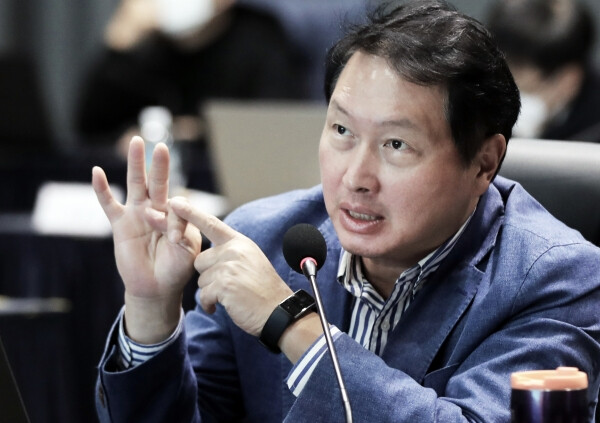
Choi Tae-won, Chairman of the Korea Chamber of Commerce and Industry (KCCI) and SK Group (pictured), has cautioned that the trade war originating from the United States is likely to be a long-term phenomenon. He emphasized the urgent need for industrial innovation through a 'Mega Sandbox' initiative. The Mega Sandbox concept goes beyond existing regulatory innovation sandboxes by selecting strategic industries specific to broader regional areas, granting regulatory exemptions, and providing comprehensive support that integrates related infrastructure and incentives, including education, workforce development, and research and development (R&D).
According to the KCCI on April 13th, Chairman Choi, during a roundtable discussion featured in KBS1's documentary "The Road to the Future Society, Mega Sandbox," stated, "I believe the era of free trade is ending, and we will probably have to live in this form of protectionism for at least several decades. The good times are over."
Chairman Choi expressed concerns about the numerous internal and external challenges facing South Korea. He pointed out, "(U.S.-based) OpenAI is only ten years old, yet ChatGPT has over 100 million users. Within our own country, we are not seeing the emergence of such companies that can create new jobs and achieve sufficient expansion."
As a solution, Chairman Choi proposed the Mega Sandbox, asserting, "Existing special economic zones have mostly been manufacturing-based zones centered around industrial complexes. They have not provided an environment that companies truly desire or is sufficient to incentivize relocation from the Seoul metropolitan area. Autonomous operation is necessary to ensure that companies can secure the necessary workforce adequately."
Further Insights on the Mega Sandbox Initiative:
The Mega Sandbox concept envisions the designation of large-scale regional zones tailored to specific high-growth potential industries. Unlike traditional special economic zones that often focus on tax breaks and infrastructure within limited geographical areas, the Mega Sandbox aims for a more holistic approach. It would involve:
Targeted Industry Selection: Identifying strategic industries with significant growth potential and aligning them with the specific strengths and resources of a given region. This could include sectors like advanced biotechnology in one area, sustainable energy in another, or next-generation mobility solutions in a third.
Comprehensive Regulatory Exemptions: Providing significant and wide-ranging exemptions from existing regulations that hinder the development and deployment of these targeted industries within the designated zone. This would allow for greater experimentation and faster innovation cycles.
Integrated Ecosystem Support: Bundling together crucial supporting elements such as specialized educational institutions to train a skilled workforce, dedicated R&D facilities and collaborations, and attractive financial incentives beyond just tax breaks. This might include grants, subsidies, and streamlined administrative processes.
Regional Specialization: Leveraging the unique characteristics and existing infrastructure of different regions to foster specialized industrial clusters. This could lead to a more geographically balanced and resilient national economy.
Emphasis on Talent Development: Recognizing that innovation is driven by talent, the Mega Sandbox would prioritize attracting and nurturing skilled individuals through partnerships with universities, vocational training programs, and potentially even attracting international expertise.
Contextualizing the Trade War Concerns:
Chairman Choi's warning about a protracted trade war aligns with growing global anxieties regarding increasing protectionist measures. The U.S., under both previous and current administrations, has implemented tariffs and trade barriers aimed at protecting domestic industries and addressing trade imbalances. This has led to retaliatory measures from other major economies, creating uncertainty and disrupting global supply chains.
Factors contributing to this shift away from free trade include:
National Security Concerns: Governments are increasingly viewing certain industries, such as technology and critical minerals, through a national security lens, leading to policies that prioritize domestic production and limit foreign reliance.
Geopolitical Competition: Rising geopolitical tensions between major powers are fueling a desire for greater economic self-reliance and a reduced dependence on potential adversaries.
Domestic Political Pressures: Populist sentiments and concerns about job losses have led to political pressure on governments to protect domestic industries from foreign competition.
Technological Disruption: Rapid technological advancements are reshaping industries and creating new areas of competition, leading to debates about fair trade practices and the need to protect emerging domestic players.
Chairman Choi's call for a Mega Sandbox reflects a proactive approach to navigating this challenging global landscape. By fostering innovation in strategic sectors through a comprehensive and regionally focused strategy, South Korea aims to enhance its competitiveness and create new engines of economic growth in an era of increasing protectionism. The success of such an initiative would depend on effective collaboration between government, industry, and academia to create an environment conducive to groundbreaking innovation and the development of future-ready industries.
[Copyright (c) Global Economic Times. All Rights Reserved.]