SEOUL — A new front has opened in the ongoing cultural friction between South Korea and China, shifting from traditional attire and folk music to the architecture of the internet. Chinese internet authorities have formally pressured South Korean domain registrar Gabia to abandon its application for the “.HAN” top-level domain, arguing the term belongs to Chinese heritage.
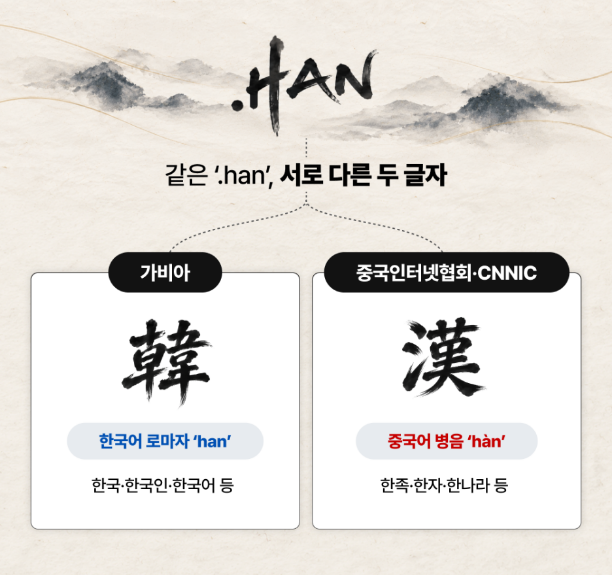
The dispute centers on Gabia’s July application to the Internet Corporation for Assigned Names and Numbers (ICANN) during its first expansion of generic top-level domains (gTLDs) in 14 years. Out of 1,615 global applications submitted, Gabia was the sole entity to apply for “.HAN,” a name deeply tied to South Korea’s identity—found in Hanguk (Korea), Hanbok (traditional clothing), and Hangeul (the Korean alphabet).
According to Gabia, the Internet Society of China (ISC) contacted the company on October 20, demanding it alter the domain’s spelling. The ISC contended that “Han” is the official romanization (Pinyin) for the Chinese character representing the Han ethnic group and the Han Dynasty, claiming its use by a Korean firm would confuse global internet users.
The pushback escalated days later when Wang Wei, a senior specialist at the state-run China Internet Network Information Center (CNNIC), warned that Beijing would seek an "Early Warning" through ICANN’s Governmental Advisory Committee (GAC) and elevate the matter to the ICANN board.
Gabia pushed back against the demands, pointing out major technical and procedural flaws in China's argument. While Chinese officials cited ICANN’s technical terminology to claim ownership of the script name, Gabia noted that ICANN’s Root Zone Label Generation Rules (RZ-LGR) define “Han” as a shared script encompassing Chinese characters, Japanese Kanji, and Korean Hanja. Notably, CNNIC’s Wang Wei co-authored a 2019 joint letter to ICANN acknowledging that experts from all three nations collaborated to establish those very rules.
Linguistically, the term also carries distinct meanings across East Asia; in Vietnamese, for instance, “Han” refers to Korea while a separate tonal variation denotes Chinese characters.
Timing also raised eyebrows in Seoul. The ISC's initial email arrived just 24 hours before ICANN’s October 21 deadline for applicants to modify domain spellings, while Wang’s follow-up arrived five days after the window had already closed.
Rejecting the pressure, Gabia maintained its original application. On November 17, ICANN officially cleared “.HAN” to enter the formal evaluation phase, opening a public comment and objection period that runs through March 16, 2027.
"‘Han’ is the very name of the Republic of Korea," a Gabia representative stated, adding that the company sees no reason to yield to demands to abandon a national identifier simply due to phonetic overlap.
The domain clash echoes broader diplomatic sensitivities between the two neighbors. In recent years, South Korean public sentiment has been strained by Chinese claims regarding the origins of Korean cultural staples, including controversy over a Hanbok-clad performer at the 2022 Beijing Winter Olympics and China’s designation of Korean folk traditions like Arirang and Pansori as state-level intangible cultural heritage.
[Copyright (c) Global Economic Times. All Rights Reserved.]