

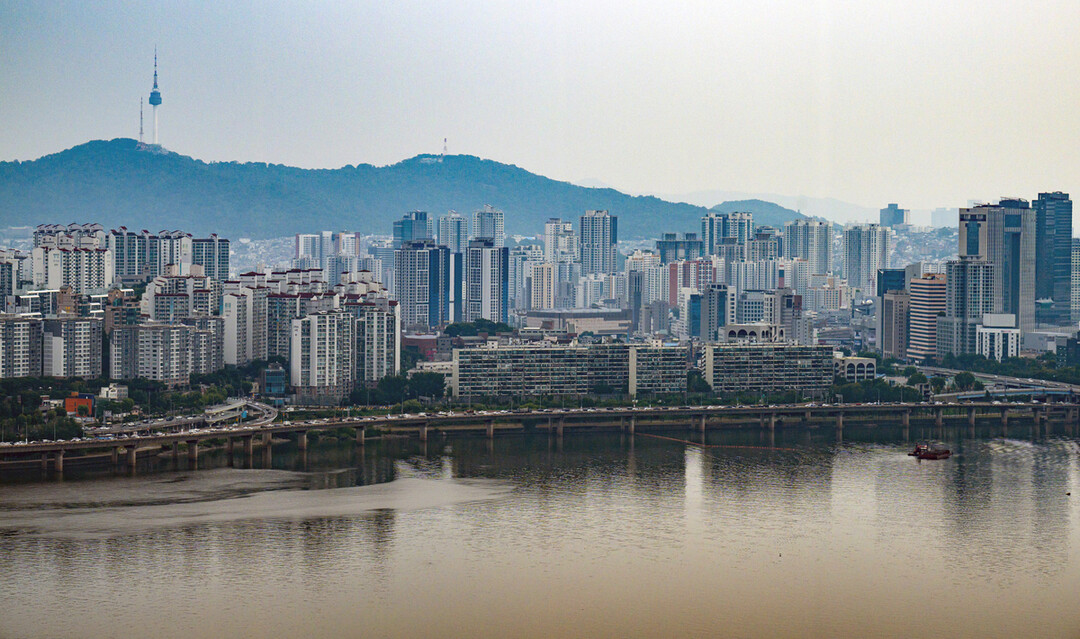
Following the October 15 real estate measures last year, which expanded regulated areas and land transaction permission zones across all of Seoul, the share of Seoul apartments purchased by non-residents decreased, while the proportion of apartments in other regions bought by Seoul residents increased.
Analysts say that an "exodus from Seoul" is becoming prominent as housing demand shifts to areas outside the capital with relatively lower housing cost burdens, driven by stringent loan regulations combined with rising apartment sales, jeonse (lump-sum deposit lease), and monthly rent prices in Seoul.
According to an analysis of apartment sales transaction status by buyer's residence from the Korea Real Estate Board on the 29th, out of 590,774 nationwide apartment sales transactions (based on transaction reporting dates) from October last year to September this year, 38,612 cases were purchases of apartments in other regions by Seoul residents, accounting for 6.5% of the total.
This is a 1.3 percentage point increase compared to the 5.2% share in the preceding one-year period (October 2024 to September 2025), and represents the highest figure for the same period in four years since recording 7.7% from October 2021 to September 2022.
In particular, buying momentum by Seoul residents flowing into the Gyeonggi-do apartment market stood out.
Since October last year, Seoul residents accounted for 15.5% of all apartment transactions in Gyeonggi-do. Not only does this surpass the 12.8% recorded in the year prior to the October 15 measures, but it is also the highest level in four years since October 2021–September 2022 (17.6%).
It is interpreted that housing demand shifted to Gyeonggi-do, where price burdens are relatively lighter, as buying a home in Seoul became difficult due to strong loan regulations and a "triple surge" in sales, jeonse, and monthly rent prices continued in outer Seoul areas such as non-Gangnam districts.
By region, the increase in the share of purchases by Seoul residents was particularly notable in Guri-si, which had been excluded from regulated areas at the time of the October 15 measures.
With its proximity to Seoul combined with favorable redevelopment news, the proportion of Guri-si apartments purchased by Seoul residents reached 39.0% over the past year. As both end-user and investment demand flowed in simultaneously, the figure more than doubled from 19.0% in the preceding year.
Even though Guri-si was designated as a "triple regulated zone"—including regulated areas and land transaction permission zones—starting in July this year, the share of purchases by Seoul residents recorded 47.2% in August and 56.1% in September, with Seoulites buying more than half of the total transaction volume.
The share of Seoul residents buying apartments in Gwangmyeong-si also rose from 30.6% in the year before the October 15 measures to 35.8% in the year after.
Hanam-si rose from 27.3% to 33.9%, Gwacheon-si—considered a residential alternative to Gangnam—increased from 18.6% to 26.5%, and Namyangju-si went up from 20.9% to 25.8%.
Uijeongbu-si, adjacent to northern Seoul, also saw its share of purchases by Seoul residents expand from 20.5% in the previous year to 26.6%.
Conversely, buying sentiment for Seoul apartments among non-residents contracted significantly.
Since October last year, the share of Seoul apartments purchased by residents of other regions stood at 18.73%, down 4.3 percentage points from the previous year (23.03%). This is the lowest figure for the same period in nine years since recording 18.72% from October 2016 to September 2017.
Experts analyze that the drop in non-resident purchases of Seoul apartments is largely due to the imposition of mandatory actual-residency requirements after the entire city of Seoul was designated as a land transaction permission zone under last year's October 15 measures.
Amid tightened mortgage loan limits of 200 million to 600 million won, "gap investments" (buying a home with an existing jeonse tenant) became impossible, leading to a noticeable decline in purchases by outsiders.
The drop in the share of non-resident purchases was particularly steep in the "Han River Belt" districts.
Seongdong-gu's non-resident purchase share reached 24.6% in the preceding year, but fell by more than 10 percentage points to 14.0% since October last year. Additionally, Mapo-gu decreased from 27.1% to 18.8%, and Gwangjin-gu dropped from 22.2% to 16.4%. Seongbuk-gu, which saw the steepest rise in apartment prices this year, also fell from 23.3% to 16.2% after the October 15 measures, while Gangdong-gu decreased from 28.4% to 23.7%.
Experts anticipate that if Seoul apartment prices turn downward due to higher property holding taxes, interest rate hikes, and next year's tax reform plan, the declining trend in Seoul apartment purchases by non-residents will continue for the time being.
[Copyright (c) Global Economic Times. All Rights Reserved.]