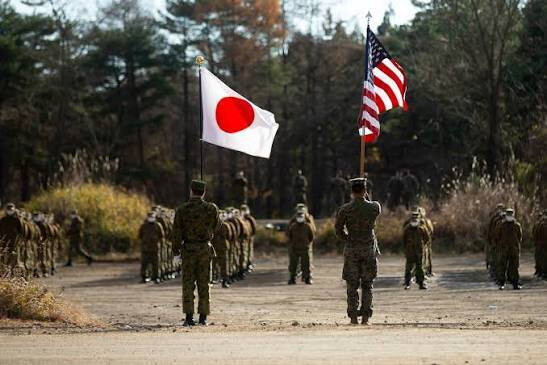
The Japanese government is reportedly considering raising its share of the cost for hosting US forces in Japan (USFJ) over the next five years starting in 2027 to an annual average of over 300 billion yen (approx. $1.9 billion USD / 2.5 trillion won), which is about 1.4 times the current level, according to the Asahi Shimbun on November 13. However, negotiations are expected to face difficulties as the United States is demanding a threefold increase over the same five-year period.
Citing multiple Japanese government officials, the newspaper reported that the US and Japanese governments are continuing specific consultations with the goal of reaching an agreement by the end of the year.
Background on the Cost-Sharing Agreement
In principle, the cost of hosting US forces in Japan is negotiated every five years to conclude a special agreement. Japan covers labor costs for Japanese employees working at USFJ bases, utility bills for facilities, and relocation expenses for US military training. To emphasize supporting the USFJ, the Japanese government refers to this as the "sympathy budget."
Because the current agreement expires in March 2027, US and Japanese diplomatic and defense authorities have been holding continuous consultations since July. A Japanese delegation visited the US for talks in early October, and further discussions are scheduled for November.
According to government officials, the US side raised the issue of host-nation support during a Japan-US defense ministerial meeting held in the Philippines on October 28, repeatedly demanding that Japan increase its financial contributions. The US is pressing Japan to dramatically raise its share to roughly three times the current annual average of 2110 billion yen.
Japan's Position and Fiscal Dilemmas
Faced with this demand, the Japanese government has concluded that an increase is unavoidable and plans to ultimately raise the annual average to over 300 billion yen. A Japanese Prime Minister's Office official told the newspaper that an increase that contributes to strengthening the Japan-US alliance and gains the public's understanding is necessary. While acknowledging that Washington's demands cannot be ignored given the bilateral alliance, Tokyo finds it difficult to readily accept a massive hike.
Japan plans to significantly boost its burden for Facility Improvement Projects (FIP), such as housing construction. It is also reviewing plans to cover higher wages for local Japanese workers and fund underground facility construction to minimize potential damage in the event of an attack on USFJ bases.
Despite these plans to raise the contribution by 1.4 times, a wide gap remains between the two allies due to Washington's demand for a 3-fold increase. A Japan-US relations source pointed out that it will be necessary to seek a compromise between the two nations moving forward.
Donald Trump's Stance and Regional Security Concerns
US President Donald Trump has expressed dissatisfaction with Japan's share of USFJ expenses since his first term (January 2017 – January 2021). The Trump administration has strongly pressured allies regarding "burden-sharing" for overseas US troop deployments, maintaining last year that Japan's contributions were insufficient.
Asahi noted that Japan remains wary of the Trump administration's posture of demanding extensive financial burdens from allies. Last April, President Trump expressed strong frustration over the perceived unfairness of the Japan-US Security Treaty, stating, "We are defending Japan, but Japan doesn't need to defend us. Japan pays nothing."
Negotiations over USFJ cost-sharing faced rough terrain during Trump's first term as well, and the US is once again pushing for drastic increases. A Japanese Foreign Ministry official lamented, "It seems the US position has not changed."
Another factor complicating Japan's negotiation stance is broader American pressure regarding defense spending. The US has previously urged allies, including Japan, to spend 3.5% of their Gross Domestic Product (GDP) on defense.
While Japan plans to substantially increase defense spending in its three core security documents slated for revision this year, it is leaning toward omitting the "3.5%" figure as a rigid five-year target due to fiscal constraints. Within the Japanese government, there is an intention to win American understanding by raising the proportion of host-nation support, which is relatively small compared to overall defense expenditures.
Amid growing concerns that potential US distractions—such as conflicts involving Iran—could reduce Washington's engagement in the Indo-Pacific region, many within the Japanese government argue that a steep increase in host-nation support is necessary to anchor the US for Japan's national security. A Japanese Defense Ministry official remarked, "If the US military withdraws, Japan is the one in trouble. We must show our commitment to strengthening the Japan-US alliance."
[Copyright (c) Global Economic Times. All Rights Reserved.]