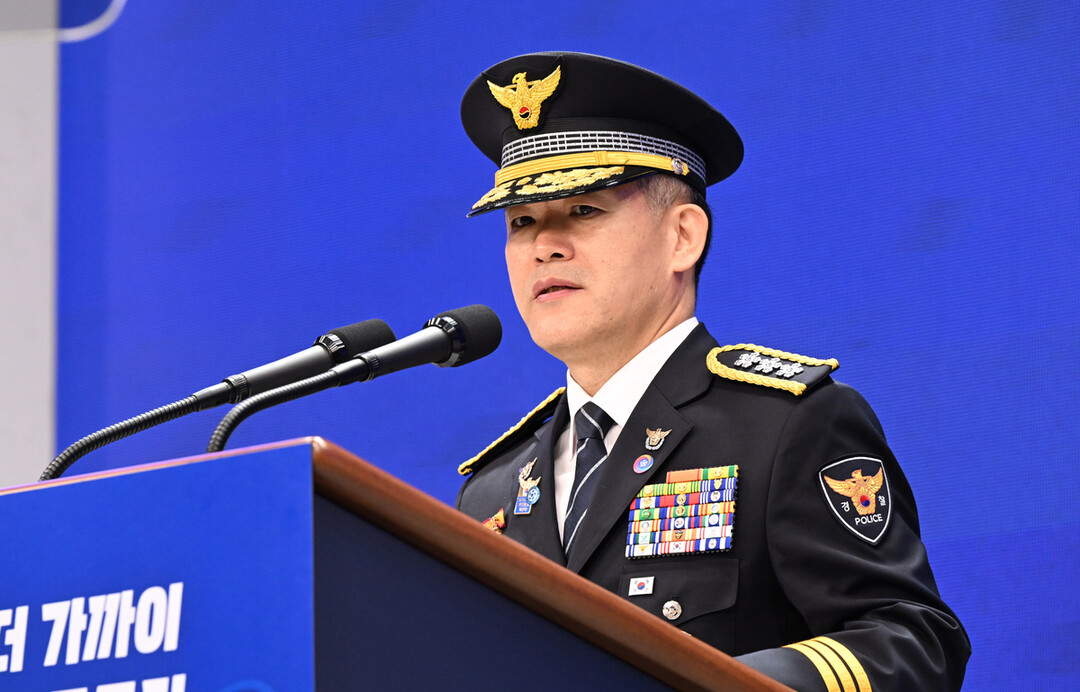
With the inauguration of new National Police Agency Commissioner General Kim Jong-chul on the 23rd, the police organization has finally established its command structure 23 months after the December 3 insurrection incident. Reorganization of the police force—which has suffered from a prolonged leadership vacuum and successive controversies over botched investigations—and the early stabilization of the new criminal justice system are cited as urgent tasks.
At his inauguration ceremony held at the National Police Agency in Seodaemun-gu, Seoul, on the 23rd, Commissioner Kim stated, “Public safety is the noblest value of the police and an essential duty that must never waver,” adding, “We will prepare extraordinary measures against relationship-based crimes targeting the vulnerable.”
To this end, he announced plans to establish a new Women and Juvenile Bureau to unify responses from prevention to investigation, thereby filling institutional blind spots. As Kim has emphasized responding to relationship-based crimes as his “No. 1 policy,” he will make his first official move this afternoon by attending a meeting of the Citizen Participation Group for Police Policy to discuss this very topic.
Commissioner Kim also expressed his commitment to strengthening police investigative capabilities, a crucial task under the new criminal justice system. He stated, “We will turn the public’s ‘question marks’ into ‘exclamation points’ by completing a fair and competent investigative system,” and added, “The police will view this criminal justice reform not as an increase in authority, but as an expansion of solemn responsibility.” He explained that the agency will bolster both the quantity and quality of investigators through staffing increases and rank adjustments.
Referring to artificial intelligence (AI)-assisted cheating controversies that surfaced ahead of the College Scholastic Ability Test (CSAT), Kim called them “ills that erode the foundation of our community,” vowing to “make an all-out effort to eradicate unfair crimes.” He warned of a stern response to crimes exploiting new technologies, stating, “High-tech crimes given the wings of AI are evolving at an unimaginable speed.” Meanwhile, police are continuing their investigation into cheating allegations surrounding the late Lee Jin-woo, a top scorer on the Legal Education Eligibility Test (LEET).
Having served as acting chief since September before officially taking the helm, Kim is expected to focus on executing existing reform measures rather than introducing drastic policy changes. He is projected to concentrate on smoothly implementing countermeasures introduced after consecutive investigative controversies—such as the Jang Yun-gi case and the Jeju missing person case—and establishing mechanisms to enhance investigative completeness following the enforcement of the revised Criminal Procedure Act. Internally, resolving conflicts over staffing, workload redistribution, and the expansion of rotational personnel transfers remains a key challenge.
Under the vision of “A Safer Society Together, a More Confident Police Built on Trust,” Kim presented four major goals and 12 priority tasks. These tasks include all-out prevention of violent crimes stemming from relationship-based offenses, overhauling responses to unprovoked crimes and missing person cases, early stabilization of the new criminal justice system, establishing victim protection and rights relief as core investigative principles, and structural innovation to relieve police workload and improve efficiency.
[Copyright (c) Global Economic Times. All Rights Reserved.]