

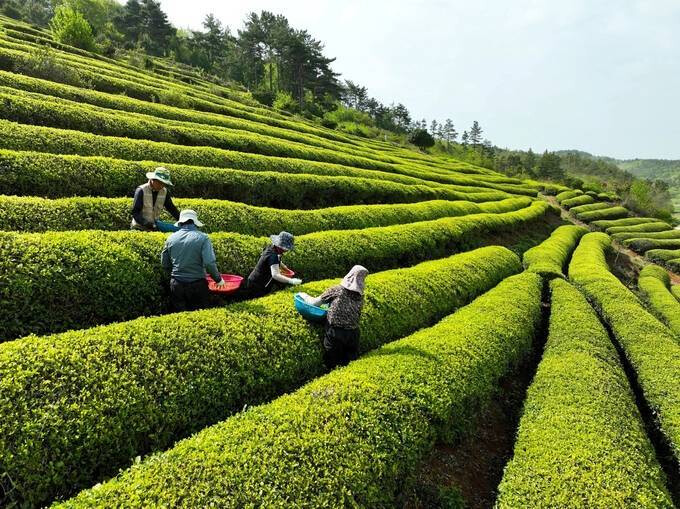
SEJONG, Nov. 25 — Facing severe supply shortages despite booming international interest, the South Korean government has announced a 10 billion won ($7.2 million) investment over the next two years to build two new matcha processing facilities in major tea-producing regions.
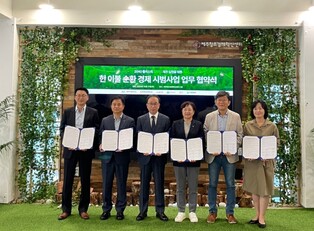
The Ministry of Agriculture, Food and Rural Affairs unveiled its "Second Basic Plan for Tea Industry Development (2027–2031)" on Wednesday at the Government Complex Sejong. The five-year roadmap aims to boost annual domestic matcha production from 650 metric tons to roughly 800 metric tons, while pushing total tea exports to $35 million by 2031—a 69% jump from 2024’s $20.75 million.
Addressing the Supply Bottleneck
Global demand for matcha—a finely ground powder of specially grown and processed green tea leaves—has skyrocketed. South Korea’s green tea exports, including matcha, surged 45.5% year-on-year to $8.66 million last year, mirroring a global matcha market projected to expand from $5.1 billion to $8.9 billion by 2033.
However, domestic supply has struggled to keep pace. According to Seo Jun-han, Director General for Food Distribution and Consumer Policy at the ministry, local production capacity falls well short of demand, leaving imports to fill nearly half of South Korea’s domestic matcha consumption.
Local growers echo this bottleneck. In Hadong, one of South Korea's premier tea hubs, exports to major markets like Mexico and Brazil totaled 20 tons last year and 16.7 tons so far this year, with producers forced to turn away additional overseas orders due to a lack of inventory.
Modernizing Cultivation and Processing
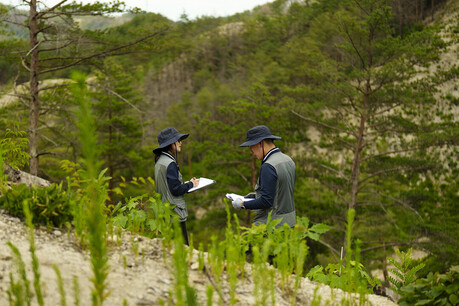
The supply crunch stems largely from an aging farming population and shrinking cultivation areas. Between 2017 and 2024, the number of domestic tea farms fell by 21.2% to 2,683, while total cultivation area dropped 16.4% to 2,551 hectares.
To reverse this trend and maintain at least 2,500 hectares of tea fields through 2031, the government plans to modernize farming and processing infrastructure:
Advanced Facilities: The two upcoming processing lines—whose locations will be selected via a public contest—will be equipped with steaming, drying, sorting, and low-temperature ultra-fine grinding machinery.
Standardization & Contract Farming: The Rural Development Administration will establish standardized shading and cultivation techniques for matcha-grade tea leaves, alongside new industry standards for color and particle size. Between 2027 and 2028, a pilot contract-farming program will link growers directly with processing and corporate buyers.
Cooperative Farming & Mechanization: Starting next year, a 3 billion won pilot project will organize farms around corporate buyers to share labor for fertilizing, shading, and harvesting. The government will also develop flatland tea fields suited for ride-on machinery, supply lightweight equipment for sloped terrains, and increase the distribution of climate-resilient seedlings from 40,000 to 60,000 annually.
Expanding Global Reach and Domestic Consumption
Beyond production, the ministry will assist exporters with international certifications, customs clearance, and overseas trade shows. Pilot promotional and export consultation hubs will also be established in one or two high-potential markets, targeting major buyers in the United States and Taiwan while exploring emerging demand in Canada.
Domestically, Seoul hopes to raise per capita annual tea consumption from 95 grams to 120 grams by 2031. Initiatives include R&D support for ready-to-drink tea beverages, hojicha, and functional ingredients, alongside pop-up tasting events at airports and university campuses, and tea-themed tourism programs in Boeun, Hadong, and Jeju.
"This master plan is designed to stabilize our domestic tea production base while translating the high growth potential of value-added products like matcha into higher farm incomes and expanded exports," said Agriculture Minister Song Mi-ryung. "We will focus our policy capabilities on making domestic tea a part of daily life and elevating 'K-Tea' in the global market."
[Copyright (c) Global Economic Times. All Rights Reserved.]