![[등록] 2026-09-01 15:48:31](/support/_updata/banner2/tl181982910_6749.png)


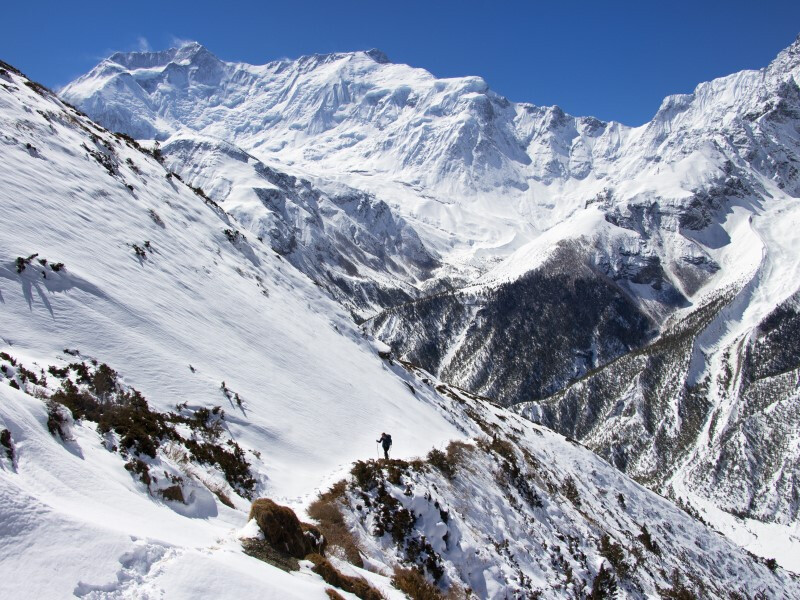
KATHMANDU, Nepal – The number of trekkers on the world-renowned Annapurna Circuit reached an all-time high last year, as they all hired guides as required under Nepal’s 2023 ban on solo trekking except in the Everest region. The ruling had initially shocked many adventurers.
When the Annapurna Conservation Area Project (ACAP) started keeping records in 1996, only 8,309 trekkers had traversed the route. In 2024, the number reached 30,866.
The Annapurna Conservation Area, home to several world-class treks—including the Annapurna Sanctuary and Annapurna Circuit—welcomes more than 200,000 trekkers annually.
The circuit is typically explored by those with time and money to undertake the challenging journey.
Despite the government’s ban on solo trekking, the number of trekkers has continued to rise. Since April 1, 2023, independent backpackers have been required to hire a trek guide in Nepal’s Himalayas, except in the Everest region.
Dhak Bahadur Bhujel, chief of the conservation area, confirmed that the Annapurna Circuit saw record-breaking numbers in 2024. Of the 30,866 trekkers recorded in the year, 18,499 were male, and 12,362 female. Five were from 'other' category.
The peak season—October and November—accounted for nearly half the total trekkers, with 8,853 trekking in October and 6,902 in November.
A significant number of trekkers came from Nepal’s neighbouring countries.
In 2024, a total of 1,831 trekkers arrived from India, while 1,569 were from China. Trekker data is collected at the tourist checkpoints in Dharapani and lower Manang.
The number of trekkers in 2023 was 21,247; before that, in 2022, it stood at 15,855—indicating a steady post-pandemic recovery.
Nestled on the southern slopes of the Annapurna range, the circuit is widely regarded as one of the most scenic trekking routes on the planet. The 7,629-square-kilometer protected area encompasses picturesque villages, lush hills, deep valleys, dramatic gorges, and tranquil lakes, with the towering Annapurna peaks as its backdrop.
The region boasts the world’s deepest gorge, the Kali Gandaki, which is 4.8 kilometres long and 2.4 kilometres wide. Fossils dating back 60 million years from the ancient Tethys Sea have been discovered in the river valley. Additionally, the area is home to the world’s largest rhododendron forest, located at Ghorepani.
Tilicho Lake, situated in Manang north of the Annapurna massif, has the distinction of being the world’s highest freshwater lake.
The Annapurna Circuit is also considered among the most incredible adventure walking trails in the world.
While the Annapurna region aspires to be a high-end tourism destination, it still faces challenges related to investment and marketing.
A report by the International Finance Corporation, the private-sector lending arm of the World Bank Group, highlighted the need for more investment and promotional efforts to attract premium clientele.
The Annapurna area first opened to foreign trekkers in 1977.
On June 3, 1950, French climbers Maurice Herzog and Louis Lachenal became the first mountaineers to summit Annapurna I, marking the first successful ascent of an 8,000-meter peak.
Herzog later chronicled this achievement in his book Annapurna, published in 1952.
By 2000, the book had sold over 11 million copies, making it one of the best-selling mountaineering books of all time. This publication is credited with significantly boosting Nepal’s mountain tourism.
Initially, the Annapurna Circuit trek began in the market town of Dumre on the Kathmandu-Pokhara highway and ended in Pokhara, taking about 23 days to complete.
However, with road construction extending to the trekking route, the original trek duration has been reduced to about a week.
Binod Gurung, president of the Tourism Entrepreneurs Committee in Manang, noted that trekker numbers have been rising steadily post-Covid. “All hotels are fully booked in the peak spring and autumn seasons. Even during the off-season, the number of trekkers has remained stable,” he said.
The trekking sector has endured several setbacks, including the Maoist insurgency, the devastating 2015 earthquake, trade blockades, floods, landslides, and the Covid-19 pandemic.
In 2006, the circuit saw 9,360 trekkers, which increased to 16,191 in 2007 following the conclusion of Nepal’s peace process.
“The Maoist insurgency significantly impacted the trekking industry,” Gurung said. “With the rise in tourist arrivals, local communities have reason to celebrate as their incomes have improved.”
According to conservation area data, trekker arrivals in 2020 dropped to zero for seven months due to Nepal’s nationwide lockdown. Only 1,976 tourists visited in the remaining five months of that year.
In 2017, the Annapurna Circuit recorded 27,068 trekkers, which rose to an all-time high of 29,484 in 2018. The numbers dipped to 26,647 in 2019 but rebounded in 2024.
Matrika Acharya, chief administrative officer of Manang, spoke of 2024 as a positive year for the trekkers’ movement. “The increasing number of visitors reflects Nepal’s peace and security, directly contributing to the national economy,” he stated.
Acharya said trekkers are drawn to Annapurna not only for its natural beauty but also for its rich cultural experiences. Many trekkers reach Thorong La Pass at 5,416 meters and visit Tilicho Lake at 4,919 meters.
Typically, trekkers travel from Manang to Tilicho Lake before returning to Manang village and proceeding to Thorong La Pass. After crossing the pass, they descend to Muktinath, Jomsom, and Myagdi before ending their trek in Pokhara.
As the Annapurna Circuit continues to thrive, its future depends on sustainable tourism initiatives, investment, and conservation efforts, which are all needed to maintain its status as one of the world’s premier trekking destinations.
[Copyright (c) Global Economic Times. All Rights Reserved.]