
![[등록] 2026-09-01 15:48:31](/support/_updata/banner2/tl181982910_6749.png)


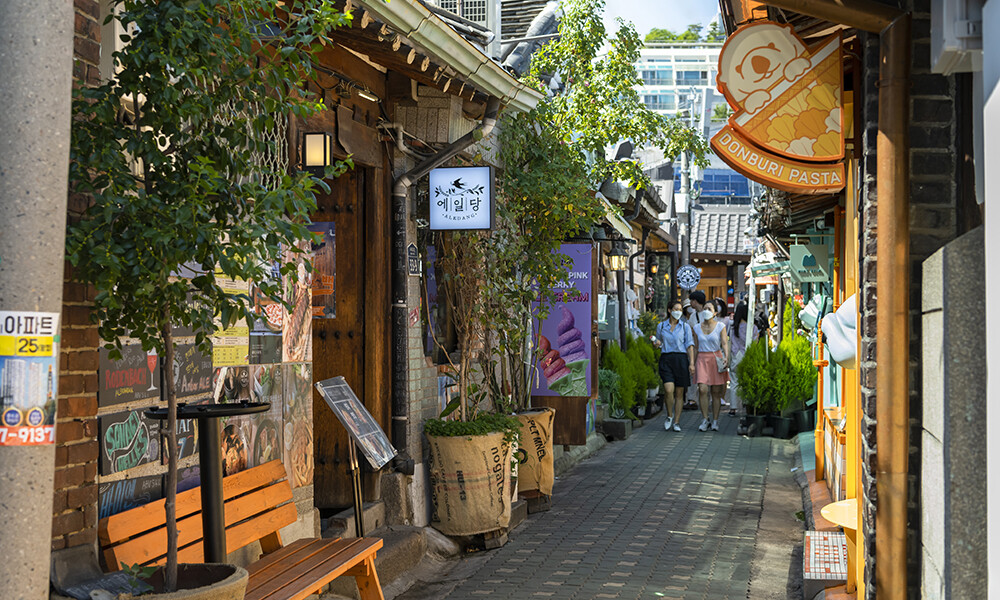
"Did you know there's a place like this in Seoul?" Just a few steps from Exit 6 of Jongno 3-ga Station, along the main street, you can find the Ikseon-dong Hanok Village, an oasis in the heart of the city.
For first-timers, it's a hidden spot that's easy to miss. Before exploring the analog-filled Ikseon-dong Hanok Village, our reporter decided to visit the Nakwon Tteokjip (rice cake shop) Arcade, a name familiar for a long time. However, after wandering around for quite a while, the Nakwon Tteokjip Arcade, as marked on the map, was virtually non-existent, with only three shops remaining.
Ms. A (female, 50s), who runs the OO Tteokjip, a fourth-generation business, lamented, "With this much dedication, one could succeed at anything," implying the immense effort for little return. She added, "With increased bread consumption and the conversion of shops to general restaurants, almost all the rice cake shops have disappeared," revealing the hardships of their livelihood.
According to the Seoul Metropolitan Government, the area was historically called Nakwon Tteokjip Arcade due to the saying "Namjubukbyeong" (Southern Wine, Northern Rice Cake). Among various expressions describing Seoul, this name originated from the reputation of wine being famous south of Cheonggye Mountain and rice cakes being famous north of it.
Furthermore, it is said that after the Japan-Korea Annexation Treaty, during the Gungjung Gaeyeok (court reforms that restricted entry to the palace and expelled many court officials and staff), court ladies who left the palaces resided in Waryong-dong, near Changdeokgung Palace, which contributed to the area's association with traditional food.
After purchasing a pack of rice cakes, our reporter headed to Ikseon-dong Hanok Street. The scene was a complete 180-degree shift from the previous atmosphere. It felt like stepping back in time to the 1920s. The quaint alleys where the past and present coexist, with the eaves of hanok houses connected as a residential complex, create a serene ambiance. Out of 213 buildings in Ikseon-dong, over half, 118, are hanoks.
This area, gaining popularity as a trendy spot with a touch of modern sensibility, is also famous as a filming location for dramas and a tourist attraction for foreigners due to the rising popularity of K-culture. The street, with its hanok framework preserved, feels like it's captured in a black and white photograph.
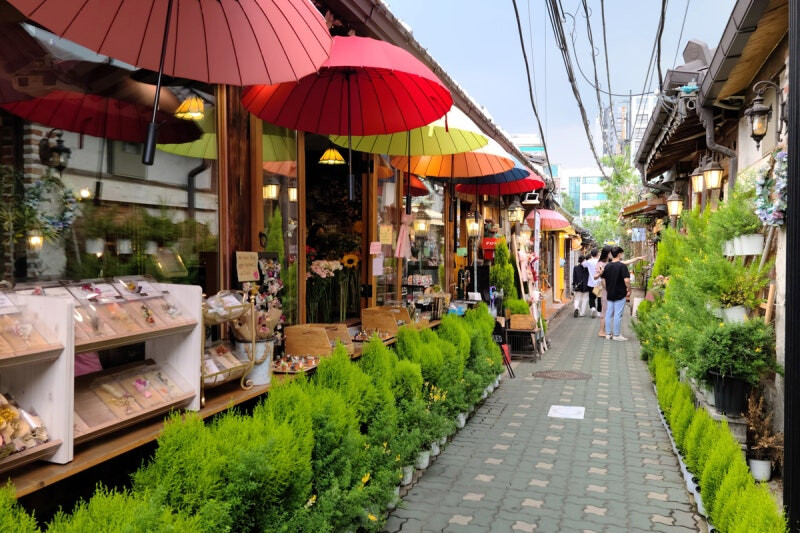
Ikseon-dong Cafe Street History
The commercial area houses a variety of establishments, including cafes, restaurants, caricature shops, photo booths, perfume stores, and clothing boutiques.
According to Namuwiki, the Ikseon-dong Hanok Street saw a significant influx of young entrepreneurs in the mid-2010s when developers renovated some of the hanoks and opened accessory shops and small cafes.
According to Open Up, the residential population of Jongno 1, 2, 3, and 4-dong in July was 6,076, with sales reaching approximately 129.3 billion KRW, ranking first among the 17 neighborhoods in Jongno-gu.
Sales by category were: restaurants (93.4 billion KRW), retail (22.1 billion KRW), education (4.4 billion KRW), lodging (3.5 billion KRW), entertainment (3.2 billion KRW), and services (2.4 billion KRW). Nineteen new stores opened, with restaurants accounting for the majority.
Ms. Choi (female, 30s), waiting for her mother outside a cafe, said, "Today is my mother's birthday, so we came here for a meal. I usually visit this place alone because I love the retro vibe."
However, while walking through the alleys, one notices hanok houses that seem to have lost their original identity, perhaps due to excessive remodeling as businesses moved in. There's a sense of disappointment because some things are hoped to remain unchanged over time, especially when they are not just personal property but also part of our heritage.
Ikseon-dong Hanok Village – simply walking through its alleys makes you feel like the protagonist in a movie. We hope that it will preserve its identity for a long time to come.
[Copyright (c) Global Economic Times. All Rights Reserved.]














