![[등록] 2026-09-01 15:48:31](/support/_updata/banner2/tl181982910_6749.png)


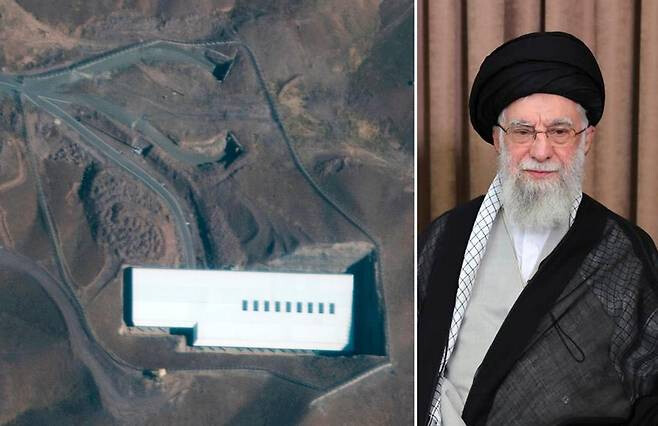
Tehran, Iran – Iran's Supreme Leader, Ayatollah Ali Khamenei, issued a stark warning on June 21 (local time), stating that the United States would suffer "more damage than Iran" should it attack Iranian nuclear facilities. This declaration, made shortly after reports of a potential US strike, signals a perilous escalation in the long-standing animosity between Washington and Tehran. Iranian state television further amplified the threat, cautioning that "all American citizens or military personnel in the Middle East are now legitimate targets." Analysts suggest the deep-rooted conflict, which began with the 1979 Islamic Revolution and the subsequent 444-day hostage crisis involving 52 American diplomats, has reached its most critical juncture yet.
Khamenei underscored his retaliatory resolve by posting a video on his Telegram account, showing him delivering a speech wherein he asserted, "The damage the United States will suffer [from Iran's attack] will be greater than the damage Iran suffered [from America's attack]." This video was reportedly from a June 18 speech where President Donald Trump discussed potential military action against Iran, thereby emphasizing Iran's determination for retribution. Abbas Araghchi, Iran's Deputy Foreign Minister, also took to X (formerly Twitter) to state, "In accordance with the UN Charter, which allows for legitimate self-defense, Iran reserves all options to defend its sovereignty, interests, and people." Iran has additionally called for an emergency meeting of the United Nations Security Council.
Potential Targets: US Military Bases in the Middle East
It appears highly probable that Iran's initial retaliatory measures would center on striking US military installations across the Middle East. Mohsen Rezaei, a member of Iran's Supreme National Security Council (SNSC) and a hardliner, who previously served as commander of the Islamic Revolutionary Guard Corps (IRGC), appeared on state television hours before the US attack reports, declaring, "If the United States engages in war, Iran will target US military bases, detonate naval mines in the Persian Gulf, and blockade the Strait of Hormuz."
Iran possesses a substantial arsenal of ballistic missiles with ranges up to 2,000 kilometers. Should it launch a missile attack on US military bases, approximately 40,000 American personnel stationed in the Middle East would fall within range. This includes forces in Iraq (2,500 personnel), Bahrain (9,000), Kuwait (13,500), Qatar (10,000), and the United Arab Emirates (UAE) (3,500).
Furthermore, any Iranian aggression against pro-US oil-producing nations like Saudi Arabia and the UAE in the Gulf (referred to as the Persian Gulf by Iran and the Arabian Gulf by Arab nations) or a blockade of the Strait of Hormuz would inevitably trigger significant fluctuations in international oil prices. Iran shares the Gulf with major oil exporters such as Saudi Arabia, the UAE, and Qatar. The Strait of Hormuz serves as the critical gateway to the Gulf. A blockade of this vital chokepoint would disrupt approximately 20% of the world's oil shipments (and roughly 70% of South Korea's imported oil).
Renewed attacks on foreign vessels in the Red Sea could also send further shockwaves through global supply chains. This is a credible threat given the potential for Iran-backed Houthi rebels in Yemen to resume their assaults on foreign shipping, particularly those associated with the United States.
However, some analyses suggest that the likelihood of Iran engaging in full-scale retaliation, akin to an all-out war with the United States, remains relatively low. This assessment is largely due to Iran's severe economic hardship under stringent Western sanctions and the significant damage sustained by its military capabilities during recent clashes with Israel.
A History of Adversarial Relations Since 1979
The current US posture, particularly the aggressive stance of the Trump administration, is believed to be rooted in a deep-seated anti-Iranian sentiment prevalent among conservative factions in the United States.
The current theocratic regime in Iran, established by the Islamic Revolution in February 1979, overthrew the pro-American monarchy. Following the revolution, Iranian revolutionary forces demanded the extradition of the exiled Shah Mohammad Reza Pahlavi, who had fled to the United States. This led to the seizure of the US Embassy in Tehran and the 444-day detention of 52 American hostages. Subsequently, the Iran-backed Hezbollah militant group carried out terrorist attacks on the US Embassy and military bases in Lebanon.
During his first term, in January 2020, President Donald Trump authorized a drone strike that targeted and killed Qasem Soleimani, commander of the IRGC's Quds Force, a significant escalation in the ongoing hostilities.
[Copyright (c) Global Economic Times. All Rights Reserved.]