#1 Boryeong City, South Chungcheong Province, was designated as a Special Tourist Zone in 1997. Various special exemptions apply to special tourist zones, most notably the "easing of business hour restrictions." The core of this measure allows restaurants and other businesses to operate 24 hours a day. At the time of designation, late-night operations of restaurants and entertainment venues were restricted to curb overconsumption, protect youth, and establish public morals, making it a truly special benefit. Now that staying open late has become the norm, the presence of the special tourist zone has faded. A merchant who has run a restaurant at Daecheon Beach in Boryeong for 24 years remarked, "Special zones should change with the times, yet the old laws remain intact," asking, "Doesn't 24-hour operation mean nothing now?"
#2 Seogwipo City, Jeju Island, was designated as the "Seogwipo Recreation and Arts Special Zone" in 2013. It is a Regional Specialized Development Zone operated by the Ministry of SMEs and Startups. The aim was to promote regional development by linking existing tourism, cultural, and artistic resources in Seogwipo with large-scale development projects such as the Jeju Healthcare Town. Despite high expectations, the special zone was not properly utilized. Although a special exemption was prepared to extend the stay of foreigners, foreign personnel did not enter the country to use the exemption because the core project, the Healthcare Town, faced setbacks. Later, as special exemptions applied to Jeju Special Self-Governing Province expanded, the benefits granted to the special zone overlapped with those under the Jeju Special Act, erasing the zone's uniqueness and effectiveness.
A special zone is a space granted special benefits by the government to achieve specific policy goals. It eases regulations, reduces taxes, and provides financial support. When functioning properly, a special zone can secure regional growth engines and attract private investment. In reality, however, there are many cases where outdated exemptions are left neglected or benefits overlap with other systems, diminishing the zones' effectiveness. Furthermore, competitive designations have led to their indiscriminate proliferation, to the point where it is hard to find a region that is not a special zone. Special zones are no longer special spaces.
◆ 1,281 Special Zones Nationwide… 93.4% of Local Governments Have at Least One
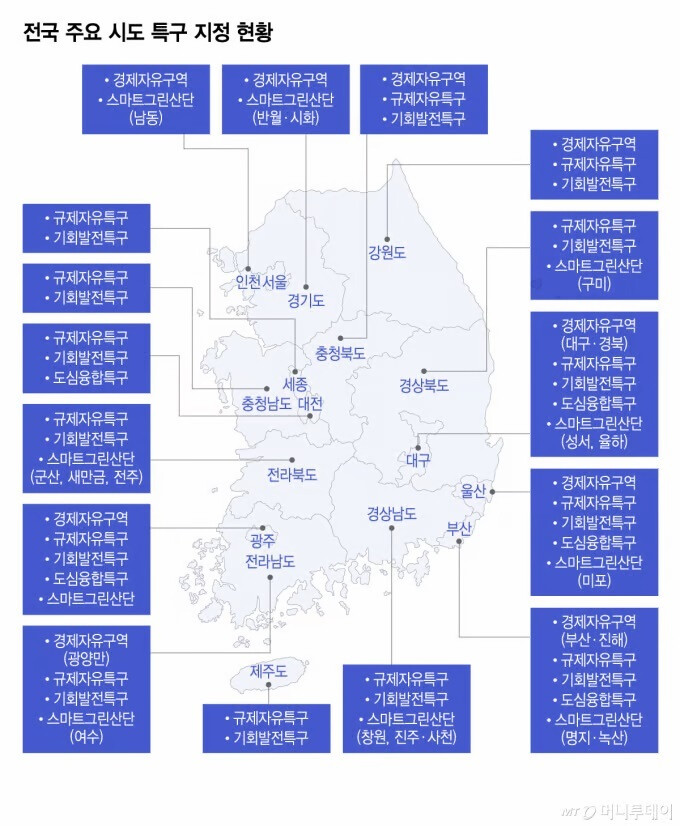
According to a research team led by Professor Jung Sung-hoon of the Department of Geography Education at Kangwon National University on the 25th, a total of 1,281 special zones have been designated nationwide. By type, Regional Specialized Development Zones designated by the Ministry of SMEs and Startups accounted for the largest share at 185 (14.5%), followed by Foreign Investment Zones (Ministry of Trade, Industry and Energy) at 110, Regulation-Free Special Zones (Ministry of SMEs and Startups) at 93, Education Development Special Zones (Ministry of Education) at 90, and Opportunity Development Special Zones (Ministry of Trade, Industry and Energy) at 80.
Special zones began surging during the Roh Moo-hyun administration compared to previous governments. While the Kim Young-sam and Kim Dae-jung administrations designated 33 and 48 special zones respectively, the Roh Moo-hyun administration created 143—more than triple the number. Passing through the Lee Myung-bak (170) and Park Geun-hye (149) administrations, the number exploded during the Moon Jae-in (346) and Yoon Suk-yeol (370) administrations. The Lee Jae-myung administration had designated 22 special zones as of August.
Special zones promoted by the central government reflect policy priorities. The Kim Young-sam administration focused on special tourist zones to respond to globalization, while the Kim Dae-jung administration emphasized venture promotion zones to overcome the Asian financial crisis. The Roh Moo-hyun administration intensively promoted regional specialized development zones under the goal of balanced national development. Special zone policies under the Lee Myung-bak and Park Geun-hye administrations showed no distinct characteristics.
By the Moon Jae-in administration, special zones based on Fourth Industrial Revolution cutting-edge technologies emerged alongside policies like regulation-free zones and smart green industrial complexes. The Yoon Suk-yeol administration tried various special zone policies, such as Education Development and Opportunity Development Special Zones, to the extent that it could be called the "government of special zones."
Special zones, having increased under every administration, now blanket the nation. Out of 226 basic local governments nationwide, only 6.6% (15 municipalities) hold no special zones at all. Excluding Cheorwon County in Gangwon, Gyeryong City in South Chungcheong, and Hapcheon County in South Gyeongsang, most of the basic local governments without special zones (12 places) are in the Seoul metropolitan area. The research team explained that this is the result of indiscriminately designating special zones in non-metropolitan areas.
Looking at the designation status by basic local government, the reality of over-designation becomes clear at a glance. The cities holding the most special zones are Cheongju in North Chungcheong and Gumi in North Gyeongsang, with 32 designated in each. They are followed by Cheonan in South Chungcheong (29), Changwon in South Gyeongsang (26), and Gangseo District in Busan (25). Categorized by urban characteristics, cities with national industrial complexes—Gumi, Changwon, Pohang, Yeosu, and Iksan—and provincial capital hub cities—Cheongju, Cheonan, Jeonju, and Chuncheon—form the two main pillars of special zones.
Due to overlapping designations, voices from the field express confusion. An official at a small-to-medium enterprise located in an industrial complex in Chuncheon, Gangwon Province, pointed out, "Because support details differ for each special zone, it is not easy for companies to figure out which benefits apply," adding, "Rather than increasing the number of special zones, improvements are needed, such as organizing existing support details and integrating them for easy access."
◆ Lee Pushes 'Mega-Regional Special Zones'… "Review Existing Zones First"
The Lee Jae-myung administration is pushing for the introduction of "Mega-Regional Special Zones" (Chogwangyeok Special Zones) to link regional special zones—previously operated separately by different ministries and purposes—on a broader regional scale. The vision is to bundle scattered regional industrial hubs and resources into a single strategic industry ecosystem to secure economies of scale and boost national strategic industry competitiveness.
This will provide a pan-governmental support package including regulatory exemptions as well as financial, fiscal, and tax support. Under this system, local governments and businesses jointly draft a special zone plan and apply, which is then designated by the Minister of Trade, Industry and Energy upon approval by the Prime Minister. The government plans to prepare a menu-style list of about 320 regulatory exemptions—the largest ever under a single law—and push for designations across regional blocs nationwide in the first half of next year.
However, it remains uncertain whether Mega-Regional Special Zones can resolve the overlap and inefficiency of existing zones. If the functions and support systems of existing zones are not properly linked, similar support and administrative procedures could end up overlapping even further. Critics point out that beyond merely designating new zones, a management system must be established to boost the utilization of existing zones while overhauling underperforming ones.
Oh Na-rae, a research fellow at the Korea Institute of Public Finance, explained in her report Operational Status and Reform Tasks of Regional Special Zones that "the proliferation and overlap of special zones is not a problem unique to Korea," noting that "major countries that have long operated place-based policies also suffered inefficiencies from accumulated systems and pursued reforms through institutional integration, project-unit evaluations and exits, and shifts to performance-based systems."
Oh advised, "If existing foundations are not fully utilized or linkages between management systems are insufficient, similar support and administrative procedures may overlap," adding that "the roles and support systems of existing special zones need to be reviewed together during the introduction of Mega-Regional Special Zones."
[Copyright (c) Global Economic Times. All Rights Reserved.]