
![[등록] 2026-09-01 15:48:31](/support/_updata/banner2/tl181982910_6749.png)


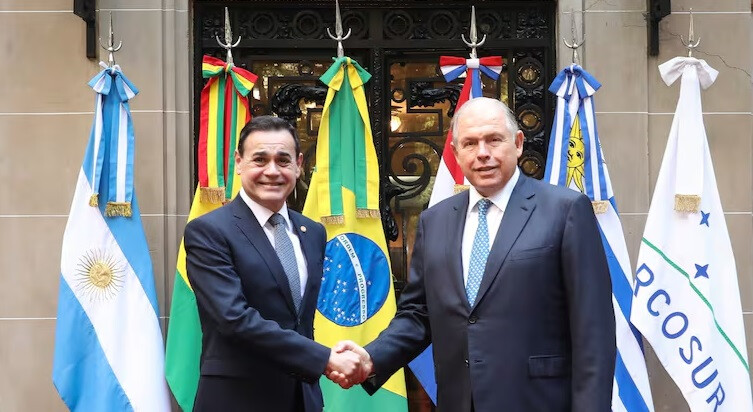
Argentina and Paraguay have embarked on strengthening cooperation in the infrastructure and energy sectors, which form a crucial axis for South American economic integration. Paraguayan Foreign Minister Rubén Ramírez Lezcano and Argentine Foreign Minister Gerardo Werthein recently met in Buenos Aires to hold in-depth discussions on key bilateral issues. This meeting is seen as an important step that goes beyond simple bilateral cooperation, aiming to promote the economic prosperity and social development of the entire South American region.
The core agenda of the meeting was to review the feasibility of infrastructure projects for physical and energy integration and to streamline border crossing procedures. The two countries paid particular attention to the 'Bioceanic Road Corridor (Corredor Vial Bioceánico)' project, considering it a key infrastructure initiative capable of strengthening regional connectivity and creating economic synergy effects. This corridor traverses the South American continent from east to west, connecting Brazil, Paraguay, Argentina, and Chile, forming a large-scale logistics network. Once completed, this project is expected to significantly improve logistics efficiency in the South American inland region and 활성화 교역 with Asian markets.
Energy cooperation was also a significant topic of discussion. Paraguay possesses abundant hydroelectric power resources, while Argentina is a country with high energy demand. The two countries anticipate that hydroelectric power cooperation will establish a stable energy supply network and further strengthen the energy security of the entire South American region. In particular, while the Itaipu Dam is jointly operated by Paraguay and Brazil, Argentina is also an important target for energy cooperation as its power grid is connected.
The simplification of border crossing procedures is an essential task to promote trade and people-to-people exchanges between the two countries. Currently, border crossing procedures between the two nations are complex and time-consuming, hindering logistics efficiency. The foreign ministers of both countries discussed measures to shorten logistics times and eliminate unnecessary administrative procedures through the digitalization and standardization of border crossing processes.
This meeting is expected to further solidify the long-standing friendly relations between the two countries and accelerate economic integration in the South American region. As key members of Mercosur (Southern Common Market), Argentina and Paraguay have consistently worked together for regional economic integration. Through this meeting, the two countries are expected to strengthen infrastructure and energy cooperation and contribute to the economic prosperity and social development of the entire South American region.
However, there are considerable challenges that need to be addressed for the issues discussed at this meeting to translate into actual results. The Bioceanic Road Corridor project is a large-scale undertaking requiring a massive budget, and there are many challenges to overcome, such as securing funding and addressing environmental issues. Furthermore, energy cooperation is also an area where the interests of the two countries may sharply conflict, requiring a cautious approach.
Nevertheless, this meeting is considered an important step forward for economic integration in the South American region. Through joint efforts, Argentina and Paraguay can maximize the economic potential of the South American region and emerge as a new growth engine for the global economy. The two countries should continue dialogue to formulate concrete cooperation plans and persist in their efforts for the common prosperity of the South American region.
[Copyright (c) Global Economic Times. All Rights Reserved.]














