![[등록] 2026-09-01 15:48:31](/support/_updata/banner2/tl181982910_6749.png)


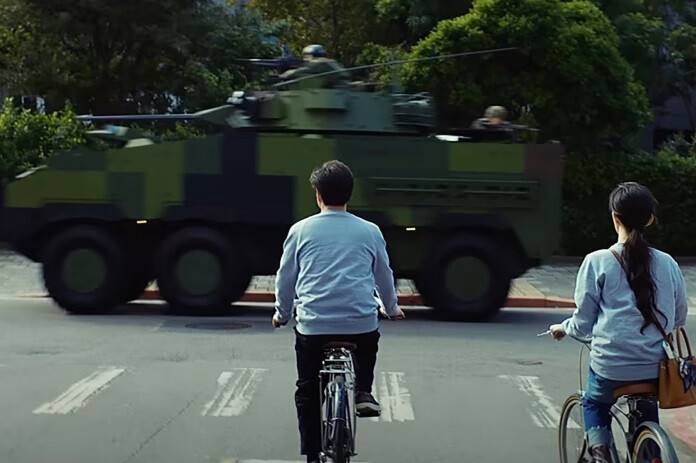
"Will war really happen?"
The TV anchor delivers the news of China's blockade of Taiwan and the imminent possibility of an attack without so much as a blink. As the screen cuts to the Ministry of National Defense, the anchor turns to the producer, a look of disbelief on their face. "Will war really happen?"
This chilling scene is from the upcoming Taiwanese TV drama 'Zero Day,' slated to air this summer. The controversial series, the first piece of mainstream entertainment to realistically depict a Chinese invasion, aims to send ripples through the real world by prompting the Taiwanese people themselves to confront that very question.
"We Taiwanese have lived under this shadow together for so long, but we haven't dared to touch it," says Cheng Hsin-mei, the creator of 'Zero Day.' "But Taiwan is very free now. Why can't we talk about it?"
Since the Chinese Nationalist government retreated to Taiwan after its defeat in the Chinese Civil War in 1949, Beijing has vowed to seize the island, by force if necessary. For decades, China lacked the military might to carry out such a threat. Then, as Taiwanese businesses poured investment into the Chinese economy, forging close ties, war seemed an impossibility.
However, 'Zero Day' arrives at a time when an invasion feels increasingly plausible, fueled by Russia's full-scale invasion of Ukraine and China's escalating military maneuvers around Taiwan.
"For a long time, especially after mainland China began its reforms and opening up, Taiwanese people didn't have much awareness of the possibility of war, and the concept itself was absent," explains Ma Cheng-kun, a professor at Taiwan's National Defense University. "Now, the public is starting to feel it and realize it, especially with the daily activities of People's Liberation Army aircraft and ships around Taiwan."
According to the Taiwan National Security Survey, a long-running series of opinion polls, the percentage of Taiwanese who believe China would attack if Taipei formally declared independence surged from 49% in 2017 to 64% last year.
Yet, many Taiwanese struggle to imagine being caught in a war and feel their nation is unprepared. "A process of social persuasion is needed for society to collectively accept this reality and be willing to participate in national defense mobilization," Ma notes.
After a failed attempt to produce a Taiwan war film six years ago, Cheng Hsin-mei, a screenwriter and former journalist, decided to take on the project herself. She assembled a team of directors, each helming episodes of the series. The first hour-long episode is set to premiere at the Copenhagen Democracy Summit on May 13th.
Shot in a visceral and hyperrealistic style, 'Zero Day' unfolds over a week-long countdown to a Chinese invasion, beginning with a blockade. A Chinese cyberattack plunges shops and homes into darkness. The familiar, verdant streets of Taipei descend into chaos as banks and public transport systems collapse. Fearful families line up at darkened harbors, desperate to escape by boat. Criminal gangs, released by corrupt prison guards, aid Beijing in subduing the population. And finally, People's Liberation Army soldiers arrive.
Observers believe the drama has the potential to have a profound impact, much like nuclear war films gripped the public imagination in Britain and the United States during the 1980s.
"I grew up in the United States during the Cold War, and the fear of nuclear war was a big, important event in my childhood. I had nightmares about it," recalls Nathan Batto, a professor at Academia Sinica. He cites the 1983 film 'The Day After,' which depicted a Soviet nuclear attack on Kansas City, and the haunting image of blanket-clad figures wandering through nuclear winter, as a recurring nightmare from his 13-year-old self.
"It was a cultural touchstone that everyone was familiar with," he says.
'Zero Day' could have a similar effect while also exposing deep-seated divisions within Taiwanese society.
While both the descendants of those who fled China with the Nationalist regime 76 years ago and the island's original inhabitants overwhelmingly reject unification with China, the growing pressure from Beijing is exacerbating fault lines.
Some Kuomintang (KMT) politicians accuse President Lai Ching-te of being a warmonger for labeling China a "hostile foreign power" and urgently seeking to strengthen Taiwan's defenses. The government's move to deport Chinese citizens who openly supported an invasion has drawn criticism from some Taiwanese with family ties in China, who view it as persecution.
Meanwhile, supporters of President Lai's Democratic Progressive Party are increasingly concerned about Beijing-backed disinformation campaigns, espionage, and other forms of infiltration.
"Along with the increased external threat, people are also aware of the threat from China from within," notes Yen Wei-ting, a political scientist at Academia Sinica, pointing to exchanges between KMT politicians and the Chinese Communist Party, as well as China's infiltration of Taiwanese criminal networks. "These threats are very real."
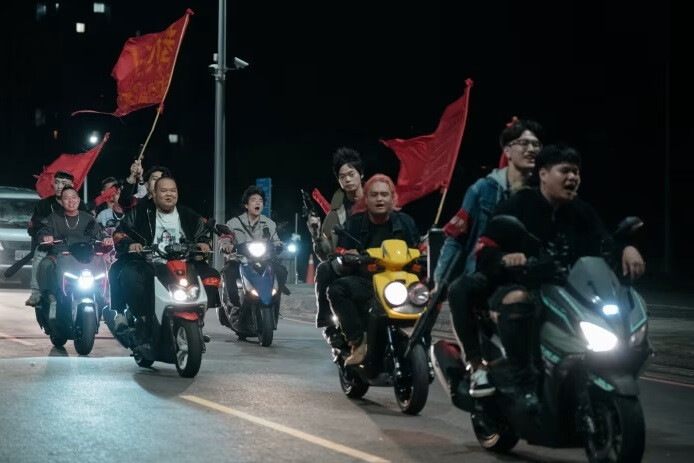
KMT politicians argue that engagement with China can help avert war. However, 'Zero Day' directly confronts the issue of divided loyalties within Taiwan, depicting those who prioritize surrender, those who flee, and those who collaborate with the invaders.
This has already ignited fierce debate. After a 17-minute trailer was released last July, opposition lawmakers demanded Cheng Hsin-mei explain if the production's intention was to target specific political parties or politicians. Other critics labeled the series a propaganda project because it received subsidies from a government-backed film fund – a common practice for many Taiwanese productions.
Days before filming a scene where a prison warden releases gangsters in exchange for a promise to help his daughter receive a liver transplant, prison authorities abruptly withdrew access to the location.
"We say that China might infiltrate the prison system and release inmates to create social unrest in preparation for an invasion. We based the plot on assumptions made by our national security authorities," Cheng Hsin-mei explains.
"The Agency of Corrections under the Ministry of Justice claimed that this was slander against them and that such a thing could not happen in a Taiwanese prison," she added. The Agency of Corrections declined to comment.
Despite the controversy surrounding the series, the 'Zero Day' production team hopes the drama can ultimately unite society. Diana Chao, whose previous work has largely been apolitical, directed an episode that follows a Taiwanese female online celebrity who gradually transforms into a pro-China influencer through a virtual relationship with a Chinese-created AI persona. When Beijing attacks, she urges her followers to surrender.
Chao hopes viewers will gain a better understanding of how their minds work. Chinese literary education and consumption have instilled a "romantic imagination about China" in some Taiwanese, Chao says. She herself comes from a family where such sentiments were prevalent.
"Some of our parents' generation may have understandable feelings for the land, which often clashes with the actual image and current essence of China," Chao explains.
There were also lengthy discussions within the production team itself.
"We asked ourselves, if there is no consensus in our country, when the infiltrators make us confront each other, when war breaks out and the People's Liberation Army lands, what is it that we Taiwanese want to defend together?" Cheng Hsin-mei recounts. "In the end, we discovered that it is freedom, democracy, and our way of life living together on this island."
More than just a drama, 'Zero Day' is poised to ignite a heated debate by presenting the realistic threats Taiwan faces and the diverse perspectives on how to confront them. It remains to be seen what questions the drama will pose to Taiwanese society and what changes it might inspire.
[Copyright (c) Global Economic Times. All Rights Reserved.]