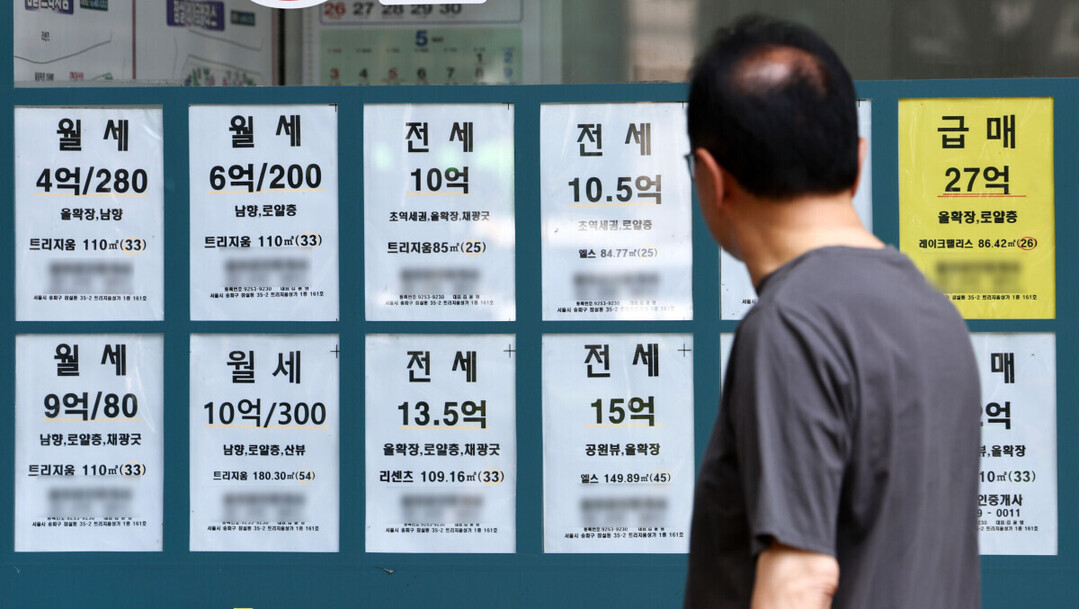
Apartment jeonse (lump-sum deposit lease) prices in the Seoul metropolitan area continue to soar. With the rate of increase in Seoul's jeonse prices approaching 10% this year, Gyeonggi and Incheon are also showing steeper upward trends than last year, causing the entire metropolitan area to fluctuate. Unlike the sales market, where a downward trend has become clear centered around Seoul's three Gangnam districts and the "Han River Belt," price instability in the jeonse market—driven by actual residential demand—persists, raising concerns that the housing burden on non-homeowning ordinary citizens could worsen.
According to the "Weekly Apartment Price Trend" for the fourth week of November (as of the 23rd) released by the Korea Real Estate Board on the 26th, the cumulative rate of increase in apartment jeonse prices in the metropolitan area this year reached 7.52%, which is 4.5 times that of the same period last year (1.66%). Seoul rose 9.58% so far this year, more than triple the same period last year (2.92%). Gyeonggi's rate of increase also grew fivefold, from 1.40% last year to 7.04% this year. Even Incheon, which fell 0.13% during the same period last year, rose 4.97% this year.
In Seoul, the sharp rise in jeonse prices was particularly pronounced in the Gangbuk area, where housing cost burdens were relatively low. Seongbuk-gu recorded the highest increase among Seoul's 25 autonomous districts at 16.92%, followed by Nowon-gu (16.03%), Dobong-gu (12.89%), and Gangbuk-gu (12.47%). Even tenants who chose relatively affordable areas to reduce housing costs are now facing soaring jeonse prices.
In Gyeonggi, Gwangmyeong-si, where jeonse prices fell 6.48% during the same period last year, made a sharp turnaround by rising 16.65% this year. Areas with good accessibility to Seoul or strong underlying demand centered around the semiconductor industry showed steep upward trends, including Dongtan-gu in Hwaseong-si (16.54%), Giheung-gu in Yongin-si (14.64%), Hanam-si (12.77%), and Yeongtong-gu in Suwon-si (12.76%). In Incheon, Yeonsu-gu—home to Songdo—saw a large increase of 7.81%, along with Bupyeong-gu (4.50%) and Namdong-gu and Gyeyang-gu (4.36% each).
This contrasts with the recent spread of declining apartment sales prices into major areas of Seoul. As Gwangjin-gu and Yeongdeungpo-gu joined the downward trend following Seoul's three Gangnam districts, the possibility of a downward shift in Seoul apartment sales prices has grown. The reason the two markets are showing diverging trends is that, unlike sales demand—which can turn to a wait-and-see stance depending on housing price outlooks or loan regulations—rental demand for actual residence does not easily decrease.
Nam Hyuk-woo, a real estate researcher at Woori Bank, stated, "As price strength continues in popular residential areas in southern Gyeonggi such as Suwon, tenants whose lease contracts are expiring are showing signs of moving to nearby areas," adding, "Rental listings are also in very short supply in Incheon and western Gyeonggi."
[Copyright (c) Global Economic Times. All Rights Reserved.]