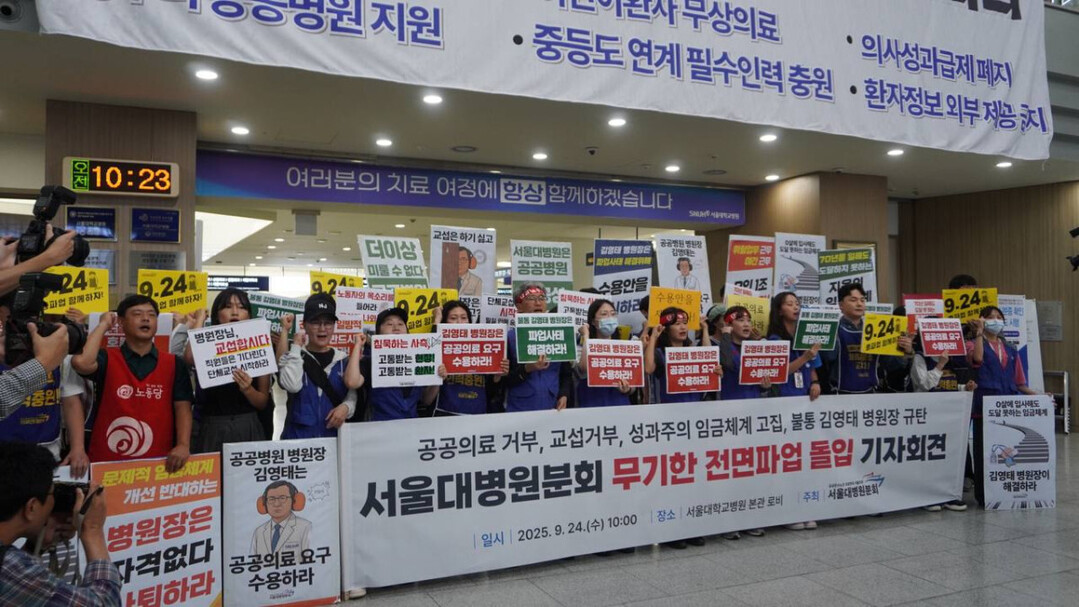
The labor union of Seoul National University Hospital (SNUH) has initiated strike procedures, demanding adequate staffing and improvements in real wages. With the union passing a strike authorization vote with an overwhelming approval rate of 91.6%, it plans to finalize strike dates if negotiations with the hospital management fail to reach a compromise.
The SNUH union declared that it will launch a full-scale, indefinite strike starting on the 28th to demand the recruitment of essential personnel. They attribute the extreme labor shortage to a domino effect caused by the reassignment of 200 nurses to fill the vacuum left by resident physicians.
The Seoul branch of the Seoul National University Hospital Chapter under the Korean Health and Medical Workers' Union (affiliated with the Korean Confederation of Trade Unions) stated, "Due to the management's refusal to present any acceptable proposals, the hospital will enter into an indefinite, full-scale strike starting October 28 until the hospital puts forth an acceptable solution."
Explaining the reasons behind the strike, the union stated, "The current hospital site has gone beyond a simple state of busyness, reaching a dangerous level for both patients and workers. With insufficient staffing, the workload has surged not only in the nursing department but across all departments, including laboratories. Overwork and intense pressure are driving up resignation rates among experienced workers."
They continued, "Ultimately, the shortage of labor goes beyond a mere issue of labor intensity; it directly threatens patient safety. Securing adequate staffing is imperative to protect patients. However, the hospital continues to operate staffing levels based solely on mechanical criteria such as bed and patient counts." The union added that even as the strike was being resolved, management has only repeated its stance that "there is no acceptable proposal."
Previously, the union has been conducting collective bargaining for the renewal of the collective agreement since August 4, focusing on key demands such as strengthening public healthcare, recruiting essential personnel linked to patient severity levels, and raising real wages. Although 16 collective bargaining sessions and roughly 20 working-level sessions were held, they have yet to find common ground.
The situation on the ground at SNUH has drastically changed following the collective action of resident physicians and the restructuring project for tertiary general hospitals. The union noted, "The tertiary general hospital restructuring project increased patient severity, which in turn caused overall workloads to explode from laboratories to hospital wards."
The union argued, "In this process, around 200 experienced nurses who were safeguarding wards and intensive care units were pulled out to serve as Physician Assistant (PA) nurses, and their vacancies were filled by new nurses who had not yet adapted."
In its press conference statement, the union said, "The chaos on the unprepared ground was devastating. To educate and support the rapidly increasing number of new nurses in a short period, the labor intensity of experienced nurses reached its peak, while new nurses were left in heavy, critical-care duties without adequate training and preparation."
They emphasized, "The result has been a succession of leaves and resignations among nurses and a surge in patient safety accidents. Recently, 244 fall accidents occurred in just six months, a tenfold increase compared to previous years."
Furthermore, the union vented, "Workers have to give up wage increases just to receive parental leave benefits."
They pointed out, "Because SNUH workers are covered by the private school pension scheme and do not receive regular parental leave benefits, the hospital has been covering these benefits out of pocket. The problem is that these costs are included in the government's total labor cost cap, which reduces the financial resources available for current employees' wage increases and leads to a drop in real wages."
"The government must exclude parental leave benefits from the total labor cost ceiling and guarantee separate funding, while the hospital must also come up with measures to compensate for wages," they noted. They added, "Although nine national university hospitals were transferred to the Ministry of Health and Welfare on August 20, SNUH remains under the jurisdiction of the Ministry of Education. The hospital president must state their position on the transfer and present a plan to strengthen public healthcare."
[Copyright (c) Global Economic Times. All Rights Reserved.]