![[등록] 2026-09-01 15:48:31](/support/_updata/banner2/tl181982910_6749.png)


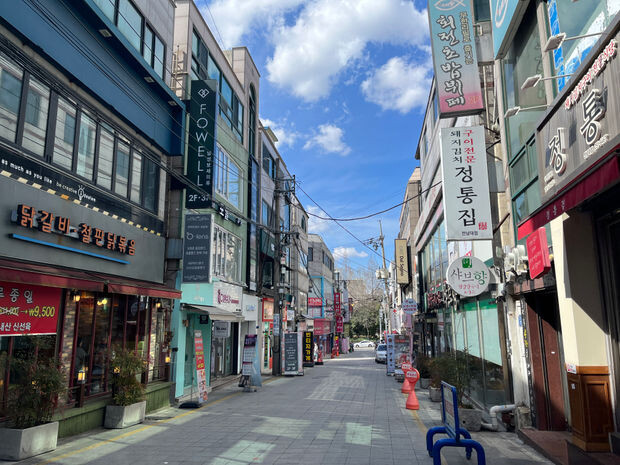
Most universities started their fall semester on September 1, but business is slow in many university towns. While students are back on campus, the usual back-to-school economic boom is nonexistent. High living costs and soaring housing prices are forcing students to cut back on spending. On top of that, a shift in university culture has led to fewer group dinners and gatherings.
"The back-to-school effect is a thing of the past," says a local merchant.
On the morning of September 2, the area around Konkuk University in Seoul's Gwangjin-gu was quiet, reminiscent of summer break. Even as noon approached, most tables in the restaurants that were open remained empty. A restaurant employee preparing for the day said, "Business isn't great, probably because of the economy." Another shop owner nearby echoed the sentiment, "I don't expect any major changes just because the semester started. We don't really cater to students anymore, but to outside customers."
The scene was similar in the Hanyang University neighborhood of Seongdong-gu. Although the main gate was bustling with students, the area near Wangsimni Station was quiet, more like a ghost town than a lively university district. While some students were seen dining, empty seats were more common.
Students report that they've had to reduce their spending due to the high cost of living. Park Sun-yoon, a 23-year-old student who lives near campus, stated, "I can feel the price of a single meal going up by a few thousand won. I mostly eat at the student cafeteria, which is cheaper than regular restaurants." Park added, "When I go out for drinks with friends, the bill can easily exceed 30,000 or 40,000 won, and that's a burden. It feels like prices in university areas are just too high."
According to Statistics Korea, consumer prices rose 2.1% and restaurant prices 3.1% in the first half of this year. Rents are also forcing students to tighten their belts. Data from the real estate platform Dabang shows that the average monthly rent in Seoul was 730,000 won in July (for a 10 million won deposit), with average rents rising in 20 of Seoul’s 25 districts compared to the previous month.
A change in university culture is also to blame for the lack of a back-to-school boost. The tradition of departments and clubs holding gatherings and drinking sessions has become less common since the COVID-19 pandemic. A 23-year-old student, identified as Lee, who used to be part of a folk music club, said, "The 'drink-til-you-drop' culture of the past is gone."
Lee explained that while his club used to have frequent gatherings, "the pandemic put a damper on things, and we don't get together in a boisterous way like we used to." He also noted that the "bap-yak" (meal promise) culture, where upperclassmen would treat freshmen to meals, has disappeared. "When I was a freshman, I had two or three of those get-togethers a week, but now, people just don't make those plans at all."
Merchants have also given up hope for a back-to-school boom. A 54-year-old owner, identified as A, who has run a pub near Hanyang University for 14 years, is preparing to downsize and move. "I have too many tables to manage by myself, but it's not the right time to hire anyone," he said. "The university scene now is completely different from when I first opened." He added that group reservations have decreased, and a gathering of 20 people is now considered large, whereas 40 to 50 used to be common. "Old customers who graduated come back and are surprised to see so many empty seats," he said, adding, "The back-to-school boom is pretty much dead."
[Copyright (c) Global Economic Times. All Rights Reserved.]