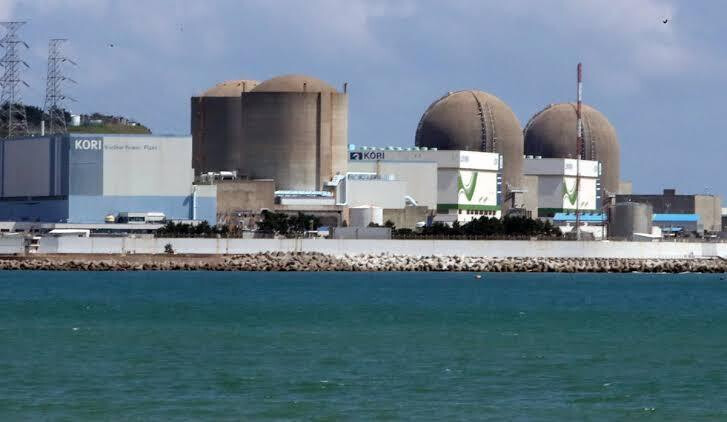
The Nuclear Safety and Security Commission (NSSC) will deliberate once again next week on the "Continued Operation Permit" for Kori Nuclear Power Plant Units 3 and 4 located in Gijang-gun, Busan.
If the relevant agenda item is approved, the extension of the operational lifespan for Units 3 and 4 will be confirmed approximately one year after Kori Unit 2 last November. However, the possibility of the decision being postponed once again cannot be ruled out.
According to relevant authorities on the 24th, the NSSC will hold its 17th meeting of 2026 on the 27th of this month to deliberate on the "Continued Operation Permit Proposal for Kori Nuclear Power Plant Units 3 and 4." This deliberation takes place approximately two weeks after the initial deliberation on the 15th.
At that time, during the 16th meeting of 2026, the NSSC placed ▷ the Approval Proposal for the Kori Nuclear Power Plant Units 3 and 4 Accident Management Plan (Agenda Item 1) and ▷ the Continued Operation Permit Proposal for Kori Units 3 and 4 (Agenda Item 3) on the agenda. It approved Agenda Item 1 while deciding to re-discuss Agenda Item 3 at the next meeting.
Typically, the procedure determining whether to extend the lifespan of aging nuclear power plants proceeds in the order of "Approval of the Accident Management Plan -> Deliberation on the Continued Operation Permit."
The Accident Management Plan is a document stipulating various measures, such as strategies and implementation systems, to recover a nuclear plant to a safe state in the event of an accident. To deliberate and pass the continued operation permit, the approval of this plan must serve as a prerequisite.
For this reason, analyses have emerged from within and outside the nuclear industry that "as the approval proposal for the accident management plan cleared the NSSC's hurdle on the 15th, the authorities' procedures to finalize the continued operation of Kori Units 3 and 4 have essentially cleared a major 'hurdle.'"
At the time, the NSSC also explained, "We confirmed that the accident management capabilities and other aspects related to Kori Units 3 and 4 satisfy the licensing criteria."
Accordingly, cautious prospects are being raised that the continued operation permit proposal could be approved at the 17th meeting held next week.
If finally approved, Kori Units 3 and 4 will be able to generate electricity for an additional 10 years based on the points when their design lifespans expired and operations were halted (September 2024 and August 2025, respectively)—meaning until around September 2034 and August 2035.
Korea Hydro & Nuclear Power (KHNP), the nuclear plant operator, will also enter preparations for restart immediately upon approval. Considering related tasks and procedures, actual restarts are projected to take place as early as early next year.
If this happens, based on next year, Unit 3 will be able to operate for an additional seven years or so, and Unit 4 for around eight more years.
However, as public opinion surrounding the extension of aging nuclear power plants remains divided, and with reports of differing views within the NSSC regarding the continued operation permit, the possibility of another postponement remains.
[Copyright (c) Global Economic Times. All Rights Reserved.]