![[등록] 2026-09-01 15:48:31](/support/_updata/banner2/tl181982910_6749.png)


(C) Radio Free Europe
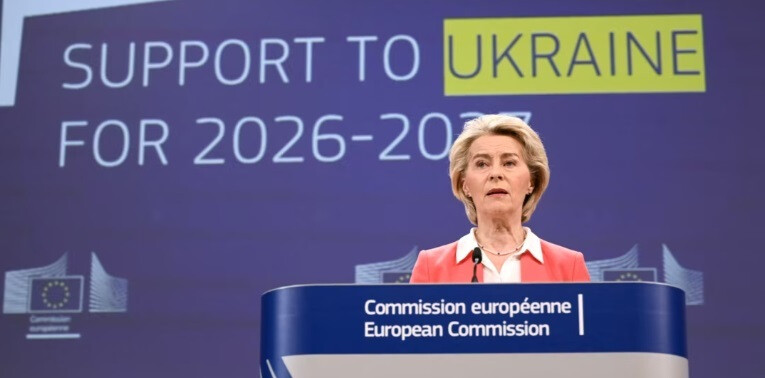
KIEV – On the fourth anniversary of the full-scale invasion of Ukraine, European Union leadership traveled to Kyiv to deliver a message of unwavering solidarity. Despite a recent diplomatic setback in Brussels, Ursula von der Leyen, President of the European Commission, pledged on February 24 (local time) that the EU would find a way to fulfill its promised €90 billion ($97.5 billion) loan to the war-torn nation.
A Broken Consensus
The commitment comes at a precarious moment. Just a day prior, an EU foreign ministers' meeting in Brussels failed to pass the massive financial aid package and a new round of sanctions against Russia. The roadblock was once again Hungary, which exercised its veto power despite having previously agreed to the loan framework during an EU summit last December.
"The promise made by all 27 member states last December cannot be broken," Von der Leyen stated during a joint press conference. "We will honor this commitment, one way or another."
The "Oil Pipeline" Dispute
The current friction centers on the Druzhba pipeline, a critical conduit for Russian crude oil into Central Europe. Budapest claimed its veto was a response to the lack of progress in repairing sections of the pipeline passing through Ukrainian territory. Hungary, along with Slovakia, has accused Kyiv of intentionally delaying repairs to exert pressure on their energy supplies.
Ukrainian President Volodymyr Zelenskyy fired back at these allegations, noting that Russian shelling is the sole reason for the infrastructure’s state. "Russia has destroyed this pipeline multiple times," Zelenskyy remarked. "If Prime Minister Orbán wants the energy flow secured, it is his task to persuade Putin to agree to an 'energy truce'."
Zelenskyy further questioned the motives behind Hungary’s demands: "Do they want us to lose more lives performing repairs while Russia continues to strike our infrastructure?"
A Race Against Time
The EU estimates that Ukraine requires approximately €135 billion in support over the next two years to prevent a total state collapse. Brussels aims to begin large-scale disbursements by April to stabilize the Ukrainian economy.
Because of the Hungarian veto, the EU delegation's visit—originally intended to be a landmark announcement of the €90 billion loan—was scaled back to smaller, immediate grants:
€100 million for humanitarian aid (including power generators).
€920 million for air strike damage recovery.
Rising Tensions within the Bloc
The internal discord has drawn sharp criticism from other EU leaders. António Costa, President of the European Council, called on Hungary to "immediately withdraw" its veto.
"Once the European Council reaches an agreement and makes a decision, every member state must cooperate to implement that decision," Costa emphasized, highlighting the growing frustration with Budapest’s perceived obstructionism.
As the war enters its fifth year, the EU faces the dual challenge of sustaining Ukraine’s defense while maintaining a fragile internal unity against a backdrop of complex energy dependencies and geopolitical maneuvering.
[Copyright (c) Global Economic Times. All Rights Reserved.]