![[등록] 2026-09-01 15:48:31](/support/_updata/banner2/tl181982910_6749.png)


(C) The Times of Israel
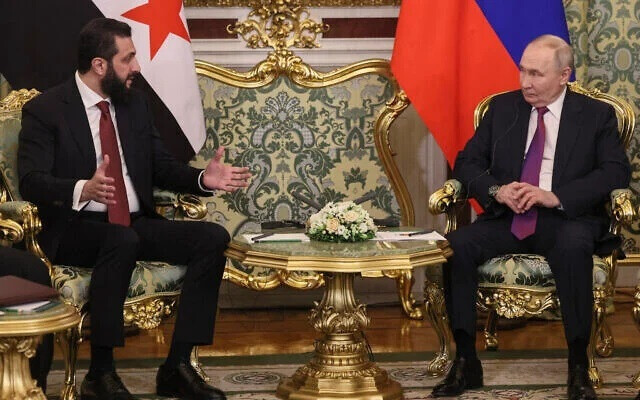
MOSCOW — Russian President Vladimir Putin and Syria’s interim president, Ahmed al-Sharaa, held a high-stakes summit at the Kremlin on Wednesday to discuss the strategic future of Russian military assets in Syria and the evolving geopolitical landscape of the Middle East.
This marks the second meeting between the two leaders since al-Sharaa established a transitional government in December 2024, following the ousting of long-time leader Bashar al-Assad. While the initial meeting in October was characterized by a cautious "thawing" of relations, Wednesday’s discussions signaled a more concrete move toward long-term cooperation.
Economic Ties and Territorial Integrity
President Putin opened the session by praising al-Sharaa’s efforts in stabilizing the war-torn nation. "Under the new reality, and largely thanks to your personal efforts, the relationship between Syria and Russia is developing," Putin stated. He noted that bilateral economic cooperation has grown by over 4%, a figure he described as "clear progress" that must be maintained. Putin also signaled that the Russian construction industry is prepared to take a leading role in Syria’s massive reconstruction projects.
Significantly, Putin expressed firm support for the Syrian government’s recent military offensive against Kurdish-controlled regions in the northeast. "We have closely monitored your efforts to restore Syria’s territorial integrity," Putin said. "We support all your endeavors to the end."
Interim President al-Sharaa responded by emphasizing Russia’s indispensable role in regional stability. "Russia plays a major role in stabilizing not only Syria but the entire region," al-Sharaa said, expressing gratitude for Moscow’s continued engagement.
The Status of Tartus and Hmeimim
While not mentioned in the public opening remarks, the primary focus of the closed-door session was the legal and operational status of Russia’s two major military installations: the naval base at Tartus and the Hmeimim airbase.
Kremlin spokesperson Dmitry Peskov confirmed ahead of the meeting that "all issues regarding our forces stationed in Syria will undoubtedly be raised." These bases represent Russia’s only military footprint outside the former Soviet Union and are crucial for Moscow’s power projection in the Middle East and Mediterranean.
The future of these bases has been shrouded in uncertainty since the fall of the Assad regime. A significant point of contention remains the presence of Bashar al-Assad in Moscow, where he currently lives in exile. The al-Sharaa government has repeatedly called for Assad’s extradition, a topic on which Peskov declined to comment.
Strategic Shifts and Diplomatic Signals
The summit comes on the heels of Russia’s recent withdrawal of troops and equipment from Qamishli Airport in northeast Syria. Analysts, and sources within the Syrian Foreign Ministry, interpret this move as a "gesture of goodwill" and a signal that Moscow does not intend to interfere in the direct conflict between the Syrian Arab Army and the Kurdish-led Syrian Democratic Forces (SDF).
The high-level nature of the talks was underscored by the attendees. The Russian delegation included Deputy Prime Minister Alexander Novak, Defense Minister Andrei Belousov, and Igor Kostyukov, head of the Main Intelligence Directorate (GRU), who recently led the Russian delegation in trilateral talks with the U.S. and Ukraine in Abu Dhabi.
As Syria navigates its transition, the outcome of these talks will likely define the extent of Russian influence in the region for the next decade, balancing Moscow's military ambitions with the demands of Syria's new leadership.
[Copyright (c) Global Economic Times. All Rights Reserved.]