• 2026.08.11 (Tue)
  • All articles
  • LOGIN
  • JOIN
Global Economic Times
fashionrunwayshow2026
  • Synthesis
  • World
  • Business
  • Industry
  • ICT
  • Distribution Economy
  • Well+Being
  • Travel
  • Eco-News
  • Education
  • Korean Wave News
  • Opinion
  • Arts&Culture
  • Sports
  • People & Life
    • International Student Report
    • With Ambassador
  • Column
    • Cho Kijo Column
    • Cherry Garden Story
    • Ko Yong-chul Column
    • Kim Seul-Ong Column
    • Lee Yeon-sil Column
  • Photo News
  • New Book Guide
MENU
 
Home > Synthesis

President Lee Steps Up Regional Growth Blueprint, Putting AI and Chips at the Center

Hwang Sujin Reporter / Updated : 2026-06-24 07:45:56
  • -
  • +
  • Print


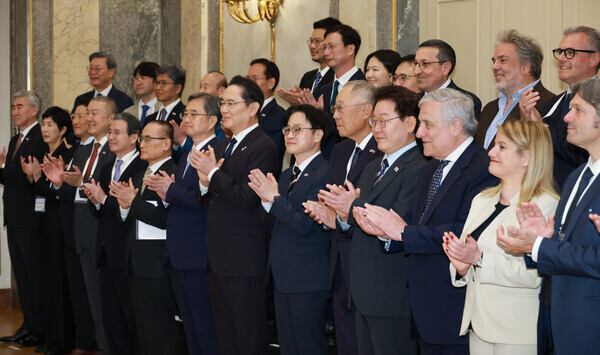
SEOUL — President Lee Jae-myung is set to hold a series of high-level meetings with the leaders of South Korea’s semiconductor giants, Samsung Electronics and SK Group, to finalize an ambitious roadmap for balanced regional development. This strategic push aims to decentralize the nation’s industrial power, currently concentrated in the Seoul metropolitan area, by leveraging the semiconductor industry’s historic boom to revitalize local economies.

Finalizing the "Growth Transformation" Strategy

President Lee is scheduled to meet with Samsung Electronics Chairman Jay Y. Lee on June 25 at the presidential office. This follows his recent meeting with SK Group Chairman Chey Tae-won on June 19. These individual consultations are considered critical preparatory steps for the "Major Business Leaders' Briefing" scheduled for June 29, where the government plans to unveil a comprehensive national transformation project.

The administration is framing this initiative as a "fundamental transformation" of South Korea’s growth strategy. During his first-anniversary press conference earlier this month, President Lee emphasized that the "fruits of growth must not remain confined to a select few corporations, regions, or sectors". 

Semiconductors and AI: The New Engines for Regional Revitalization

According to government and business sources, the core of this new strategy involves shifting investment toward non-capital regions by fostering industrial ecosystems centered on Artificial Intelligence (AI) and semiconductors. The government envisions a "local production, local consumption" model, particularly in power-intensive industries, by aligning new production facilities with regions that have strong renewable energy infrastructure. 

Key components of the upcoming investment plan include:

Semiconductor Clusters: Potential construction of front-end memory chip fabrication plants and advanced back-end packaging facilities in regions like Gwangju and the Honam area. 
AI Infrastructure: Deployment of AI data centers across the Chungcheong and Gangwon provinces to support local digital transformation. 
Comprehensive Support: To ensure the success of these regional projects, the government is preparing a package of incentives, including tax benefits, regulatory reforms, and the expansion of water, power, and transport infrastructure. 

Addressing Economic Polarization

The administration’s urgency stems from the dual challenge of declining potential growth and widening regional inequality. While the semiconductor sector has driven significant stock market gains, President Lee has warned that this success has created a "dark shadow of wealth polarization". 

Prime Minister Kim Min-seok and Chief of Staff Kang Hoon-sik have both recently echoed the President’s vision, signaling that the government intends to utilize excess tax revenues generated by the semiconductor boom to invest in "future generations" and create high-quality, long-term jobs in local communities. 

Future Outlook and Challenges

While the plan marks a bold shift toward "balanced growth," industry experts note several hurdles. Successful implementation will require not only government support but also sustained corporate commitment, even during potential market downturns. The government’s ability to secure reliable infrastructure and prevent speculative real estate activities during the selection of new industrial sites will be crucial to the plan's viability.

As the June 29 briefing approaches, all eyes are on whether this "major transformation" can effectively transition South Korea from a capital-centric economy to a more equitable and innovation-driven landscape.

[Copyright (c) Global Economic Times. All Rights Reserved.]

  • #Hormuz Impasse
  • #globaleconomictimes
  • #micorea
  • #mykorea
  • #nammidonganews
  • #singaporenewsk
  • #Samsung
  • #Daewoo
  • #Hyos
Hwang Sujin Reporter

Popular articles

  • Japan Estimated to Have Spent ¥6–7 Trillion in Fresh Yen-Buying Intervention as US Joint Action Hints Emerge

  • South Korea’s Top Three Mobile Carriers Launch Pre-Orders for Samsung’s Galaxy Z Series with Aggressive Subsidies and Service Bundles

  • S. Korea Accelerates Leveraged ETF Rules: ₩30M Cash Deposit Required Starting July 31

I like it
Share
  • Facebook
  • X
  • Kakaotalk
  • LINE
  • BAND
  • NAVER
  • https://www.globaleconomictimes.kr/article/1065566613796882 Copy URL copied.
Comments >

Comments 0

Weekly Hot Issue

  • Riot Games Hosts Largest-Ever TFT Festival at The Hyundai Seoul to Launch 'Sylvan Secrets' Set
  • MINISTRY OF EMPLOYMENT AND LABOR DIRECTS IMMEDIATE EXPANSION OF REST FACILITIES AT GIMPO AIRPORT AFTER UNANNOUNCED HEATWAVE INSPECTION
  • XAVIS Secures Contract to Supply Advanced X-Ray Inspection Systems to European Lines of Global Food Sauce Brand
  • Emma Expands Collaboration with Interior Design Experts to Present Sleep Space Solutions
  • Trump Criticizes U.S. Congressional AI Regulations as Threat to Tech Industry
  • Memory Chips Become Dominant Force in Global Semiconductor Industry, Expected to Account for 60% of Total Market This Year

Most Viewed

1
Planting Hope: Ethiopia’s Green Legacy and the Power of National Transformation
2
Japan Estimated to Have Spent ¥6–7 Trillion in Fresh Yen-Buying Intervention as US Joint Action Hints Emerge
3
The 16th Ethiopia-gil World Festival & Meskel Festival
4
South Korea’s Top Three Mobile Carriers Launch Pre-Orders for Samsung’s Galaxy Z Series with Aggressive Subsidies and Service Bundles
5
KT and Amorepacific Complete ‘Data Highway’ Project, Unveiling AI-Specialized Research Platform
광고문의
임시1
임시3
임시2

Hot Issue

MINISTRY OF EMPLOYMENT AND LABOR DIRECTS IMMEDIATE EXPANSION OF REST FACILITIES AT GIMPO AIRPORT AFTER UNANNOUNCED HEATWAVE INSPECTION

Riot Games Hosts Largest-Ever TFT Festival at The Hyundai Seoul to Launch 'Sylvan Secrets' Set

Nable Communications Secures 5G Private Network Upgrade Deal with LG Uplus

Ansan City Pay-as-You-Throw Trash Bag Abandoned in Japan Sparks Controversy in Kamikochi

Fashion Runway Show 2026

Global Economic Times
korocamia@naver.com
CEO : LEE YEON-SIL
Publisher : KO YONG-CHUL
Registration number : Seoul, A55681
Registration Date : 2024-10-24
Youth Protection Manager: KO YONG-CHUL
Singapore Headquarters
5A Woodlands Road #11-34 The Tennery. S'677728
Korean Branch
Phone : +82(0)10 4724 5264
#304, 6 Nonhyeon-ro 111-gil, Gangnam-gu, Seoul
Copyright © Global Economic Times All Rights Reserved
  • 향기네무료급식
  • BCB부천방송
  • 반달곰 프로젝트
Search
Category
  • All articles
  • Synthesis
  • World
  • Business
  • Industry
  • ICT
  • Distribution Economy
  • Well+Being
  • Travel
  • Eco-News
  • Education
  • Korean Wave News
  • Opinion
  • Arts&Culture
  • Sports
  • People & Life 
    • 전체
    • International Student Report
    • With Ambassador
  • Column 
    • 전체
    • Cho Kijo Column
    • Cherry Garden Story
    • Ko Yong-chul Column
    • Kim Seul-Ong Column
    • Lee Yeon-sil Column
  • Photo News
  • New Book Guide
  • Multicultural News
  • Jobs & Workers