SEOUL, South Korea — Nearly two decades after introducing South Korea’s first robotic surgical system in 2005, Severance Hospital reached a global milestone in April by completing 50,000 cumulative robot-assisted procedures—the highest volume recorded by a single medical institution worldwide.
In a recent interview, Kang Sang-wook, Deputy Director of the Yonsei Cancer Center, reflected on the rapid evolution of minimally invasive surgery and outlined how artificial intelligence (AI) and real-time connectivity are poised to define the next era of surgical care.
From Skepticism to Global Standard
When robotic systems were first introduced to South Korea, they faced skepticism from both clinicians and patients who viewed the technology as excessive. Initially confined to a handful of specialties such as urology, robotic techniques gradually expanded into gastrointestinal surgeries before breaking new ground in thyroid, breast cancer, and transplant procedures—areas rarely attempted with robotics overseas. Today, more than 200 robotic systems operate across South Korea, with annual procedure volumes surging eightfold over the past decade to roughly 80,000 cases.
According to Kang, the true value of the 50,000-case milestone lies not merely in the volume, but in establishing a reproducible ecosystem that integrates clinical practice, research, and education. By lowering technical barriers for newcomers across departments, the institution has trained nearly 7,000 medical professionals from 43 countries and published over 800 peer-reviewed papers in SCI(E) journals. Korean surgeons have also pioneered globally adopted surgical standards, including clinical guidelines for robotic gastrectomy as well as scar-minimizing thyroid approaches via the underarm, behind the ear, and through the mouth.
Precision, Cosmetics, and Remote Training
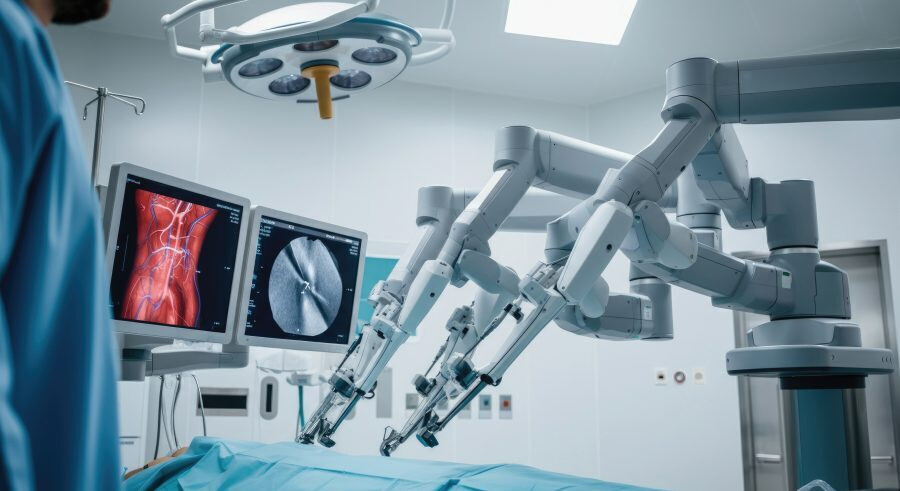
Robotic platforms were designed to overcome the constraints of traditional laparoscopy, which relies on two-dimensional imaging and rigid instruments. Equipped with high-definition 3D visualization and articulated wrists, robotic arms allow surgeons to maneuver in tight anatomical spaces while controlling auxiliary instruments independently.
The introduction of single-port (SP) robotic systems has further benefited fields like head-and-neck, endocrine, and breast surgery. For example, conventional neck dissections for metastatic thyroid cancer often require a 12-centimeter incision that leaves visible scarring. Single-port robotics reduces the incision size dramatically, improving cosmetic outcomes and accelerating postoperative recovery.
Training methodologies are evolving alongside hardware. Since launching the SimNow simulation platform in June 2025, trainees have logged over 2,100 practice sessions to build proficiency before entering the operating room. Meanwhile, Telepresence technology enables live, two-way surgical broadcasts via IP connections—a capability recently utilized to stream a live single-port procedure to an international training course hosted by IRCAD in Taiwan, while also expanding educational access for regional hospitals within South Korea.
The Integration of AI and Tactile Feedback
Looking ahead, Kang emphasized that digital integration and AI are augmenting, rather than replacing, human expertise. Preoperative imaging powered by AI already helps map out critical blood vessels and nerves as restricted zones to prevent intraoperative injury. Newer systems, such as the da Vinci 5, also incorporate force-feedback sensors that allow surgeons to gauge the physical resistance of tissue, minimizing unnecessary trauma.
"Even if autonomous robotic surgery becomes a reality, managing unforeseen complications during a procedure will always depend on seasoned clinicians," Kang noted. He added that the hospital's long-term objective is to transition the entire operating suite into a data-driven, AI-assisted environment that supports real-time clinical decision-making.
For patients weighing robotic surgery against conventional or laparoscopic options, Kang advises focusing on personal priorities rather than assuming one method is universally superior. While safety, precision, and complication rates remain comparable across techniques—particularly in thyroid surgery—each carries distinct trade-offs regarding scarring and recovery comfort that should be discussed thoroughly with a physician.
[Copyright (c) Global Economic Times. All Rights Reserved.]