![[등록] 2026-09-01 15:48:31](/support/_updata/banner2/tl181982910_6749.png)


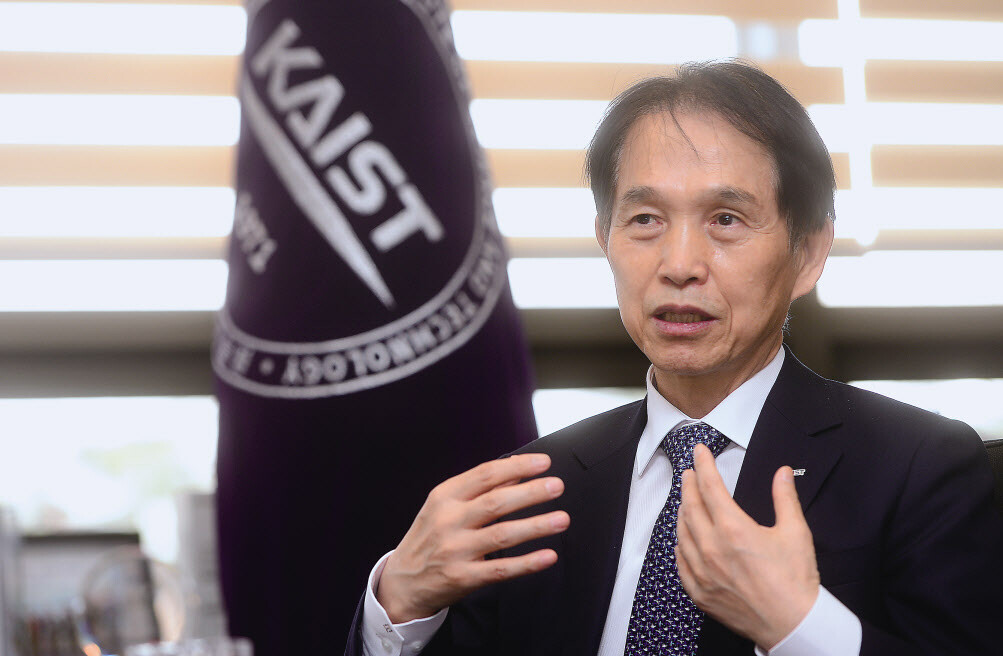
[GLOBAL ECONOMIC TIMES] “There is a saying, ‘If the strong decide to take away the patent of the weak, that patent immediately becomes a meaningless piece of paper.’ This is the current state of domestic intellectual property rights. “In Korea, intellectual property rights are not assets that can be protected or make money.”
KAIST President Lee Kwang-hyung rolled up his sleeves as an ‘intellectual property protector.’ The intention is to internally serve as a shield for weak links such as small and medium-sized businesses and startups, and externally to create a bastion that protects Korea's intellectual property rights against the attacks of global companies. He was inaugurated as chairman of the National Intellectual Property Committee (Intellectual Property Committee), a pan-ministerial intellectual property control tower, last August.
Korea's level of intellectual property protection is numerically at the bottom among major countries. According to the results of the national competitiveness assessment announced by the International Management Development Institute (IMD) in Switzerland in 2023, Korea ranked 4th among 64 countries in the world in the number of patent applications and patent registrations, respectively, and 2nd in the number of patent applications per 100,000 population. However, its intellectual property protection ranking is only 28th. Chairman Lee points out that this is due to the domestic structure in which the strong can easily take away the intellectual property rights of the weak.
Usually, the subject of intellectual property infringement is the powerful. Chairman Lee asked, “For example, have you seen a case where a small business tries to take away a patent owned by a large company?” He explained, “Because of this physiology, it is easy for the strong in Korea to take away the intellectual property rights of the weak.”
Theft of intellectual property rights begins with an invalidation lawsuit. Chairman Lee said, “The powerful search through all the patents around the world and come up with similar ones,” and added, “They claim invalidation based on this, and more than half are invalidated at this stage.”
Even if you are lucky and survive without it being invalidated, you will be frustrated at the ‘compensation stage’. Since the strong infringed on the patents of the weak, they must receive compensation. However, even at this stage, the weak remain the weak. Chairman Lee said, “For the weak to receive compensation, the strong must prove how they used the infringing patent and how much money they made. But this is almost impossible. “If a powerful party claims that it cannot be disclosed because it is a trade secret, that is the end,” he explained.
These lawsuits take several years for each process. This is an unbearable time for the weak, who must run their businesses with all their might. Even if you win, the compensation amount is extremely small. It is a structure that makes it impossible for a story like ‘David and Goliath’ to become a reality.
Chairman Lee proposed a professional judge system, introduction of the Discovery Act, and revision of related tax laws as solutions to this problem. He said, “The reason why a judgment takes so long is because the expertise of judges in rotating positions is low,” and “Advanced countries such as the United States and Germany are introducing a ‘life system’ for patent judges. He emphasized, “Korea also needs a system of specialized patent judges.”
It is also necessary to introduce a ‘Korean style discovery law’ to break down the structure in which the strong have the upper hand in intellectual property litigation using trade secrets as a weapon. Discovery law in the United States is a procedure in which parties to a lawsuit disclose relevant information or documents at each other's request. If a request is rejected without reasonable cause, you will be subject to court punishment and sanctions. Chairman Lee said, “We must allow experts appointed by the judge to examine whether the strong have infringed on the intellectual property rights of the weak.”
He said a plan to reduce the high patent inefficiency was also needed. Chairman Lee said, “Because the number of patent attorneys involved in patent work is small, patent registration work is carried out in a multiple-release manner, so inefficiency is bound to be high,” and “We need to comprehensively change various factors, such as the lack of number of examiners at the Patent Office.” .
In particular, he emphasized that he would increase the value of domestic intellectual property rights. He said, “We need to instill awareness that if intellectual property rights are violated, the company may fail as a result,” and “From the perspective of the weak, we will instill the awareness that intellectual property rights are valuable assets.”
This is expected to be helpful in responding to overseas technology leaks, which are increasing day by day, as it aims to instill a culture that values intellectual property rights. To this end, the plan is to promote revisions to related patent laws and tax laws.
The Intellectual Property Committee, established in 2011, is an agency under the President and has been coordinating and managing national intellectual property policies, including matters related to the establishment and change of the National Intellectual Property Basic Plan and the National Intellectual Property Implementation Plan. However, some argued that it was ‘useless’ due to limitations in authority to collect opinions from ministries and lack of expertise in driving major agendas.
Chairman Lee emphasized, “There is no disagreement about the importance of intellectual property rights,” and added, “I will instill awareness of the issue in the members of the organization and lead them powerfully.”
[Copyright (c) Global Economic Times. All Rights Reserved.]