• 2026.06.27 (Sat)
  • All articles
  • LOGIN
  • JOIN
Global Economic Times
fashionrunwayshow2026
  • Synthesis
  • World
  • Business
  • Industry
  • ICT
  • Distribution Economy
  • Well+Being
  • Travel
  • Eco-News
  • Education
  • Korean Wave News
  • Opinion
  • Arts&Culture
  • Sports
  • People & Life
    • International Student Report
    • With Ambassador
  • Column
    • Cho Kijo Column
    • Cherry Garden Story
    • Ko Yong-chul Column
    • Kim Seul-Ong Column
    • Lee Yeon-sil Column
  • Photo News
  • New Book Guide
MENU
 
Home > New Book Guide

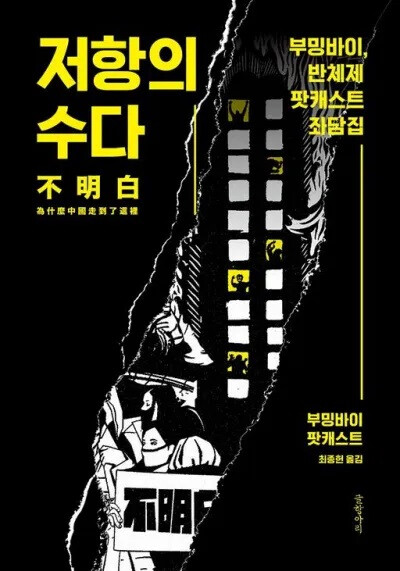
Rising Resentment: Uncensored Voices Expose China's Surveillance State

KO YONG-CHUL Reporter / Updated : 2025-12-11 09:10:05
  • -
  • +
  • Print


A new book, “Resistance Chatter” (저항의 수다 in Korean), based on the popular 'Bu Mingbai' (不明白 - 'I Don't Understand') podcast, has cast a stark light on the intensifying surveillance and growing popular discontent within China. The book, compiling conversations from the podcast co-founded in 2022 by a Chinese New York Times columnist and other Chinese journalists, paints a picture of a society where free expression is stifled and public dissent is bubbling beneath the surface.

The title, 'Bu Mingbai,' literally meaning "I don't understand," reflects the confusion and disbelief of ordinary Chinese citizens facing a torrent of incomprehensible events and policies. Though the podcast is blocked in mainland China, it has reportedly become essential listening for many seeking uncensored discussion on current affairs.

The Stranglehold of Surveillance

The book's sources assert that the current level of social control under President Xi Jinping’s regime is even more pervasive than during the Mao era, significantly strengthening following Xi's ascent to power in 2012 and subsequent pandemic-related lockdowns. The surveillance apparatus extends far beyond official channels. One professor quoted in the book estimates that at least one percent of China's population is engaged in constant monitoring and reporting on their neighbors and peers. These agents include not only official party and administrative staff but also a vast network of citizens recruited as 'spies.'

This chilling environment means that citizens in mainland China cannot freely criticize the state's policies or the supreme leader, Xi Jinping. The widespread use of cutting-edge technology, including facial recognition, DNA collection, and big data algorithms, has transformed China into what human rights groups have called a "dystopian digital surveillance state." Furthermore, the implementation of a "grid system" for neighborhood-level surveillance ensures systematic monitoring and immediate repression of potential unrest. This system is instrumental in the Chinese Communist Party's (CCP) ongoing goal of "stability maintenance," which prioritizes detecting and preventing protests and dissent.

Unrest and the Impulse for Expression

Despite the state’s rigorous control, public frustration is palpable. The book highlights the critical role of major public tragedies in amplifying this discontent. Incidents like the deadly Yangtze River cruise ship sinking, the Sichuan earthquake, and the Tianjin port explosion have repeatedly exposed the government’s priority of strict media and social media control to hide the truth and prevent criticism.

A powerful anecdote from the book recalls the memorial for the 2022 Urumqi apartment fire tragedy, where someone dared to shout the slogan, “CCP step down!” The shock and fear that rippled through the crowd underscore just how deep the self-censorship has become.

While state-run surveys often report overwhelming support for President Xi and the government, studies using anonymous methods reveal a much starker reality. When assured of anonymity, Chinese citizens' support for the party and government plummets by nearly 30 percentage points, and the fear of repression is acknowledged by an estimated 40% of the population as a major deterrent to protest. The suppressed criticism and simmering dissatisfaction voiced through 'Bu Mingbai' serve as a strong indication that "public sentiment is boiling," despite the CCP's comprehensive attempts to enforce silence.

[Copyright (c) Global Economic Times. All Rights Reserved.]

  • #Globaleconomictimes
  • #Korea
  • #Seoul
  • #Samsung
  • #LG
  • #Bitcoin
  • #Meta
  • #Business
  • #Economic
  • #The Woori Bank
KO YONG-CHUL Reporter
Reporter Page

Popular articles

  • Our Embassy met on Friday, May 29, with the Kkottongnae brothers, who run a nursing home in the city of Caacupé, to learn about their main activities and future plans.

  • Ambassador Hyuk-Sang Sohn participated on May 26 in the signing ceremony of the Discussion Memorandum

  • Personal Interest Engraved on the Dollar: Witnessing the Regression of American Democracy

I like it
Share
  • Facebook
  • X
  • Kakaotalk
  • LINE
  • BAND
  • NAVER
  • https://www.globaleconomictimes.kr/article/1065571758684135 Copy URL copied.
Comments >

Comments 0

Weekly Hot Issue

  • BYD Unveils First Plug-in Hybrid ‘Sealion 6’ in Korea, Targeting Eco-Friendly Market at 37.5 Million Won 
  • Kia’s Strategic Pivot: Accelerating Electrification Through SDV, PBV, and EREV Innovation
  • Devastating Twin Earthquakes Strike Venezuela: Death Toll Rises Amid Humanitarian Crisis
  • Hyundai Motor Prioritizes "Customer Experience" Over Pricing: Aiming for Lifelong Loyalty with the New Avante
  • South Korea's Path to Round of 32 Grows Perilous Following Australia-Paraguay Draw
  • The True Face of Our Politics After Stripping Away the Mask of Fairness

Most Viewed

1
[In-depth Report] The Islamic ‘Halal Barrier’ Just Around the Corner… The Silent Screams of K-Beauty SMEs
2
Asking about the Future of ‘Hangeul City Ulsan’… Special Lecture by Novelist Kim Jin-myung to be Held
3
Embassy of Pakistan in Seoul Hosts Commemorative Event for the 150th Birth Anniversary of Muhammad Ali Jinnah
4
KOSPI Hits Historic 9,300 Milestone as Market Cap Surpasses 8,000 Trillion Won
5
'K-Medicine' Sweep Drives Foreign Medical Spending in Korea to Record High of 250 Billion Won
광고문의
임시1
임시3
임시2

Hot Issue

Devastating Twin Earthquakes Strike Venezuela: Death Toll Rises Amid Humanitarian Crisis

Political Debates Spark Over Semiconductor "Windfall" Redistribution

Google Play Hosts 'ChangGoo Alumni Day' to Accelerate Global Expansion for 760 Korean Startups

Government Slashes Petroleum Price Caps by 150 Won per Liter amid Easing Middle East Tensions

Fashion Runway Show 2026

Global Economic Times
korocamia@naver.com
CEO : LEE YEON-SIL
Publisher : KO YONG-CHUL
Registration number : Seoul, A55681
Registration Date : 2024-10-24
Youth Protection Manager: KO YONG-CHUL
Singapore Headquarters
5A Woodlands Road #11-34 The Tennery. S'677728
Korean Branch
Phone : +82(0)10 4724 5264
#304, 6 Nonhyeon-ro 111-gil, Gangnam-gu, Seoul
Copyright © Global Economic Times All Rights Reserved
  • 향기네무료급식
  • BCB부천방송
  • 반달곰 프로젝트
Search
Category
  • All articles
  • Synthesis
  • World
  • Business
  • Industry
  • ICT
  • Distribution Economy
  • Well+Being
  • Travel
  • Eco-News
  • Education
  • Korean Wave News
  • Opinion
  • Arts&Culture
  • Sports
  • People & Life 
    • 전체
    • International Student Report
    • With Ambassador
  • Column 
    • 전체
    • Cho Kijo Column
    • Cherry Garden Story
    • Ko Yong-chul Column
    • Kim Seul-Ong Column
    • Lee Yeon-sil Column
  • Photo News
  • New Book Guide
  • Multicultural News
  • Jobs & Workers