![[등록] 2026-09-01 15:48:31](/support/_updata/banner2/tl181982910_6749.png)


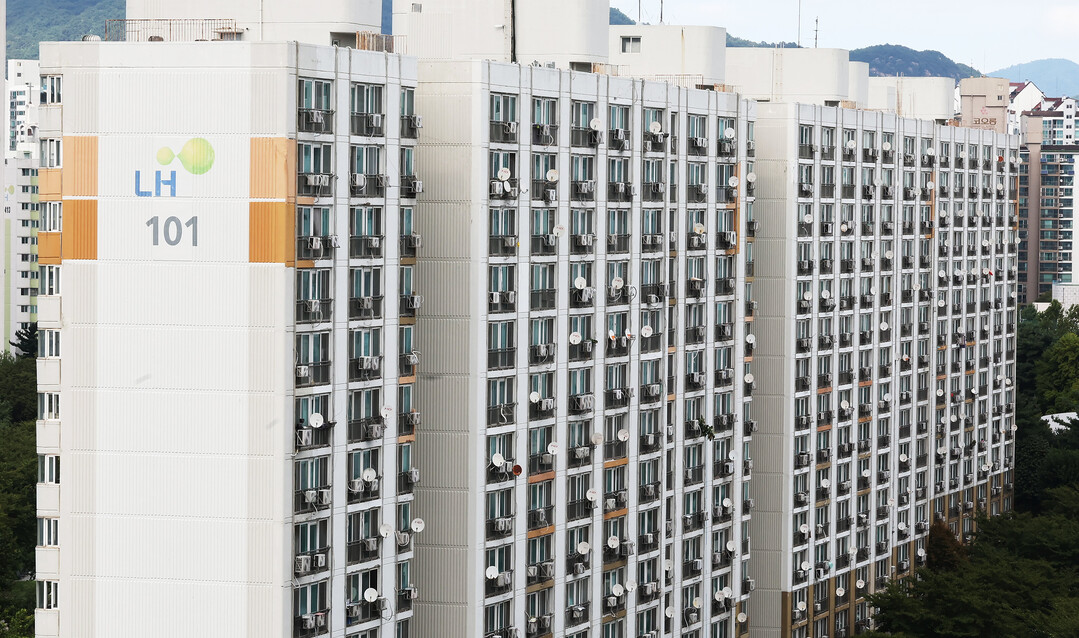
With 2,287 LH (Korea Land and Housing Corporation) public construction rental housing units remaining vacant for over six months in Gyeongnam Province, experts have suggested that government-expanded "maeip" (purchased-lease) rental housing must also be supplied by carefully considering regional demand, location, and housing size rather than just total supply volume. The rationale is that unless housing genuinely needed by target groups like young adults and newlyweds is supplied in the right locations, the mismatch between supply and demand—where public rentals increase yet tenants cannot be found—will only repeat.
On the morning of the 23rd, a policy seminar titled "Current Status and Tasks of Maeip Rental Housing for Housing Stability" was held at the 2nd Small Conference Room of the National Assembly Members' Hall in Yeouido, Seoul. The event was hosted by the office of National Assembly Member Song Young-gil (Democratic Party of Korea, Yeonsu-gu, Incheon) and jointly organized by the Korean Planners Association and the LH Land and Housing Institute.
Maeip rental housing, the main topic of the day, is a method where public entities like LH purchase existing housing or pre-contract to purchase housing built by the private sector to supply it as public rental housing. It has the advantage of enabling faster supply than developing new housing sites by utilizing existing downtown homes.
Nationwide, the stock of maeip rental housing has steadily grown from 40,880 units in 2010 to 82,298 units in 2015, 178,351 units in 2020, and 236,420 units in 2024. The government is continuing to expand supply focusing on young adults and newlyweds this year as well.
Attorney Lee Kang-hoon (Executive Committee Member of People’s Solidarity for Participatory Democracy), who presented on "Diagnosis and Outlook of Maeip Rental Housing Current Status," stated, "While expanding maeip housing is a necessary policy for the housing stability of urban low-income households and young adults, problems emerging during the supply process must be resolved together." Key examples include appropriate purchase prices, financial burdens, project periods, and mismatches between rental demand and supply.
In particular, Attorney Lee proposed the need for a system that verifies actual demand first before establishing supply plans. As grounds for this, he pointed out that there is currently no prospective tenant registry to properly grasp public rental housing demand, and that it is difficult to accurately know what types of public rental housing are wanted by age and region.
Attorney Lee suggested, "We need to create a prospective tenant registry to understand demand and establish supply plans tailored to those results, and we also need to rethink the method of excessively concentrating supply targets on young adults or newlyweds." He added that allocation criteria by type should be established by reflecting the demands of various classes such as general, elderly, and multi-child households, and that affordable prices and housing quality must be secured alongside supply expansion.
Long-Term Vacancies and Operational Challenges
This issue is closely connected not only to nationwide maeip rental housing but also to the long-term vacancy status of public rental housing. According to data received from LH by National Assembly Land, Infrastructure and Transport Committee Member Jang Jong-tae (Democratic Party of Korea, Seo-gu 갑, Daejeon), out of 56,981 LH construction rental housing units in Gyeongnam alone, 2,287 units have been vacant for six months or longer (as of the end of July). The vacancy rate stood at 4.0%, which is 0.1 percentage points higher than the national average of 3.9%.
A significant portion of these empty homes has been unable to find tenants for a long time. Among the 2,287 long-term vacancies of 6 months or more in Gyeongnam, 1,359 units (59.4%) have been vacant for a year or longer. Specifically, there are 893 units vacant for 1 year to under 2 years, 342 units for 2 years to under 3 years, and 124 units vacant for 3 years or more. There are as many as 466 units that have been empty for over two years. As such, statistics from Gyeongnam illustrate the common challenge that actual user demand, location, and housing size must be considered during the public rental supply process.
Lee Young-eun, a senior research fellow at the LH Land and Housing Institute who presented on "Diagnosis and Future Tasks of Customized Maeip Rental for Youth Downtown Residence," also emphasized a sustainable operational structure post-supply. She analyzed, "While customized maeip rental can provide housing spaces and diverse services targeting specific classes like youth, restrictions on non-rent revenue during operations alongside burdens of management fees, labor costs, and operational expenses can lower project sustainability."
Consequently, Researcher Lee views that a business structure allowing operating entities to continuously participate is necessary. She suggested establishing management systems such as selecting operating organizations, calculating operating costs, and conducting performance evaluations so that operating bodies take charge of asset management and operations, and diversifying supply entities.
Attorney Han Joong-seok diagnosed, "Since maeip rental involves the private sector supplying housing and the public sector purchasing and supplying it, it cannot function properly unless the private and public sectors cooperate. Institutional design is required to draw private participation while maintaining publicness."
Attorney Han emphasized, "To stably continue the supply of newly built maeip rentals, we must enhance the stability of purchase price calculation methods so that private operators can predict project costs and financial expenses, and improve conditions for business participation. Furthermore, we must design not only the supply volume, but also who is allocated what housing and how stably they can reside."
[Copyright (c) Global Economic Times. All Rights Reserved.]