
![[등록] 2026-09-01 15:48:31](/support/_updata/banner2/tl181982910_6749.png)


(C) Tha Star
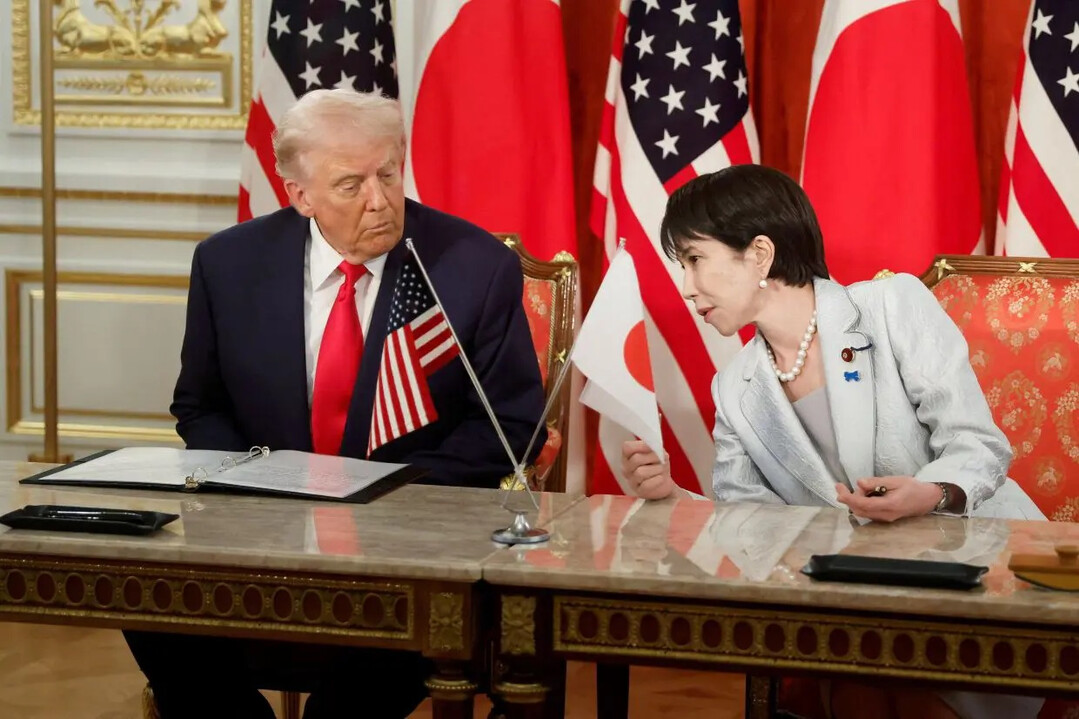
News that U.S. President Donald Trump delivered a nuanced message to Japanese Prime Minister Sanae Takaichi, advising her 'not to provoke China over the Taiwan issue,' has once again brought to the surface the emerging cracks in the U.S.-Japan alliance and the 'America First' foreign policy stance of the Trump administration. This incident occurred amid heightened Sino-Japanese tensions following Takaichi’s recent remarks regarding the possibility of Japan exercising collective self-defense in a Taiwan contingency. It is widely interpreted as the result of Trump’s pragmatic approach, which prioritizes trade agreements over the interests of his ally, Japan.
Call with Xi Jinping, a Prelude to Advice to Japan
Trump's advice is notable because it came immediately after an approximately one-hour phone call with Chinese President Xi Jinping the day before. According to reports from the U.S. daily Wall Street Journal (WSJ), President Xi reportedly dedicated about half of the call to asserting 'China's historical sovereignty over Taiwan' and emphasizing that 'the U.S. and China must jointly manage the global order.' Some U.S. officials stated that Xi was 'angry, and President Trump was listening,' suggesting that Trump felt strong pressure regarding Taiwan, which is a core Chinese interest.
Against this backdrop, during the subsequent call between Trump and Prime Minister Takaichi, Trump reportedly suggested that Takaichi 'needed to tone down the intensity' of her Taiwan-related comments. This was seen as a 'calming' measure following the escalation of diplomatic conflict between China and Japan, which was triggered by Takaichi’s statement in the Diet on the 7th that Japan could exercise collective self-defense rights in the event of a Chinese maritime blockade of Taiwan. China responded with vehement criticism directed at Takaichi and announced diplomatic retaliation, rapidly cooling Sino-Japanese relations.
The Foreign Policy Calculation: Prioritizing Trade Interests
The prevailing analysis suggests that the core reason Trump appeared to partially accommodate China's position rather than fully backing the traditional ally, Japan, lies in trade issues. White House officials expressed strong concern over China delaying its previously promised purchases of U.S. soybeans, a move interpreted as an attempt to appeal to voters in Republican strongholds with agricultural bases ahead of next year's mid-term elections.
Indeed, following his call with Xi, President Trump directly demanded that China "buy soybeans faster." China subsequently moved to appease the U.S. by purchasing $300 million (approximately 440 billion KRW) worth of soybeans. Trump justified improving relations with China through a statement, saying, "Getting along well with China is beneficial for both the United States and Japan," framing the improved relationship in practical terms of maintaining 'peace' and concluding a 'trade deal.'
Ally's Concern: Japan Feels Blindsided The U.S. side insisted that Trump's advice did not amount to pressure on Takaichi to retract her statement, but was merely 'advice.' It was also conveyed that President Trump understood the difficulties Takaichi faced in retracting the remarks politically within Japan.
However, Japanese government officials viewed Trump's remarks with 'concern,' according to the WSJ. This is because at a sensitive time of escalating Sino-Japanese conflict, the core ally, the U.S., appeared to partially align with China's 'cooperate with US, isolate Japan' (通美封日) strategy rather than offering unwavering support to Japan's position. This could foster a sense of being 'blindsided' in Japan, which had expected firm U.S. support on security issues fundamental to the U.S.-Japan alliance, and is likely to create subtle tension in the future security cooperation structure of the Asia-Pacific region. It is judged as an instance where the U.S. demonstrated its willingness to restrain an ally's stance on a critical geopolitical issue for the sake of trade benefits.
Taiwan Issue, The Core of the U.S.-China-Japan Triangular Conflict
This incident once again revealed how sensitive and sharp an 'Achilles' heel' the Taiwan issue is in the U.S.-China-Japan triangular relationship. Prime Minister Takaichi's remarks were the first instance where a sitting prime minister suggested the possibility of exercising collective self-defense by defining a 'Taiwan contingency' as a 'Situation that gravely affects Japan’s existence.' This extremely provoked China, which views Taiwan as its own territory, and served as the background for President Xi Jinping to push Japan as a remnant of 'militarism' during his call with Trump, urging the two countries to jointly safeguard the achievements of the World War II victory.
The U.S. weighing security cooperation with an ally against economic gains is expected to remind regional countries of U.S. 'strategic ambiguity,' and will likely have complex consequences for the stability of the Taiwan Strait and the regional security order going forward.
[Copyright (c) Global Economic Times. All Rights Reserved.]














