![[등록] 2026-09-01 15:48:31](/support/_updata/banner2/tl181982910_6749.png)


On June 21st (Saturday), military tensions in the Middle East reached an all-time high as the United States, in full coordination with Israel, conducted airstrikes on three major Iranian nuclear facilities (Fordow, Natanz, and Isfahan). The U.S. emphasized that these attacks were aimed at neutralizing Iran's nuclear weapons development capability and were not intended to target the Iranian people or overthrow the regime. However, Iran had previously warned of retaliation for attacks on its territory and cautioned that U.S. involvement could escalate into a full-scale regional war.
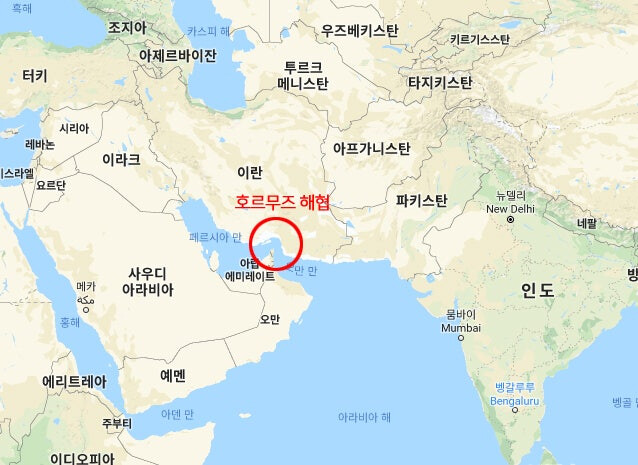
Immediately following the U.S. airstrikes, on June 22nd (Sunday), Iranian state media reported that the Iranian parliament had supported a measure to blockade the strategically vital Strait of Hormuz in response to the U.S. attack on its nuclear facilities. Although the final decision rests with Iran's Supreme National Security Council (SNSC) and Supreme Leader Ayatollah Ali Khamenei, the parliamentary support makes a blockade more likely than ever.
Strait of Hormuz, the Heart of the World's Energy Artery
The Strait of Hormuz is a narrow waterway connecting Iran and Oman, linking the Persian Gulf to the open sea. Approximately 30% of the world's seaborne oil shipments and about 20% of liquefied natural gas (LNG) seaborne transport pass through this strait. Europe imports oil and LNG from Gulf countries such as Saudi Arabia, Qatar, and the United Arab Emirates (UAE), with most of these shipments transiting via the Strait of Hormuz. South Korea, too, relies heavily on Middle Eastern energy, with about 70% of its imported oil passing through this strait, underscoring the world's major nations' significant dependence on Middle Eastern energy.
The shallow depth of the strait and the limited sea lanes for large oil tankers mean that Iran effectively has control over the strait. Even if a traditional "blockade" is difficult, Iran's closure of the strait's waterways to commercial traffic could paralyze global maritime transport.
Anticipated Ripple Effects of a Blockade: Global Economic Chaos
Deepening Energy Crisis: If the Strait of Hormuz is blockaded, international oil prices will undoubtedly skyrocket. Severe disruptions to global oil and natural gas supply chains would lead to an unprecedented energy shortage worldwide, particularly in Europe. Countries highly dependent on Middle Eastern fuel could face economic paralysis. A sharp rise in oil prices would fuel overall price increases (inflation) and increase energy costs, causing immense disruption across industries.
Global Supply Chain Disruption: Beyond oil, the Strait of Hormuz is a major route for global maritime transport. Disruptions to maritime traffic could fatally impact global supply chains by delaying imports of raw materials, electronics, and consumer goods. Soaring shipping insurance premiums would increase costs for European businesses and consumers, likely leading to a global economic recession.
U.S. Warnings and International Reactions
The United States has strongly warned against an Iranian blockade of the Strait of Hormuz. On June 22nd (local time), U.S. Secretary of State Marco Rubio appeared on CBS's "Face the Nation," stating that a Strait of Hormuz blockade would be a "suicidal act that would turn the whole world against them" and that the Iranian navy would be annihilated. Former U.S. Central Command Commander Frank McKenzie also emphasized that while Iran has the capability to lay mines, the U.S. military has clear plans to remove them, and after a temporary disruption to commercial activity, the strait would reopen.
The U.S. stated that the recent airstrikes aimed to neutralize Iran's nuclear weapons development capability and that the door to diplomatic solutions remains open. Secretary Rubio warned that if Iran chooses the path of dialogue, the U.S. would respond immediately, but if it chooses another path, there would be consequences. Furthermore, the U.S. made it clear that the reason for stationing 40,000 troops and operating several bases in the Middle East is to "absolutely protect U.S. citizens and interests."
Immediately after the U.S. attack on Iranian nuclear facilities, two very large crude carriers (VLCCs), the Coswisdom Lake and South Royalty, which were entering the Strait of Hormuz from the Persian Gulf, changed their routes and turned back to avoid danger. This demonstrates the immediate reaction of the international shipping industry to the possibility of a Strait of Hormuz blockade.
The Greek Ministry of Shipping, which holds the world's largest tanker fleet, advised ship owners and shipping companies planning to transit the Strait of Hormuz to reconsider their routes and await in nearby safe ports. The U.S.-led multinational coalition, the Joint Maritime Information Center (JMIC), strongly advised U.S.-affiliated shipping companies to exercise "extreme caution and consider potential route changes."
Currently, the international community is keenly watching Iran's final decision. A blockade of the Strait of Hormuz is a massive variable that could bring unpredictable shocks to the global economy, beyond just a regional conflict. The fate of both Middle East geopolitics and the global economy is likely to be determined by the Iranian Supreme National Security Council's final decision.
[Copyright (c) Global Economic Times. All Rights Reserved.]