• 2026.08.11 (Tue)
  • All articles
  • LOGIN
  • JOIN
Global Economic Times
fashionrunwayshow2026
  • Synthesis
  • World
  • Business
  • Industry
  • ICT
  • Distribution Economy
  • Well+Being
  • Travel
  • Eco-News
  • Education
  • Korean Wave News
  • Opinion
  • Arts&Culture
  • Sports
  • People & Life
    • International Student Report
    • With Ambassador
  • Column
    • Cho Kijo Column
    • Cherry Garden Story
    • Ko Yong-chul Column
    • Kim Seul-Ong Column
    • Lee Yeon-sil Column
  • Photo News
  • New Book Guide
MENU
 
Home > Industry

POSTECH Researchers Double Metal-Polymer Adhesion via 3D Printing Surface Control

Global Economic Times Reporter / Updated : 2026-05-08 12:13:26
  • -
  • +
  • Print


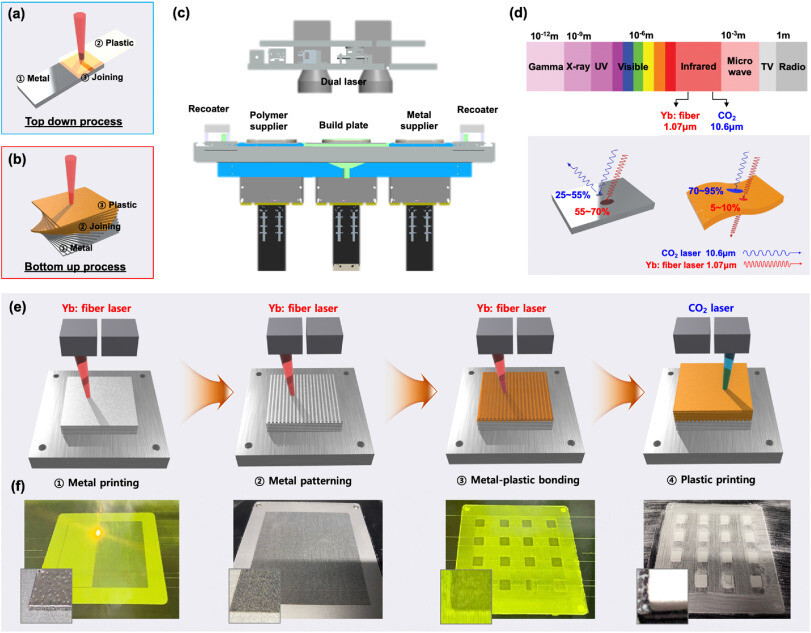
POHANG, South Korea — A research team at the Pohang University of Science and Technology (POSTECH) has achieved a breakthrough in material science by turning a common manufacturing defect into a functional advantage. Led by Professor Hyoung Seop Kim from the Graduate School of Green Materials and Energy, the team has developed a technique to double the adhesion strength between metals and polymers by precisely controlling surface roughness during the 3D printing process.

The "Velcro" Effect: Rethinking Surface Roughness
In traditional additive manufacturing, the "roughness" or uneven surface created by melting metal powder with lasers (Laser Beam Powder Bed Fusion, or PBF-LB/M) is typically viewed as a defect that requires costly post-processing to smooth out. However, the POSTECH team viewed these microscopic peaks and valleys as a "programmable element" rather than a flaw.

By meticulously adjusting laser power, scanning speed, and hatch spacing, the researchers successfully controlled the surface roughness of titanium alloys within a range of 20 to 70 micrometers ($mu m$). This allows for "spatial surface design," where different areas of a single component can have varying degrees of grip.

When a liquid polymer, such as Polydimethylsiloxane (PDMS), is applied to these engineered surfaces, it seeps into the microscopic crevices. As it solidifies, it creates a mechanical "interlocking" structure—much like the hook-and-loop mechanism of Velcro. This physical bond, combined with the increased surface area, resulted in an adhesion strength more than 200% higher than that of smooth surfaces.

Why It Matters: Hybrid Structures Without Chemicals
The ability to fuse rigid metals with flexible polymers is a "Holy Grail" for several high-tech industries:

Soft Robotics: Creating robots with rigid internal frameworks and flexible "skin" or actuators.
Medical Devices: Developing implants that require a firm metal base but must integrate seamlessly with soft human tissue.
Aerospace & Automotive: Reducing vehicle weight by replacing heavy bolts with integrated metal-polymer hybrid parts.
Traditionally, joining these disparate materials required complex chemical treatments or toxic primers, which are often difficult to apply to complex 3D shapes. The POSTECH method eliminates these steps, offering a cleaner, more streamlined production route for multi-material structures.

Global Recognition and Future Impact
"The core of this research is that we can significantly enhance bonding performance simply by managing the textures that naturally occur during 3D printing," noted Professors Anna Lee and Dong-Sik Kim of the Department of Mechanical Engineering.

Professor Hyoung Seop Kim added that this technology opens new doors for "hybrid structural design," allowing engineers to customize the bonding strength of different sections within a single integrated part.

The study, supported by the National Research Foundation of Korea and the Ministry of Science and ICT, was recently published in Virtual and Physical Prototyping, a leading international journal in manufacturing and production engineering. As 3D printing moves toward mass production, this "innovation through imperfection" is expected to set a new standard for how we build the machines of tomorrow.

[Copyright (c) Global Economic Times. All Rights Reserved.]

  • #Hormuz Impasse
  • #globaleconomictimes
  • #micorea
  • #mykorea
  • #nammidonganews
  • #singaporenewsk
  • #Samsung
  • #Daewoo
  • #Hyos
Global Economic Times Reporter
Reporter Page

Popular articles

  • Planting Hope: Ethiopia’s Green Legacy and the Power of National Transformation

  • OpenAI Rebounds in Secondary Market as Valuation Surges 20% in Three Months

  • Google Cloud Deploys ‘Gemini Enterprise’ to Samsung Electronics DX Division

I like it
Share
  • Facebook
  • X
  • Kakaotalk
  • LINE
  • BAND
  • NAVER
  • https://www.globaleconomictimes.kr/article/1065582637770695 Copy URL copied.
Comments >

Comments 0

Weekly Hot Issue

  • Riot Games Hosts Largest-Ever TFT Festival at The Hyundai Seoul to Launch 'Sylvan Secrets' Set
  • MINISTRY OF EMPLOYMENT AND LABOR DIRECTS IMMEDIATE EXPANSION OF REST FACILITIES AT GIMPO AIRPORT AFTER UNANNOUNCED HEATWAVE INSPECTION
  • XAVIS Secures Contract to Supply Advanced X-Ray Inspection Systems to European Lines of Global Food Sauce Brand
  • Emma Expands Collaboration with Interior Design Experts to Present Sleep Space Solutions
  • Trump Criticizes U.S. Congressional AI Regulations as Threat to Tech Industry
  • Memory Chips Become Dominant Force in Global Semiconductor Industry, Expected to Account for 60% of Total Market This Year

Most Viewed

1
Planting Hope: Ethiopia’s Green Legacy and the Power of National Transformation
2
Japan Estimated to Have Spent ¥6–7 Trillion in Fresh Yen-Buying Intervention as US Joint Action Hints Emerge
3
The 16th Ethiopia-gil World Festival & Meskel Festival
4
South Korea’s Top Three Mobile Carriers Launch Pre-Orders for Samsung’s Galaxy Z Series with Aggressive Subsidies and Service Bundles
5
KT and Amorepacific Complete ‘Data Highway’ Project, Unveiling AI-Specialized Research Platform
광고문의
임시1
임시3
임시2

Hot Issue

MINISTRY OF EMPLOYMENT AND LABOR DIRECTS IMMEDIATE EXPANSION OF REST FACILITIES AT GIMPO AIRPORT AFTER UNANNOUNCED HEATWAVE INSPECTION

Riot Games Hosts Largest-Ever TFT Festival at The Hyundai Seoul to Launch 'Sylvan Secrets' Set

Nable Communications Secures 5G Private Network Upgrade Deal with LG Uplus

Ansan City Pay-as-You-Throw Trash Bag Abandoned in Japan Sparks Controversy in Kamikochi

Fashion Runway Show 2026

Global Economic Times
korocamia@naver.com
CEO : LEE YEON-SIL
Publisher : KO YONG-CHUL
Registration number : Seoul, A55681
Registration Date : 2024-10-24
Youth Protection Manager: KO YONG-CHUL
Singapore Headquarters
5A Woodlands Road #11-34 The Tennery. S'677728
Korean Branch
Phone : +82(0)10 4724 5264
#304, 6 Nonhyeon-ro 111-gil, Gangnam-gu, Seoul
Copyright © Global Economic Times All Rights Reserved
  • 향기네무료급식
  • BCB부천방송
  • 반달곰 프로젝트
Search
Category
  • All articles
  • Synthesis
  • World
  • Business
  • Industry
  • ICT
  • Distribution Economy
  • Well+Being
  • Travel
  • Eco-News
  • Education
  • Korean Wave News
  • Opinion
  • Arts&Culture
  • Sports
  • People & Life 
    • 전체
    • International Student Report
    • With Ambassador
  • Column 
    • 전체
    • Cho Kijo Column
    • Cherry Garden Story
    • Ko Yong-chul Column
    • Kim Seul-Ong Column
    • Lee Yeon-sil Column
  • Photo News
  • New Book Guide
  • Multicultural News
  • Jobs & Workers