• 2026.03.22 (Sun)
  • All articles
  • LOGIN
  • JOIN
Global Economic Times
fashionrunwayshow2026
  • Synthesis
  • World
  • Business
  • Industry
  • ICT
  • Distribution Economy
  • Well+Being
  • Travel
  • Eco-News
  • Education
  • Korean Wave News
  • Opinion
  • Arts&Culture
  • Sports
  • People & Life
    • International Student Report
    • With Ambassador
  • Column
    • Cho Kijo Column
    • Cherry Garden Story
    • Ko Yong-chul Column
    • Kim Seul-Ong Column
    • Lee Yeon-sil Column
  • Photo News
  • New Book Guide
MENU
 
Home > Industry

A New Approach to Workplace Safety: Balancing Enforcement and Prevention

Hwang Sujin Reporter / Updated : 2025-08-20 12:23:04
  • -
  • +
  • Print


The South Korean government, under the strong leadership of President Lee Jae-myung, is considering new and stringent penalties for companies that repeatedly cause fatal industrial accidents. Measures under review include license revocation, business suspension, and expanded financial penalties for safety violations. This hardline stance, however, is raising concerns among businesses, particularly small and medium-sized enterprises (SMEs), who argue that a focus solely on punishment could be counterproductive.

The Government's New Stance on Industrial Accidents 

President Lee Jae-myung recently declared that "workplaces where people go to live should never become places of death." He characterized accidents resulting from inadequate safety measures as "murder through negligence or social murder," emphasizing the need for robust penalties that make safety violations financially painful.

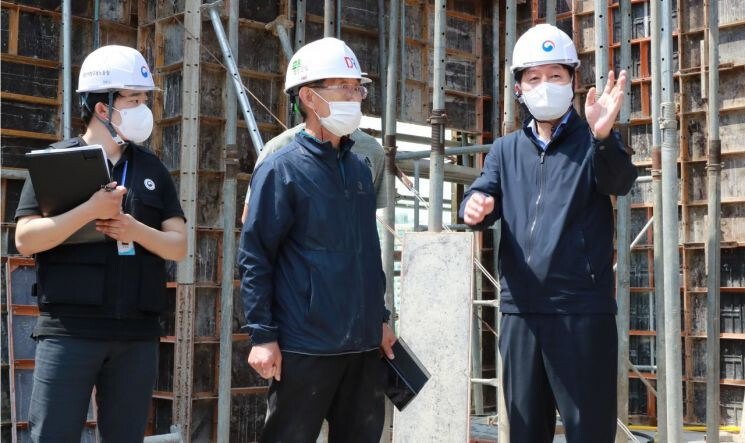
This policy direction is being spearheaded by Vice Minister of Employment and Labor, Kwon Chang-jun. At a recent press conference, he outlined plans to institutionalize tougher penalties by revising the Industrial Safety and Health Act. The proposed changes would:

Expand Economic Sanctions: Introduce fines and administrative penalties for safety and health violations.
Widen the Scope of Penalties: Broaden the criteria for business suspension and bidding restrictions from the current "two or more simultaneous deaths" to "multiple deaths in a year."
Introduce License Revocation: Create new regulations to request the revocation of a construction company's license if a fatal accident recurs after a business suspension request.
In addition to these stricter measures, the government plans to enhance on-site inspections by expanding the workforce and granting local governments authority over labor supervision. They are also considering requiring companies to disclose accident statistics and prevention plans, particularly for subcontractors, to curb the "outsourcing of risk."

The Call for a Balanced Approach 

While acknowledging the government's good intentions, the business community, particularly SMEs, believes that a punishment-only approach is not the ultimate solution. These smaller companies often lack the financial resources and manpower to meet strict new regulations, and they warn that such a policy could push safety issues underground.

Experts and industry leaders are advocating for a "two-track approach" that balances stricter enforcement with a stronger focus on prevention. At a recent forum on industrial accident prevention, Professor Jeong Jin-woo of Seoul National University of Science and Technology stated that the most successful countries in accident prevention "are not defined by the severity of their penalties, but by the robustness of their prevention systems." He argued that fostering companies' ability to improve safety on their own is a more effective long-term strategy.

Professor Seo Yong-yoon of Dongguk University echoed this sentiment, suggesting that a strict, regulation-heavy approach will have limited effect on SMEs struggling for survival. He proposed that the government offer incentives and rewards to motivate companies to prioritize safety and create a unified, cross-ministry support system to help them build their safety capabilities.

In conclusion, industry insiders believe that a truly effective strategy would combine stronger penalties for egregious violations with robust, prevention-focused support for businesses. They argue that this approach would not only increase accountability but also foster a culture where companies view investment in safety as a competitive advantage.

[Copyright (c) Global Economic Times. All Rights Reserved.]

  • #globaleconomictimes
  • #micorea
  • #mykorea
  • #Lifeplaza
  • #nammidonganews
  • #singaporenewsk
  • #Samsung
  • #Daewoo
  • #Hyosung
  • #A
Hwang Sujin Reporter

Popular articles

  • IVE Sheds "Princess" Persona for Darker Horizon with 2nd Full-Length Album 'REVIVE+'

  • BLACKPINK Becomes First Artist to Surpass 100 Million YouTube Subscribers, Receiving the ‘Red Diamond’ Award

  • Kim Jong-un Signals "New Leap Forward" at 9th Party Congress, Buoyed by Strengthening Russia Ties

I like it
Share
  • Facebook
  • X
  • Kakaotalk
  • LINE
  • BAND
  • NAVER
  • https://www.globaleconomictimes.kr/article/1065583286483629 Copy URL copied.
Comments >

Comments 0

Weekly Hot Issue

  • Coway Clinches Top Honor at "Water Taste Awards" for 7th Consecutive Year
  • HP Targets Korea as Strategic Hub for 'Edge AI' Expansion, Seeking Startup Partnerships
  • Pearl Abyss’s 'Crimson Desert' Shatters Records with 2 Million Copies Sold on Day One
  • "BTS Over Books?" Indian Academies Issue Emergency Notices as Students Plot Mass Absences for Comeback Live
  • Naver to Shut Down Men's Fashion Service 'MR.' to Launch Expanded AI-Driven Fashion Platform
  • JBNU and SKKU Researchers Achieve Breakthrough in "Dream Material" MXene, Setting New World Records in Performance

Most Viewed

1
An Open Letter to BTS On the Eve of a Historic Performance
2
From Industrial Capital to Tourism Mecca... Ulsan Makes a Bold Move with ‘Experiential Content’ in 2026
3
Ko Sang-goo, President of World Federation of Korean Associations, Elected as First Private Sector Chair of World Korean Community Leaders Convention
4
It is Time for BTS’s Fandom, ARMY, to Step Forward
5
Korean Stock Market Plunges: Circuit Breaker and Sidecar Triggered Amid Geopolitical Crisis
광고문의
임시1
임시3
임시2

Hot Issue

Vishay Unveils Ultra-Compact 0404 RGB LED with Independent Chip Control for Enhanced Color Precision

Coway Clinches Top Honor at "Water Taste Awards" for 7th Consecutive Year

AI Medical Ecosystem in Focus: KIMES 2026 Opens in Seoul as Global Healthcare Hub

Netanyahu Declares Decisive Blow to Iran’s Nuclear and Missile Programs, Signals Early End to War

Let’s recycle the old blankets in Jeju Island’s closet instead of incinerating them.

Global Economic Times
korocamia@naver.com
CEO : LEE YEON-SIL
Publisher : KO YONG-CHUL
Registration number : Seoul, A55681
Registration Date : 2024-10-24
Youth Protection Manager: KO YONG-CHUL
Singapore Headquarters
5A Woodlands Road #11-34 The Tennery. S'677728
Korean Branch
Phone : +82(0)10 4724 5264
#304, 6 Nonhyeon-ro 111-gil, Gangnam-gu, Seoul
Copyright © Global Economic Times All Rights Reserved
  • 에이펙2025
  • APEC2025가이드북TV
  • 독도는우리땅
Search
Category
  • All articles
  • Synthesis
  • World
  • Business
  • Industry
  • ICT
  • Distribution Economy
  • Well+Being
  • Travel
  • Eco-News
  • Education
  • Korean Wave News
  • Opinion
  • Arts&Culture
  • Sports
  • People & Life 
    • 전체
    • International Student Report
    • With Ambassador
  • Column 
    • 전체
    • Cho Kijo Column
    • Cherry Garden Story
    • Ko Yong-chul Column
    • Kim Seul-Ong Column
    • Lee Yeon-sil Column
  • Photo News
  • New Book Guide
  • Multicultural News
  • Jobs & Workers