![[등록] 2026-09-01 15:48:31](/support/_updata/banner2/tl181982910_6749.png)


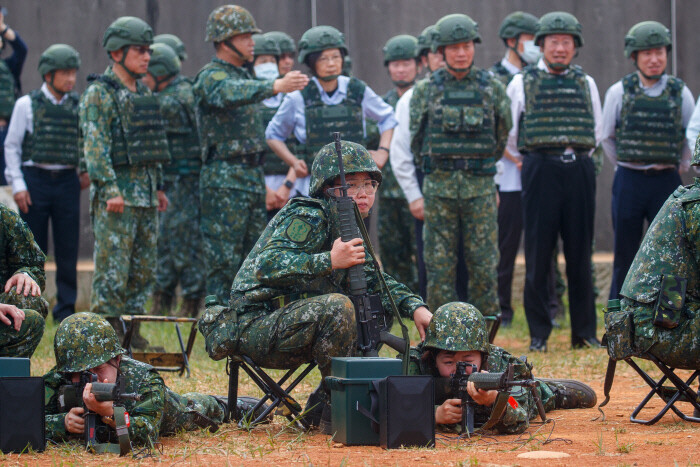
TAIPEI, Taiwan – Amid escalating military tensions in the Taiwan Strait, Taiwan's reservist forces are reportedly intensifying live-fire drills based on the US military's urban warfare engagement rules. This move is seen as an effort to bolster defensive capabilities against the potential threat of a Chinese invasion of Taiwan.
Full Implementation of 'US-Style Urban Warfare Training' Synergizes with New Reservist System
Taiwanese local media outlets, including the China Times, reported on June 2nd that Taiwan's reservists are now undergoing rigorous 14-day live-fire training sessions once every two years, as part of the new reservist mobilization training system fully implemented this year. A key aspect of this training is the introduction of 'US-style urban warfare training,' which involves learning US urban combat doctrines and applying them in actual residential environments.
According to anonymous sources, reservists, after mastering US urban warfare doctrines, are divided into defending forces and simulated enemy forces (opposition forces) to conduct drills in real residential areas. Moving beyond past training methods confined to military bases, the drills now involve moving to and deploying in tactically important locations for enhanced practical response capabilities, including eating and sleeping on-site, simulating actual combat conditions.
Given Taiwan's high population and housing density, urban warfare holds significant importance. Accordingly, reservist training now includes various forms of shooting drills, with an increased emphasis on practical skills such as establishing strongholds, which were not previously covered. This indicates Taiwan's efforts to enhance its defense strategies against potential threats.
China's Order to Develop Taiwan Invasion Capability; US Intelligence Warnings
Taiwan's proactive measures are closely related to the persistent concerns regarding a potential Chinese invasion of Taiwan. Previously, US intelligence agencies revealed that Chinese President Xi Jinping had instructed his military to be capable of invading Taiwan by 2027. This has been a major factor escalating international concerns about Taiwan's security.
Indeed, reports from the US think tank Institute for the Study of War (ISW) indicate that the Chinese military has been secretly constructing specialized facilities to simulate urban military operations, primarily in the Eastern Theater Command, which oversees the Taiwan Strait, and has been continuously honing its combat proficiency through training. This demonstrates China's ongoing efforts to refine its personnel and tactics in preparation for potential urban warfare scenarios during a Taiwan invasion.
Taiwan's Efforts to Strengthen Defense: New Fighter Jet Introductions and US Support
Taiwan is also accelerating its own defense buildup in response to the Chinese threat. The US-made F-5E/F Tiger fighter jets, which have played a crucial role in defending Taiwan's airspace for the past half-century, are scheduled to be retired at the end of this month. Their missions will be taken over by state-of-the-art fighter jets such as the F-16V.
The F-16V is a significantly upgraded version of the original F-16, equipped with the latest radar and avionics, greatly improving its detection and engagement capabilities. Taiwan received approval from the US in 2019 to purchase 66 new F-16V fighter jets and is expected to receive all aircraft by 2026. This is a crucial step to modernize Taiwan's air force and effectively counter the threat from the Chinese air force.
Additionally, Taiwan is strengthening its overall defense capabilities through various means, including independently building submarines to enhance its naval power. US military assistance to Taiwan also continues. Under the Taiwan Relations Act, the US is committed to providing Taiwan with defensive capabilities and has recently strengthened practical support by accelerating military sales to Taiwan and expanding joint exercises.
The Future of the Taiwan Strait: Heightened Tensions in a Complex Security Environment
The security environment in the Taiwan Strait remains complex and unstable. China considers Taiwan an inseparable part of its territory and firmly adheres to the 'One China' principle. In contrast, Taiwan, as a democratic nation, seeks to maintain its independent identity. This fundamental difference in positions is a primary cause of military tension.
While the United States maintains a policy of 'strategic ambiguity,' not explicitly stating its stance on intervention in Taiwan, it effectively supports Taiwan's defense capabilities and security. Neighboring countries such as Japan and the Philippines also show deep interest in the stability of the Taiwan Strait and are closely monitoring related developments.
The introduction of 'US-style urban warfare training' for Taiwan's reservists exemplifies Taiwan's commitment to not only bolstering its military but also significantly enhancing its tactical preparedness for actual combat situations. This is seen as a clear affirmation of its defensive will against a potential Chinese invasion, as well as a realistic measure to minimize casualties and effectively resist in the event of an emergency. Tensions surrounding the Taiwan Strait are expected to continue for some time, making diplomatic efforts and military preparedness among regional countries even more crucial.
[Copyright (c) Global Economic Times. All Rights Reserved.]