![[등록] 2026-09-01 15:48:31](/support/_updata/banner2/tl181982910_6749.png)


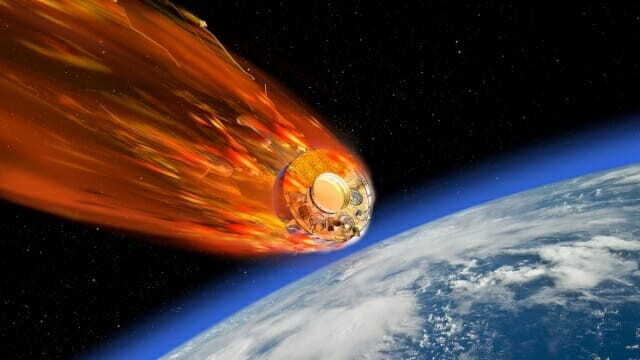
The Korea Aerospace Administration (KASA) has officially confirmed that the Russian (formerly Soviet) Venus probe lander, Cosmos 482, which was launched in 1972, made its final descent into the South Pacific Ocean west of the southern tip of Chile at approximately 2:30 PM Korean time on May 10th. After drifting in Earth's orbit for over half a century, the remnants of the probe are believed to have mostly burned up during its re-entry into the Earth's atmosphere.
Cosmos 482 was a descent module designed by the Soviet Union for Venus exploration, launched alongside its mothership on March 31, 1972. However, shortly after launch, a premature engine malfunction on the mothership prevented it from reaching Venus orbit, leaving the lander stranded in Earth's orbit. For the subsequent 53 years, this lander circled the Earth, gradually losing altitude until it was pulled back into the atmosphere by Earth's gravity.
KASA had been aware of the potential for Cosmos 482's re-entry and proactively announced its predicted trajectory on the morning of May 9th, closely monitoring the situation. Based on precise analysis from the Korea Astronomy and Space Science Institute (KASI), a specialized space risk surveillance agency, the estimated time of the crash was predicted with a margin of error, and it was assured that the probe's path would not cross the Korean Peninsula, alleviating public concerns.
The prediction process highlighted the exceptional technical capabilities of KASI. According to a KASA official, "Observation data from the OWL-Net (Optical Wide-field patroL Network) telescopes in Morocco (Unit 2) and the United States (Unit 4), operated by KASI, allowed us to pinpoint the precise re-entry time about seven hours before it occurred, at 8:00 AM that day." This analysis preceded information from the U.S. Space Command (CSpOC), demonstrating South Korea's internationally competitive space surveillance capabilities.
Cosmos 482 was designed to study the atmosphere and surface of Venus. Following its separation from the mothership after reaching Venus orbit, it was intended to enter the Venusian atmosphere and conduct various scientific observations. However, the engine failure thwarted these plans. Despite not achieving its original mission of exploring Venus, the probe potentially provided valuable data about the space environment during its extended time in Earth's orbit.
This crash marks a natural end-of-life scenario for an artificial space object that resided in Earth's orbit for over five decades. Experts explain that while most objects re-entering the atmosphere are destroyed by frictional heat, the possibility of some debris reaching the Earth's surface cannot be entirely ruled out. However, in the case of Cosmos 482, the relatively small size of the descent module and its predicted crash location over the sparsely populated South Pacific Ocean significantly minimized the risk of damage to life or property.
This event serves as a reminder of the long-term implications of failed space missions and the potential impact of space debris on the Earth's environment. With numerous satellites and space probe remnants continuing to orbit the Earth, ongoing monitoring, prediction, and preparation for potential risks are becoming increasingly crucial.
The swift and accurate re-entry prediction and information dissemination by KASA and KASI are credited with minimizing public anxiety and raising awareness about space risks. Continued efforts to enhance South Korea's space surveillance capabilities and engage in international cooperation will be essential for ensuring the safety of the space environment.
The crash of Cosmos 482 reflects a chapter in the ambitious Venus exploration plans of the former Soviet Union and simultaneously highlights both the triumphs and setbacks of space exploration. Having completed its 53-year journey, the aging probe's final plunge into the Pacific Ocean will remain a part of the historical narrative of humanity's relentless pursuit of the cosmos.
[Copyright (c) Global Economic Times. All Rights Reserved.]