![[등록] 2026-09-01 15:48:31](/support/_updata/banner2/tl181982910_6749.png)


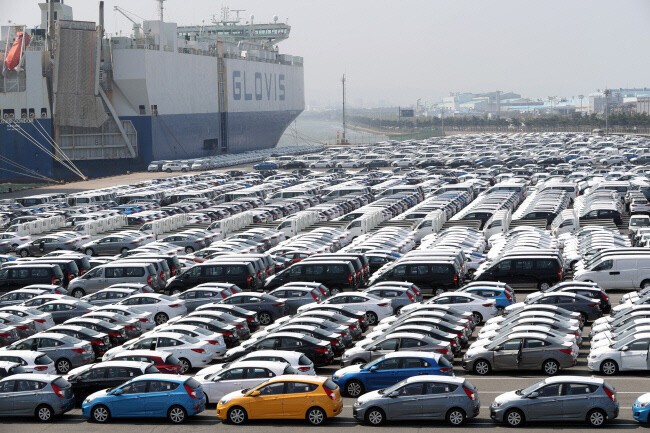
The impact of the "Trump tariffs" has begun to significantly affect South Korean automotive exports to the United States, with figures released by the Ministry of Trade, Industry and Energy (MOTIE) on Tuesday revealing a near 20% year-on-year decline in export value for April.
According to MOTIE's "April Automotive Industry Trends," South Korea's total automotive exports reached $6.53 billion in April 2025. This represents a 3.8% decrease compared to April of the previous year. When considering the cumulative figures for the first four months of the year, total exports amounted to $23.82 billion, a 2% drop from the same period in 2024.
In terms of volume, the decline in exports was also evident. April saw 246,924 units shipped overseas, an 8.8% decrease from the previous April. The total export volume for the January-April period stood at 920,000 units, marking a 4% reduction year-on-year.
The primary driver behind this downturn is the significant contraction in exports to the United States, South Korea's largest automotive market. The value of vehicles exported to the US in April amounted to $2.89 billion, a substantial 19.6% decrease compared to the same month last year. This near one-fifth reduction underscores the severity of the impact.
Analysts attribute this sharp decline primarily to the 25% tariff imposed by the Trump administration on imported vehicles from South Korea, which took effect on May 3rd. While the April figures only partially reflect this new tariff regime, the significant drop suggests its immediate and substantial impact. Furthermore, the recent commencement of operations at Hyundai Motor Group's Metaplant America in Georgia, a state-of-the-art electric vehicle and battery manufacturing facility, is also likely contributing to the decrease in US-bound exports as more vehicles are produced locally.
A MOTIE official commented on the decline in US-bound shipments, stating, "The full-fledged implementation of US tariffs and the 본격적인 operation of Hyundai Motor Group's new plant in Georgia are the main factors behind this decrease."
Despite the slump in US exports, gains in other key markets partially offset the losses. Exports to the European Union saw a significant 26.7% increase in April, driven by the popularity of models like the Kia EV3 and the Casper EV. Additionally, South Korean automakers have benefited from increased demand in Syria's used car market following the easing of international sanctions. Exports to Europe, the Middle East, and Asia experienced robust growth rates of 11.6%, 4.5%, and 53.9% respectively compared to April 2024.
Domestically, the South Korean automotive market showed resilience, with sales increasing by 6.7% year-on-year to 151,000 units in April. Notably, the surge in demand for electric vehicles (EVs) and hybrid vehicles was a key feature, with sales increasing by 50.3% and 29.9% respectively compared to the previous year. EVs and hybrids accounted for a significant 46% of all domestic sales in April, reflecting a growing consumer preference for more environmentally friendly vehicles.
Overall vehicle production in South Korea saw a modest decrease of 2.2% year-on-year to 386,000 units. The increase in domestic sales and strong export performance in regions outside North America helped to mitigate a larger decline in production.
Interestingly, exports of auto parts to the United States saw a slight increase of 3.5% in April, reaching $2.03 billion. This increase likely reflects existing orders and shipments made before the full impact of the parts tariffs, which also took effect on May 3rd, are fully reflected in the trade statistics. The coming months will be crucial in assessing the broader and longer-term consequences of the US tariffs on both vehicle and auto parts exports from South Korea.
[Copyright (c) Global Economic Times. All Rights Reserved.]