
![[등록] 2026-09-01 15:48:31](/support/_updata/banner2/tl181982910_6749.png)


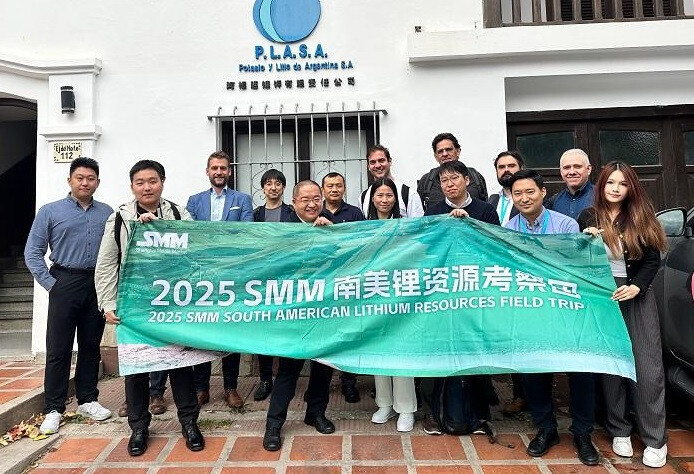
On May 31, 2025, the Shanghai Metals Market (SMM) visited Argentina Lithium & Potash Co., Ltd., effectively controlled by Tibet Summit Resources Co., Ltd., as the fourth stop of its 2025 South American Lithium Resource Field Trip, engaging in in-depth discussions. This visit garnered significant attention amidst the drastic fluctuations in lithium prices, especially as the bright prospects of the new energy industry and the importance of lithium resources continue to be highlighted.
The Importance of the 'Lithium Triangle' and SMM's Field Trip
South America boasts the world's most abundant lithium resources, primarily concentrated in the 'Lithium Triangle' region (Bolivia, Argentina, and Chile), which accounts for over 55% of global lithium reserves. Against this backdrop, SMM, led by Chen Siyu, SMM Overseas South American Lithium Resources Field Trip Project Manager, and Zhou Zhicheng, Senior Analyst for New Energy and Lithium Batteries, visited various lithium-related companies in South America from May 15 to 26. The trip focused on touring local lithium mines and material companies, engaging in in-depth discussions with corporate executives to explore potential opportunities in lithium mine resource development, technological exchange, and investment cooperation.
Tibet Summit Resources: A Successful Implementation of the 'Belt and Road' Strategy
Tibet Summit Resources, visited by the SMM delegation, is positioned in the upstream sector of the non-ferrous metal resource industry. Its lead-zinc polymetallic mine in Tajikistan has become a benchmark for successful Chinese enterprise investment under the 'Belt and Road' Initiative. Particularly in Argentina, the company has invested in upstream lithium brine lake development projects for the new energy industry, achieving continuous transformation and upgrading, thus growing into one of the leading enterprises in the mining resource development sector in the securities market.
In April 2018, Tibet Summit partnered with financial investors to acquire and privatize a Canadian-listed company for $206.7 million, securing full ownership of two lithium brine lake projects in Argentina. This marked a significant milestone, officially entering the upstream lithium resource development sector of the new energy industry.
Argentina Lithium & Potash's Key Projects and Innovative Technology
Tibet Summit indirectly controls Argentina Lithium & Potash in Argentina. This company's Argentine projects include two major lithium brine blocks. These projects have completed resource evaluation, secured economic feasibility for mining, and are supported by freshwater resources and suitable geological conditions, laying a solid foundation for continuous operation and large-scale lithium extraction.
Specifically, the Diablillos brine lake project is scheduled for completion and operation in 2025. It has completed preliminary drilling and oil pumping tests, with construction progressing smoothly. The project site plans to adopt a hybrid energy supply model combining solar power and diesel, meeting both environmental protection and continuous operational demands.
The 'adsorption + membrane separation' process (DLI process) applied to the Argentine brine lake project differs significantly from traditional evaporation pond methods and offers the following advantages:
High lithium recovery rate: The recovery rate reaches 80-90%, leading among similar projects.
Shortened production cycle: The entire production cycle is reduced from the traditional 18-24 months to approximately 12 months.
Reduced environmental impact: Eliminates the need for large-scale evaporation pond construction, avoiding significant land occupation and greatly reducing environmental pollution.
Flexible and adjustable process: The process can be finely tuned according to various brine compositions, enabling adaptive extraction from complex brines.
Optimized energy consumption: Membrane separation and adsorption processes have low energy consumption while improving overall process efficiency.
In terms of operating costs, calculations by the project team estimate the total production cost per ton of lithium carbonate using the adsorption + membrane method to be approximately 40,000 RMB (approximately 7.6 million KRW), which is expected to be much lower than traditional processes. This implies that even when lithium prices remain at 60 RMB per kilogram (60,000 RMB per ton, approximately 11.4 million KRW), the project maintains strong profitability, demonstrating an attractive internal rate of return (IRR) and strong resilience to market cycle changes.
The final product will primarily be lithium carbonate, not lithium chloride, and the strategy will be flexibly adjusted based on market demand and profitability. The focus will be on final market demand and the acceptability of downstream customers, rather than solely pursuing high-purity products.
Argentine Government Support and Future Outlook
Tibet Summit stated that Argentina encourages lithium resource development at a national level, and export channels are smooth. Considering the international shifts in the lithium battery industry chain and price trends, lithium brine lake projects have good development prospects in the mid-to-long term.
Overall, Tibet Summit's Argentine lithium brine lake projects are international resource development projects with a clear structure, advanced technology, optimized costs, and promising profitability. Through technological innovation, localization efforts, policy adaptation, and the effective export of Chinese experience, these projects possess strong mid-to-long-term development potential, presenting a reproducible model for Chinese enterprises aiming to 'go global.'
Through this field trip and investigation, SMM and the delegation gained a deeper understanding of the business development of Argentina Lithium & Potash, effectively controlled by Tibet Summit Resources, and gained a more profound insight into the market status, development trends, and existing problems of the South American lithium battery industry. It is expected that cooperation with major enterprises will be deepened in the future to achieve mutually complementary advantages and promote the development of the lithium battery industry.
[Copyright (c) Global Economic Times. All Rights Reserved.]














