
![[등록] 2026-09-01 15:48:31](/support/_updata/banner2/tl181982910_6749.png)


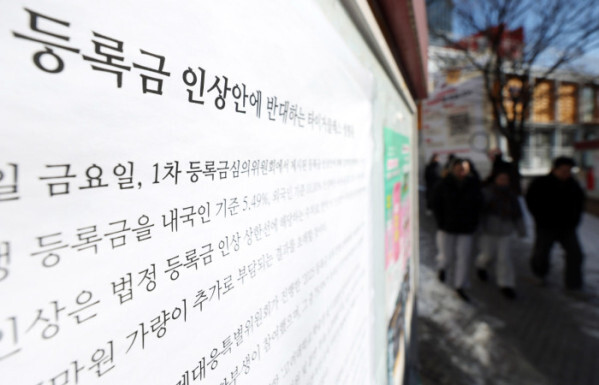
SEOUL, SOUTH KOREA – South Korea is experiencing a significant surge in education costs, with the education inflation rate climbing to its highest level since the global financial crisis of 2008-2009. Data released by the National Statistical Office on Monday revealed that the education price index jumped by 2.9% last month compared to the same period last year. This marked the most substantial increase in 16 years and one month, since the 4.8% rise recorded in February 2009.
The primary catalyst for this inflationary pressure in the education sector is the escalating tuition fees at South Korean universities, particularly within the private higher education system. According to the Korean Council for University Education, a staggering 79.5% (120 out of 151) of four-year private universities have decided to increase their tuition fees as of February 20, 2025. Even among national and public universities, 11 out of 39 institutions (28.2%) have opted for tuition hikes.
This development signals a weakening of the long-standing government policy aimed at freezing university tuition. Since 2012, the South Korean government has used the ‘National Scholarship II Type (University-Linked Support Type)’ as leverage, conditioning the provision of these scholarships on universities maintaining their tuition fees at the same level.
However, this tuition freeze, in place for 17 years, appears to have reached its limit. Mounting financial pressures on universities have led many institutions to conclude that raising tuition within the legally permissible cap is a more viable solution than solely relying on government subsidies. The legal upper limit for tuition increases in South Korea for the current year stands at 5.49%.
The impact of these decisions is already evident in the data. Last month, payments to private universities, encompassing admission and tuition fees, surged by 5.2% year-on-year, representing the steepest increase since February 2009 (7.1%). National and public universities also saw a rise in payments, albeit a more modest 1.0%, which is still the largest increase since February 2022 (2.1%).
Adding to the burden on households, kindergarten fees have also experienced a significant upswing. Payments for kindergartens rose by 4.3% last month, marking the most substantial increase in approximately nine years, since the 8.4% jump recorded in February 2016. This increase reflects growing operational costs and potentially reduced government subsidies for early childhood education institutions.
An official from the National Statistical Office cautioned about potential further increases, stating, "Although the probability is not high, if universities decide to raise tuition fees again in the second semester, this could further contribute to the upward pressure on the consumer price index."
The confluence of rising university tuition and escalating kindergarten fees poses a significant challenge to household budgets in South Korea, particularly for families with students in higher education or young children. The erosion of the government's tuition freeze policy highlights the ongoing debate surrounding the financing of higher education and the financial sustainability of universities. As education remains a crucial aspect of South Korean society, the increasing costs are likely to fuel discussions about affordability and access to quality education at all levels.
[Copyright (c) Global Economic Times. All Rights Reserved.]














