• 2026.03.22 (Sun)
  • All articles
  • LOGIN
  • JOIN
Global Economic Times
fashionrunwayshow2026
  • Synthesis
  • World
  • Business
  • Industry
  • ICT
  • Distribution Economy
  • Well+Being
  • Travel
  • Eco-News
  • Education
  • Korean Wave News
  • Opinion
  • Arts&Culture
  • Sports
  • People & Life
    • International Student Report
    • With Ambassador
  • Column
    • Cho Kijo Column
    • Cherry Garden Story
    • Ko Yong-chul Column
    • Kim Seul-Ong Column
    • Lee Yeon-sil Column
  • Photo News
  • New Book Guide
MENU
 
Home > Industry

Singapore Airlines Sees Cargo Revenue Rise but Profitability Declines Amidst Intensified Competition… Monitoring Global Trade Environment

KO YONG-CHUL Reporter / Updated : 2025-05-17 17:50:44
  • -
  • +
  • Print

Singapore – Singapore Airlines (SIA) Group announced on May 15th that its cargo revenue for the fiscal year 2024/25 increased by 4.4% year-on-year to S$2.1 billion (approximately KRW 2.1 trillion), driven by rising demand for e-commerce and perishables, as well as increased air cargo demand due to disruptions in sea freight.

According to SIA's announcement, cargo and mail traffic volume increased by 16.3% compared to the previous year, and the cargo load factor (CLF) also rose by 1.6 percentage points to 56.1%. This indicates robust growth in SIA Group's cargo business segment. In particular, the continuous growth of the e-commerce market since the COVID-19 pandemic, along with disruptions in sea freight, is analyzed as a major factor contributing to the increased demand for air cargo.

However, despite the revenue increase, cargo yield fell by 7.8% due to intensified competition. This is interpreted as a result of price reduction pressure amid fierce competition in the air cargo market. SIA Group increased its cargo capacity by 10.1% during the fiscal year, but appears to have faced difficulties in securing profitability despite the increased supply.

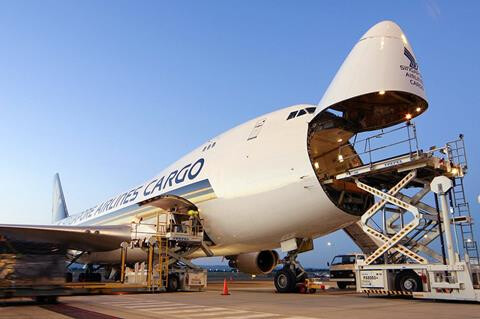
As of March 31, 2025, Singapore Airlines Group's cargo network comprised 132 destinations in 37 countries and regions, and it operates its own fleet of 7 freighter aircraft. According to aviation information website Planespotters, Singapore Airlines owns 7 Boeing 747-400F freighters and leases 5 Boeing 777F freighters to operate for DHL Aviation. Additionally, it has 7 Airbus A350F freighters on order, with plans to further expand its cargo transportation capacity in the future.

In its earnings report, Singapore Airlines Group pointed out that the future performance of its cargo business could be vulnerable to global trade issues. The report stated, "The global airline industry faces a challenging operating environment amidst evolving tariff policies and trade tensions, economic and geopolitical uncertainties, and persistent supply chain constraints." It further warned, "These factors could impact consumer and business confidence, potentially affecting both passenger and cargo markets."

However, it also mentioned that opportunities for business expansion exist due to trade and supply chain developments in the Asian region. SIA Group's extensive global passenger and cargo network, with Singapore as its hub, is expected to capitalize on its geographical advantage of being located in growing economic centers in Southeast Asia, South Asia, and the broader Asia-Pacific region to capture new opportunities.

Meanwhile, Singapore Airlines Group's total revenue increased by 2.8% year-on-year to S$19.4 billion, but its operating profit decreased by 37.3% compared to the previous year due to increased fuel costs, staff costs, handling charges, and passenger-related expenses. This indicates that despite the revenue increase in the cargo business segment, overall cost increases negatively impacted the Group's profitability.

Industry experts analyze that for Singapore Airlines to achieve sustained growth in its cargo business segment, it needs to closely monitor changes in the global trade environment and make efforts to improve profitability in response to intensified competition. In particular, it will be crucial to develop strategies that can effectively meet the increasing demand for cargo transportation while maintaining profitability. Furthermore, along with expanding transportation capacity through the introduction of new freighters, exploring ways to increase yields, such as developing high-value cargo transportation markets, is also required.

[Copyright (c) Global Economic Times. All Rights Reserved.]

  • #NATO
  • #OTAN
  • #OECD
  • #G20
  • #globaleconomictimes
  • #Korea
  • #UNPEACEKOR
  • #micorea
  • #mykorea
  • #newsk
  • #UN
  • #UNESCO
  • #nammidongane
KO YONG-CHUL Reporter
Reporter Page

Popular articles

  • Ko Sang-goo, President of World Federation of Korean Associations, Elected as First Private Sector Chair of World Korean Community Leaders Convention

  • Revised and Expanded Edition of ‘Failure of Negotiations with North Korea: Truth and Solutions’ Published

  • Commentary That Douses the Joy of Victory: A Twisted Perspective

I like it
Share
  • Facebook
  • X
  • Kakaotalk
  • LINE
  • BAND
  • NAVER
  • https://www.globaleconomictimes.kr/article/1065603007162691 Copy URL copied.
Comments >

Comments 0

Weekly Hot Issue

  • Coway Clinches Top Honor at "Water Taste Awards" for 7th Consecutive Year
  • HP Targets Korea as Strategic Hub for 'Edge AI' Expansion, Seeking Startup Partnerships
  • Pearl Abyss’s 'Crimson Desert' Shatters Records with 2 Million Copies Sold on Day One
  • "BTS Over Books?" Indian Academies Issue Emergency Notices as Students Plot Mass Absences for Comeback Live
  • Naver to Shut Down Men's Fashion Service 'MR.' to Launch Expanded AI-Driven Fashion Platform
  • JBNU and SKKU Researchers Achieve Breakthrough in "Dream Material" MXene, Setting New World Records in Performance

Most Viewed

1
An Open Letter to BTS On the Eve of a Historic Performance
2
From Industrial Capital to Tourism Mecca... Ulsan Makes a Bold Move with ‘Experiential Content’ in 2026
3
Ko Sang-goo, President of World Federation of Korean Associations, Elected as First Private Sector Chair of World Korean Community Leaders Convention
4
It is Time for BTS’s Fandom, ARMY, to Step Forward
5
Korean Stock Market Plunges: Circuit Breaker and Sidecar Triggered Amid Geopolitical Crisis
광고문의
임시1
임시3
임시2

Hot Issue

Vishay Unveils Ultra-Compact 0404 RGB LED with Independent Chip Control for Enhanced Color Precision

Coway Clinches Top Honor at "Water Taste Awards" for 7th Consecutive Year

AI Medical Ecosystem in Focus: KIMES 2026 Opens in Seoul as Global Healthcare Hub

Netanyahu Declares Decisive Blow to Iran’s Nuclear and Missile Programs, Signals Early End to War

Let’s recycle the old blankets in Jeju Island’s closet instead of incinerating them.

Global Economic Times
korocamia@naver.com
CEO : LEE YEON-SIL
Publisher : KO YONG-CHUL
Registration number : Seoul, A55681
Registration Date : 2024-10-24
Youth Protection Manager: KO YONG-CHUL
Singapore Headquarters
5A Woodlands Road #11-34 The Tennery. S'677728
Korean Branch
Phone : +82(0)10 4724 5264
#304, 6 Nonhyeon-ro 111-gil, Gangnam-gu, Seoul
Copyright © Global Economic Times All Rights Reserved
  • 에이펙2025
  • APEC2025가이드북TV
  • 독도는우리땅
Search
Category
  • All articles
  • Synthesis
  • World
  • Business
  • Industry
  • ICT
  • Distribution Economy
  • Well+Being
  • Travel
  • Eco-News
  • Education
  • Korean Wave News
  • Opinion
  • Arts&Culture
  • Sports
  • People & Life 
    • 전체
    • International Student Report
    • With Ambassador
  • Column 
    • 전체
    • Cho Kijo Column
    • Cherry Garden Story
    • Ko Yong-chul Column
    • Kim Seul-Ong Column
    • Lee Yeon-sil Column
  • Photo News
  • New Book Guide
  • Multicultural News
  • Jobs & Workers