![[등록] 2026-09-01 15:48:31](/support/_updata/banner2/tl181982910_6749.png)


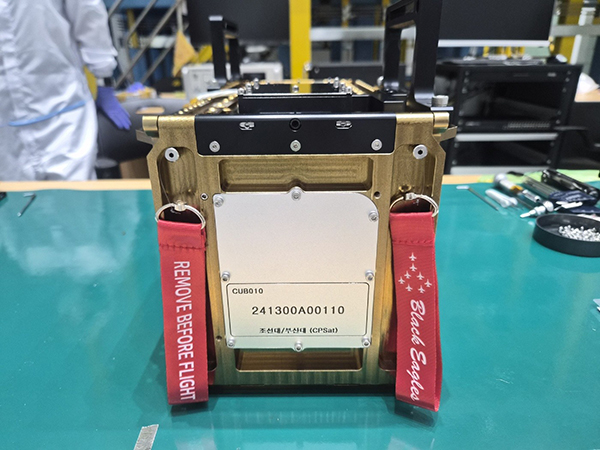
Chosun University announced that CPSat (Cosmic Pulsating Nano-Satellite), a cube satellite developed with its participation, has successfully entered its designated space orbit and established communication.
According to the Korea AeroSpace Administration (KASA) and the Korea Aerospace Research Institute (KARI) on the 13th, CPSat was deployed into an orbit at an altitude of approximately 575km on the 7th as a secondary payload of the Nuri rocket's 5th launch. Following the receipt of its first beacon signal at around 2:00 PM on the 7th, the satellite successfully completed two-way communication with the ground station at around 11:00 PM that same night.
KARI confirmed initial operational success by securing satellite status, operational data, and image data.
CPSat is a small, box-shaped nano-satellite jointly developed by Chosun University and Pusan National University. Chosun University oversaw the overall satellite system design, testing, manufacturing, and operation, while Pusan National University handled the attitude control technology for the sub-system. Like conventional satellites, cube satellites are used for ground data transmission, observation of the Earth's atmosphere, oceans, and forests, space environment and astronomical research, and exploration. Because they require less development cost and shorter production timelines, they are frequently developed by universities and research institutions.
The primary mission of CPSat is to verify optical communication technology and multi-RF (Radio Frequency) communication technology in a real space environment. The success of the CPSat project is expected to serve as a cornerstone for combining the optical industry technology capabilities accumulated by Gwangju, Jeonnam, and Chosun University with the space environment, exploring new industrial applications. The research team at Chosun University plans to drive a full-scale space optical communication technology demonstration while checking the satellite's operational status and payload performance.
Research teams—including Professors Seol-hyun Park (Department of Mechanical Engineering) and Hyun-jae Lee (Department of Aerospace Engineering) at Chosun University—are expanding their research capabilities in space technology by taking charge of developing the 6U-class "Suncheon SAT" and "Gwangju AI Mobility Satellite," scheduled to be loaded onto the 6th launch of Nuri next year.
Professor Park, who oversees the research and development, stated, "As small satellite development gains attention in line with the 'New Space' trend—where private enterprises, rather than governments, lead space industry development—we will contribute to strengthening space technology and commercial competitiveness."
[Copyright (c) Global Economic Times. All Rights Reserved.]