![[등록] 2026-09-01 15:48:31](/support/_updata/banner2/tl181982910_6749.png)


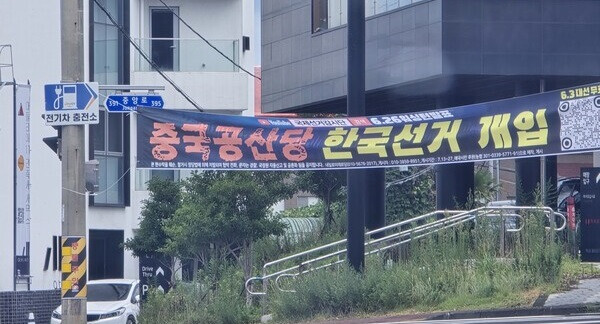
SEOUL – The South Korean government has announced and immediately implemented new guidelines designed to allow for the removal of political banners containing hate speech and slander, a move aimed at curbing the proliferation of offensive and divisive signage across the country. The Ministry of the Interior and Safety (MOIS) prepared the "Guidelines for the Application of Prohibited Advertisements under the Outdoor Advertising Act," distributing them to local governments on Tuesday.
The decision comes in response to growing public dissatisfaction and a direct order from President Lee Jae-myung, who, during a Cabinet meeting on November 11, criticized the inability to remove "low-quality and shameful" banners simply because they were installed by political parties.
Loophole Exploited by Parties
A 2022 amendment to the Outdoor Advertising Act granted political parties significant freedom in displaying banners. Unlike general advertisements, party banners were exempted from local government reporting or prior approval, and they could be installed virtually anywhere. This change was intended to safeguard the freedom of political expression.
However, critics quickly pointed out that this legislative loophole was being exploited. Streets became inundated with banners promoting hate against specific nations or races, or containing false, slanderous content, leading to a widespread call for regulatory intervention.
A survey commissioned by Democratic Party Rep. Lee Hae-sik’s office and conducted by WinGKorea Consulting on September 29-30 revealed the extent of the problem. Among 1,004 adults surveyed, 79.4% of citizens who had seen party banners containing expressions related to electoral fraud or refusing to accept the presidential election results reported feeling discomfort.
New Criteria for Removal
To address the issue, MOIS established concrete standards and application examples to help local governments determine if a banner constitutes a prohibited advertisement under the Outdoor Advertising Act.
While the new guidelines uphold the principle of maximizing the freedom of expression, they stipulate that speech which infringes upon the rights or reputation of others, or violates public morality and social ethics, must be restricted, as per the Constitution.
The MOIS guidelines specify that an advertisement can be deemed a "prohibited advertisement" if its content:
Denigrates human dignity and value.
Infringes upon individual rights.
Distorts or denies democratic principles.
Raises concerns about undermining social cohesion.
Receives complaints from the directly affected party or a significant number of people (multiple complainants).
The Prohibited Advertisement categories are grouped into six types: content justifying or cruelly depicting criminal acts, obscene or decadent content, content likely to hinder the protection and guidance of youth, advertisements for gambling industries that incite speculation, racially or sexually discriminatory content, and content prohibited by other laws.
For example, a banner expressing hate toward a specific country or its members, or one disseminating defamatory false information, may be classified as content that "raises concerns about human rights violations" and thus be subject to removal under the prohibited advertisement rules.
The initial determination of whether a banner is prohibited will be made by the local government department responsible for advertisements. If the determination is complex, the case will be reviewed and processed by the local government’s Outdoor Advertising Deliberation Committee.
The MOIS has committed to supporting a more fundamental solution by cooperating on relevant legislative efforts. The ministry plans to work towards the swift passage of 10 proposed amendments to the Outdoor Advertising Act and 5 amendments to the Political Parties Act, all currently pending in the National Assembly, to provide a lasting framework for regulating these contentious political advertisements.
[Copyright (c) Global Economic Times. All Rights Reserved.]