![[등록] 2026-09-01 15:48:31](/support/_updata/banner2/tl181982910_6749.png)


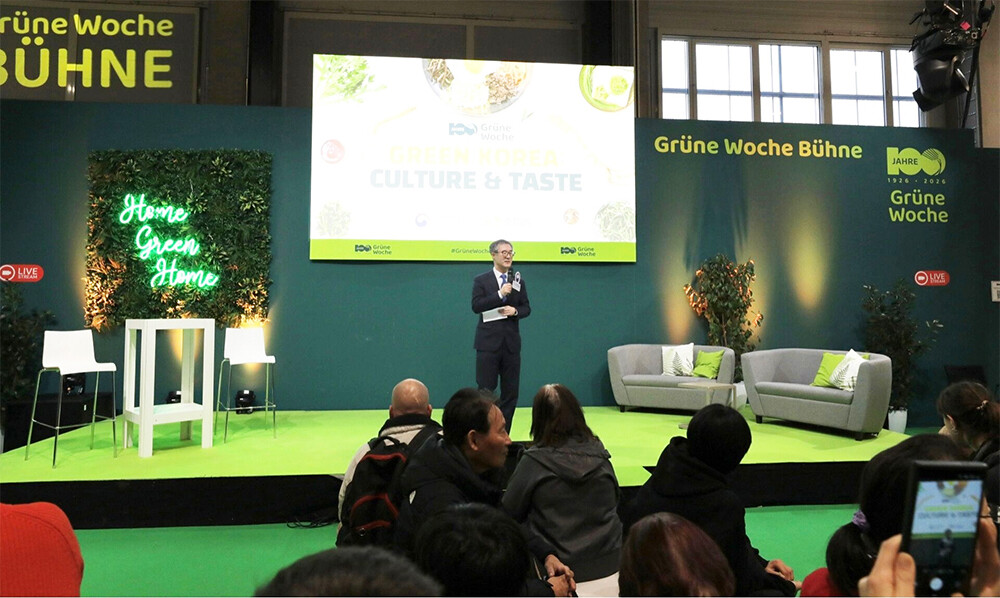
| Ambassador of the Republic of Korea to Germany, Lim Sang-beom, delivering welcoming remarks. (C) Korean Cultural Center in Germany
The Korean Cultural Center in Germany (Director Yang Sang-keun, hereinafter referred to as "the Cultural Center") announced that it presented a stage program titled "Green Korea: Tastes and Culture of Korea," which combined Korean food (Hansik) and the Korean Wave (Hallyu), at "Grüne Woche" (International Green Week) held in Berlin, Germany, from January 15 to 24.
This cultural event was organized following an official request from the exhibition organizers. Amid the growing international interest in Hallyu and Hansik, the organizers' direct invitation to the Cultural Center adds significant meaning to the participation. This is evaluated as a clear demonstration of the international standing of Korean cultural content, particularly as "Grüne Woche" expands its scope beyond simple food exhibitions to highlight the culinary culture and cultural identities of various nations.
Founded in 1926 and celebrating its 100th anniversary this year, "Grüne Woche" is a massive international exhibition featuring over 1,600 companies from approximately 50 countries, attracting more than 350,000 visitors. Moving a step beyond the traditional method of focusing solely on agricultural products, the Cultural Center operated a cultural program integrated with Hallyu to introduce the diverse charms of Korean culture to the attendees.
Over the final two days of the event, from January 24 to 25, the Cultural Center hosted stage events under the theme "Green Korea: Tastes and Culture of Korea." The Hansik program featured a live cooking show centered on Bibimbap, which is well-known internationally as a healthy dish. A Korean chef active overseas demonstrated the preparation of Bibimbap, introducing both gochujang (red chili paste) and soy sauce-based versions. Visitors had the opportunity to experience the various flavors of the dish through on-site tastings. Additionally, a large-scale Bibimbap performance based on the theme of "Son-mat" (the traditional "taste of one's hands"), a symbol of Korean food culture, received an enthusiastic response from the crowd.
Following the culinary introduction, a variety of performances encompassing both traditional and modern Korean dance, as well as K-pop dance, were held, capturing the attention of visitors. The event was praised for introducing three-dimensional Korean cultural content that harmoniously combined food and performance.
The Chungcheongnam-do Frankfurt Office also participated as a collaborative partner to promote regional specialties. Focusing on Geumsan Ginseng, a representative specialty of Chungnam, they conducted presentations on the benefits and excellence of ginseng, showcasing healthy foods and various recipes utilizing the root. Furthermore, they achieved significant results in promoting regional content overseas by exhibiting and offering tastings of processed ginseng products alongside tourism promotion for the Chungcheongnam-do region.
The Cultural Center stated that it plans to continue expanding cultural touchpoints with German and European audiences and will persist in sustainable cultural diplomacy activities that link Hansik, K-culture, and regional content.
https://newsk.net/europe/?idx=169695208&bmode=view
[Copyright (c) Global Economic Times. All Rights Reserved.]