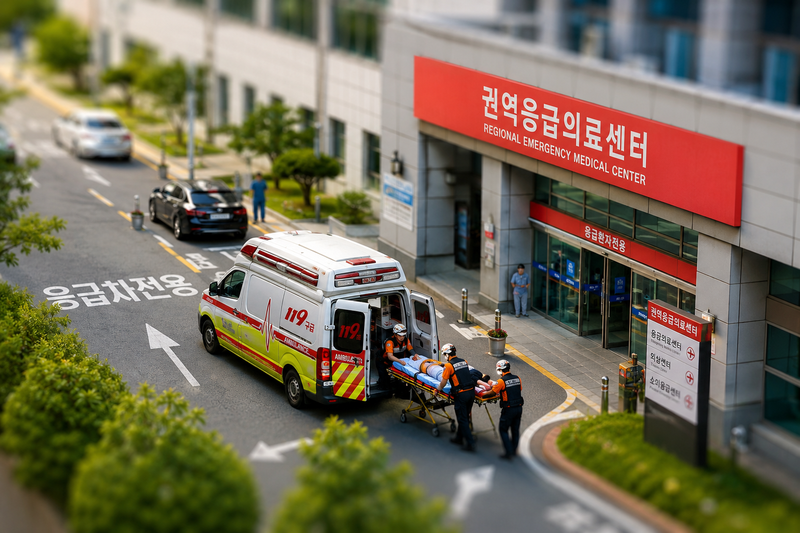
Critics claim the exclusion of "ER stay duration" from primary penalty-reward metrics shields major metropolitan medical centers.
SEOUL — South Korea's recent decision to decouple emergency room (ER) length-of-stay metrics from comprehensive hospital grading and financial incentives has sparked intense debate. Critics argue the policy shift disproportionately benefits large-scale metropolitan hospitals, often referred to as the "Big 5."
The controversy came to light after Rep. Heo Jong-shik of the opposition Democratic Party, a member of the National Assembly's Health and Welfare Committee, reviewed a mock evaluation report provided by the Ministry of Health and Welfare (MOHW).
According to the data, out of 53 regional emergency medical centers nationwide, six institutions scored poorly—landing in the bottom tiers (grades 4 and 5)—regarding patient stay duration for severe conditions. Four of these institutions belong to the elite tier of medical facilities: Seoul National University Hospital, Severance Hospital, and Seoul National University Bundang Hospital received grade 5, while Asan Medical Center received grade 4.
A grade of 4 or 5 indicates that the median stay time for critically ill ER patients exceeds six hours. Notably, the three hospitals receiving grade 5 reported that over 5% of their emergency patients remained in the ER for longer than 24 hours.
During an evaluation briefing session, the Ministry of Health and Welfare announced that emergency room stay times would no longer directly trigger insurance fee adjustments or overall institutional grades. Instead, the metric will be reduced to a secondary sub-indicator.
This regulatory adjustment coincides with an expansion of regional emergency medical center designations, which directly impact a hospital's bid for tertiary general hospital status. Beginning with the 6th-term tertiary hospital evaluations, facilities operating regional emergency centers are awarded between 0.25 and 1.5 bonus points. Qualified centers also receive up to 600 million won ($430,000 USD) in annual operational subsidies alongside targeted medical fee support.
Government Defends Policy as Necessary Safeguard
The Health Ministry defended the revision, stating that directly tying stay times to financial penalties caused hospitals to reject complex cases that required prolonged care. By removing this direct penalty linkage, the government aims to prevent institutions from cherry-picking patients.
To further accommodate facilities treating high volumes of critical cases, the ministry shifted its calculation formula from a standard average to a median value, while tracking 12-hour and 24-hour stay ratios through separate oversight channels.
Health Minister Jung Eun-kyeong addressed the concerns directly. "Critically ill patients and psychiatric emergencies inherently require longer evaluation and stabilization periods," Jung stated. "This change is not meant to favor major hospitals, but rather to protect patients from being turned away due to strict institutional stay-time penalties." She added that long-term stays continue to be monitored independently as part of a separate metric.
Despite these assurances, lawmakers remain skeptical. Rep. Heo criticized the timing, noting that major Seoul hospitals—which historically struggle with prolonged ER wait times—stand to benefit the most now that the financial penalties tied to this specific indicator have been relaxed.
"We must question whether this policy contradicts the administration's core commitment to strengthening regional, essential, and public healthcare," Heo said, calling on authorities to transparently disclose risk-adjusted facility data and how institutional grades would shift under the new framework.
[Copyright (c) Global Economic Times. All Rights Reserved.]