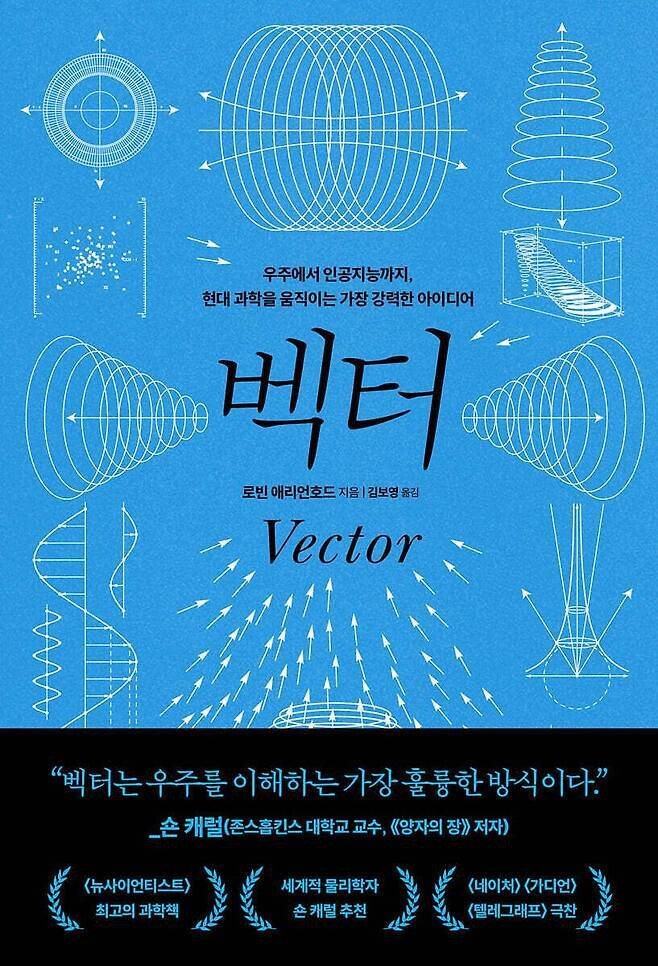
There are concepts in mathematics that feel daunting simply because of their intimidating names. Vector, the title of this book, is certainly one of them. The product of a scalar and a vector, the dot product, the cross product... Even after solving problems, the underlying purpose often remains unclear. Consequently, many people leave school harboring only a vague memory—that "scalars have magnitude, while vectors have magnitude and direction"—along with a lingering resistance to esoteric jargon and a sense of helplessness. The only small comfort is that we are not alone in this experience, a fact evidenced by the publication of books dedicated entirely to introducing the concepts, history, and applications of vectors.
The book begins with the Irish mathematician William Rowan Hamilton, who, while attempting to extend complex number calculations into three-dimensional space, discovered quaternions (a number system extending complex numbers). Since complex multiplication can represent the rotation, scaling, and stretching of a plane, Hamilton sought a similar "number" system for space. However, problems that could not be solved with three components were successfully resolved when a fourth component was introduced. Hamilton named the real part of the quaternion a scalar, and the remaining three-component portion a vector. The term scalar carried the meaning of "a scale or gradient," while vector signified "carrying" from one point to another.
In the mid-19th century, James Clerk Maxwell found a new mathematical tool to express electromagnetism within the quaternions introduced by his friend Peter Tait. In a profound way, abstract mathematics ultimately contributed to laying the foundations of modern radio and electronic civilization. Yet, a fierce "vector war" broke out in the late 19th century regarding how this tool should be utilized: some insisted on adhering to quaternions, others argued for isolating vectors for independent use, and still others maintained that calculating individual components without introducing new concepts was sufficient. The victors were the vector analysis faction, who advocated for separating the vector concept to develop an independent operational calculus. Vectors spread rapidly alongside modern equations that concisely expressed Maxwell's theories.
However, certain relationships resisted expression through vectors alone. For instance, the stress (tension) acting upon a single point inside a physical object varies depending on the chosen reference direction. Although the physical phenomenon is singular, its mathematical representation shifts depending on the selected coordinate system. How could geometric relationships be expressed and calculated consistently regardless of coordinate changes? In the late 19th century, mathematicians such as Gregorio Ricci-Curbastro and Tullio Levi-Civita developed "absolute differential calculus," designed to handle the geometry of curved surfaces and spaces. The word "absolute" was chosen to signify that these relations always hold true regardless of coordinate transformations.
In the early 20th century, Albert Einstein, seeking to explain gravity through the geometry of spacetime, encountered this mathematics with the help of his friend Marcel Grossmann. Together, they applied it to gravitational theory, which also popularized tensor—a generalized mathematical and physical concept encompassing both scalars and vectors—as a symbol of this new mathematics. Modern physics found its breakthrough in novel mathematics, while mathematics simultaneously expanded its utility and influence through physics.
At first glance, vectors and tensors might seem like little more than shorthand notations designed to abbreviate complex calculations. Yet, by bundling multiple components into a single unifying concept, we gain the ability to focus entirely on the relationships between those concepts. In essence, good notation serves as a springboard that enables entirely new ways of thinking.
The result? As far as human knowledge extends, vectors and tensors are deeply embedded everywhere—from the vast expanse of the cosmos to architectural structures, heavy machinery, and even modern artificial intelligence language models.
Just as contemporary mathematicians held differing views on vectors, readers may approach this book with mixed perspectives. Because historical progression does not always align with pedagogical order, readers looking for a systematic mathematical foundation may find themselves disappointed. Furthermore, while contemporary applications span across topics like the tensor products of language models, the text contains enough formulas to deter casual scanning. As a historical overview, the period following Einstein is treated relatively briefly—likely a reflection of the author’s background as a general relativity specialist and a researcher of Maxwell and Einstein. Had the book also unraveled how the mathematics explaining the universe became everyday tools for bridges, buildings, and machines, it could have illustrated even more vividly how vectors and tensors permeate our world. Nevertheless, just as a vector integrates multiple components into a single concept, this book—weaving together mathematics, history, and application—mirrors the very nature of a vector itself.
[Copyright (c) Global Economic Times. All Rights Reserved.]