![[등록] 2026-09-01 15:48:31](/support/_updata/banner2/tl181982910_6749.png)


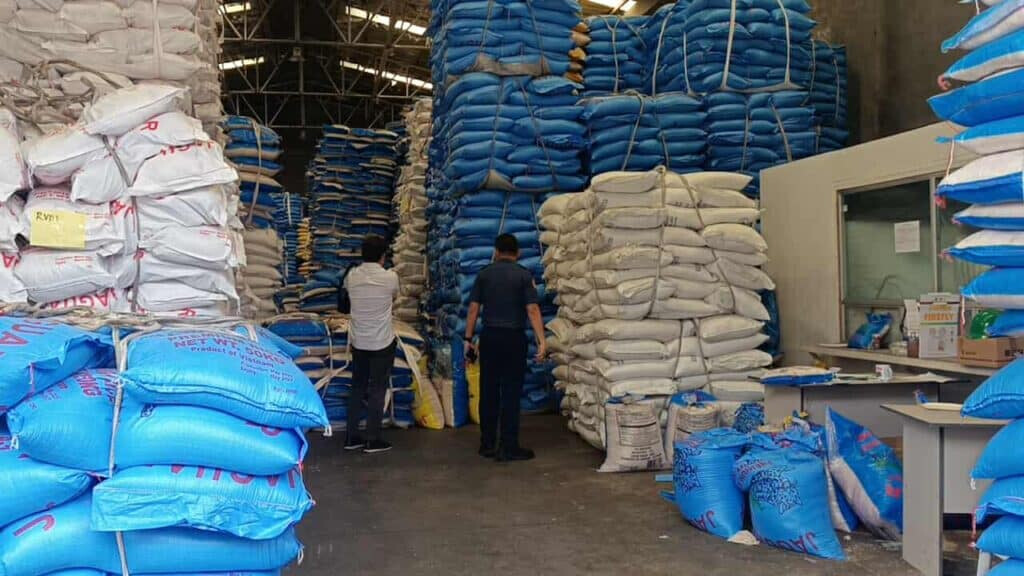
MANILA – The Anti-Agricultural Economic Sabotage (AAES) Council, under the Philippine Department of Justice (DOJ), announced on Wednesday the seizure of 26,526 sacks (approximately 863,345 kg) of smuggled rice, valued at PHP 38 million (approximately KRW 890 million), from a warehouse in Talisay City, Cebu. This operation is seen as a strong testament to the Philippine government's unwavering commitment to ensuring food security and upholding the rule of law.
The AAES Council successfully conducted its first enforcement operation since its establishment on June 20. This action took place the day after the Executive Committee received intelligence reports on suspected smuggled agricultural products violating the AAES Law and subsequently directed a search of multiple warehouses in the Gimba Compound. The enforcement group (EG), composed of the Philippine National Police (PNP) Criminal Investigation and Detection Group (CIDG) and the Maritime Group (MG), discovered a large quantity of smuggled rice in the area occupied by River Valley Distribution Inc. (RVDI).
This seizure reflects President Ferdinand R. Marcos Jr.'s firm resolve to prevent agricultural economic disruption caused by smuggling and to ensure the stability of the nation's food supply. Frederick Go, Chairperson of the AAES Council and Special Assistant to the President for Investment and Economic Affairs, stated, "The seized items were confirmed to be illegal. This decisive action sends a strong and clear message to economic saboteurs that the government stands united and will relentlessly combat illegal activities."
The AAES Council was established under Republic Act 12022, also known as the "Anti-Agricultural Economic Sabotage Law," to eradicate large-scale agricultural smuggling, hoarding, profiteering, and cartel activities. This law was enacted to protect the Philippines' agricultural economy and safeguard farmers and consumers from unfair market distortions.
The AAES Council comprises Chairman Go, who serves as the permanent representative of the Office of the President and Chairman of the AAES Council, Department of Justice Secretary Jesus Crispin Remulla, and the enforcement group. The DOJ's Special Prosecutions Team (STP) will file charges of economic sabotage against those responsible in connection with this case. Under Philippine law, economic sabotage is classified as a non-bailable heinous crime.
The Philippines has long suffered significant losses due to agricultural smuggling. Rice, being the staple food of the Filipino people, particularly poses a direct threat to food security, as smuggled rice reduces farmers' incomes and distorts prices in the domestic rice market. In 2023, the Philippines is estimated to have incurred losses of approximately USD 3 billion (approximately KRW 3.9 trillion) due to agricultural smuggling. This not only leads to a reduction in government revenue but also weakens the domestic agricultural base.
Since the beginning of his term, President Marcos Jr. has prioritized the eradication of agricultural smuggling. Under his strong leadership, the AAES Law was enacted, and various agencies, led by the Department of Justice, are collaborating to intensify anti-smuggling efforts. This large-scale seizure operation in Cebu demonstrates that the government's efforts are beginning to yield tangible results. The government aims to completely halt illegal distribution through seizure orders for smuggled agricultural products and to severely punish those involved to prevent the recurrence of similar crimes.
Through this action, the Philippine government is taking an important step towards protecting domestic agriculture, strengthening national food security, and further promoting overall economic stability. The continued vigilance and enforcement activities of the AAES Council and relevant agencies are expected to play a crucial role in safeguarding the Philippines' agricultural economy in the future.
[Copyright (c) Global Economic Times. All Rights Reserved.]