![[등록] 2026-09-01 15:48:31](/support/_updata/banner2/tl181982910_6749.png)


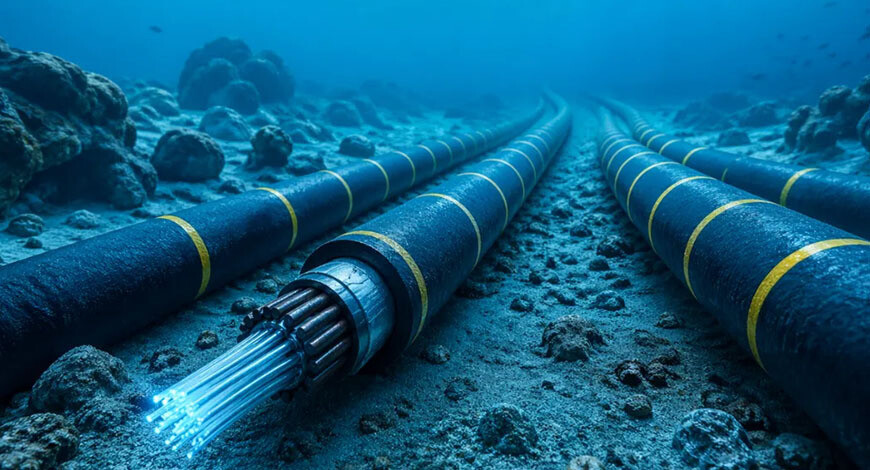
TEHRAN — Following its controversial push to levy transit fees on commercial vessels, Iran is now expanding its maritime "tollgate" strategy to the digital realm. Recent reports from state-affiliated media and high-ranking officials suggest that Tehran is preparing to impose "transit fees" on the critical subsea fiber-optic cables that pass through the Strait of Hormuz, effectively weaponizing its geography to extract economic and geopolitical concessions from the international community.
According to a series of analytical reports published by the Tasnim News Agency—an outlet closely linked to the Islamic Revolutionary Guard Corps (IRGC)—the Iranian government has identified the Strait of Hormuz not only as a global energy chokepoint but also as a "strategic digital pressure point." The reports argue that after what they term the "Third Forced War" (referring to recent military tensions with the U.S. and Israel), Iran has decided to redefine its exercise of sovereignty over the waterway.
A New "Digital Toll" Logic
The crux of Iran’s argument rests on its claim of absolute jurisdiction over its territorial waters and the seabed beneath them. Tasnim News asserted that "no international union or multinational telecommunications company has the right to install or maintain internet cables or energy pipelines through this strait without Iran’s permission and payment of usage fees."
The economic stakes are astronomical. Citing a report from the UK-based think tank Policy Exchange, Iranian media highlighted that over $10 trillion in financial transactions—including bank settlements, stock market trades, and foreign exchange—are processed through subsea cables daily. By positioning itself as the "gatekeeper" of these data flows, Tehran aims to convert its physical control of the strait into a steady stream of "legitimate wealth" for its people.
"The value of these cables lies not in the physical assets themselves, but in the massive economic activity they enable," the report stated, emphasizing that Iran intends to set its own rules for navigation and subsea infrastructure, independent of the 1982 UN Convention on the Law of the Sea (UNCLOS), to which Iran is not a party.
Coercion and Regional Pressure
The Fars News Agency, another IRGC-aligned outlet, took a more coercive tone, describing the Strait of Hormuz as the "artery of the global internet." It warned that any damage to these cables would cause "widespread chaos" in the digital economies of multiple nations. This rhetoric is seen by analysts as a thinly veiled threat to the global telecommunications infrastructure.
Furthermore, Iranian media pointed out that neighboring Gulf nations—including Saudi Arabia, the UAE, Qatar, Bahrain, and Kuwait—are significantly more dependent on these maritime internet routes than Iran itself. By threatening to disrupt or tax these connections, Tehran is signaling its ability to exert pressure on its regional rivals and their international partners.
"Valuable as an Atomic Bomb"
The push for "internet transit fees" is not merely the talk of media outlets; it reflects a broader shift in Tehran’s high-level strategy. Mohammad Mokhber, an economic advisor to Iran’s Supreme Leader, recently described the Strait of Hormuz as an "opportunity as valuable as an atomic bomb." He lamented that Iran had previously "neglected" its strategic position and vowed that the country would not surrender the "achievements" of the recent conflict.
"We will change the legal framework of the Strait of Hormuz, through international law if possible, or unilaterally if necessary," Mokhber stated, confirming that the Iranian leadership views the control of the strait’s surface and seabed as a permanent geopolitical leverage.
International Concerns
The maritime industry is already on high alert. Lloyd’s List recently reported that Iran has established an organization to oversee the authorization and fee collection for ships transiting the strait. The addition of subsea cables to this "taxation list" raises profound questions about the stability of global communication.
International law experts warn that Iran’s unilateral attempts to rewrite the rules of transit in an international strait could lead to increased military friction. However, with Tehran showing a growing appetite for "monetizing" its strategic geography, the world’s digital and energy lifelines remain increasingly vulnerable to the whims of the Islamic Republic.
As Tehran moves from theory to practice, the "hidden highways" of the seafloor are becoming the newest front in Iran’s confrontation with the West, turning a global commons into a private toll road.
[Copyright (c) Global Economic Times. All Rights Reserved.]