![[등록] 2026-09-01 15:48:31](/support/_updata/banner2/tl181982910_6749.png)


WASHINGTON — The U.S. Department of Homeland Security (DHS) is moving forward with plans to impose massive fees on international students participating in U.S. work authorization programs, as part of an effort to protect American jobs.
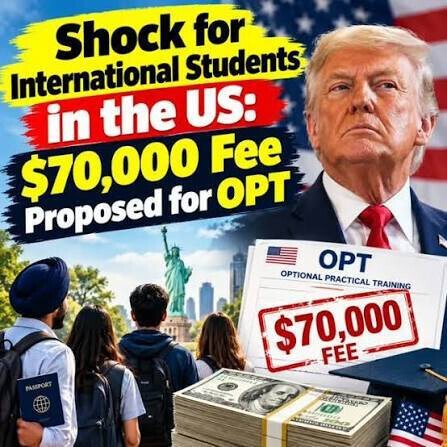
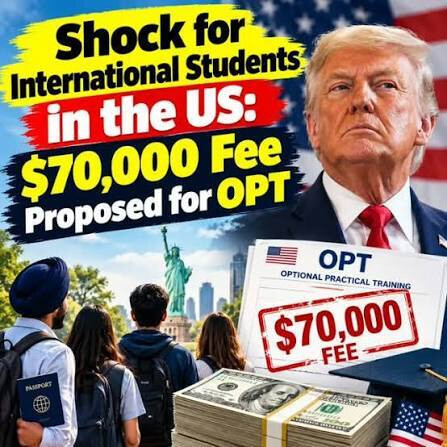
According to the DHS on the 7th (local time), the core of the new proposed regulation requires F-1 visa students studying in the U.S. to pay $70,000 (approx. 94 million KRW) when first applying for Optional Practical Training (OPT). An additional rule mandates a $30,000 (approx. 40 million KRW) fee for subsequent OPT applications. While this is somewhat reduced compared to the previously floated "$100,000" figure, it remains an overwhelming financial burden.
OPT is a program that allows international students studying in the U.S. to gain work experience at American companies through internships during or after their academic programs. It is generally granted for 12 months, with students who earn degrees in science, technology, engineering, and mathematics (STEM) fields eligible to apply for a 24-month extension. This program has historically served as a critical stepping stone for international students attending U.S. universities to build local networks and secure employment in the United States.
However, the Trump administration argues that the program is frequently exploited for "fraud." The DHS explained that the new fee introduction is intended to "address fraud and regulatory abuses identified through the Student and Exchange Visitor Program (SEVP)." The DHS stated that there have been schemes exploiting current regulations, such as "problematic work locations and 'pay-to-stay' visa schemes."
A DHS spokesperson stated in a press release, "Optional Practical Training (OPT) must not become a backdoor into the U.S. labor market, a subsidy for cheap labor, or a benefit for those who exploit the system." The spokesperson added, "DHS aims to improve the OPT program by requiring international students to prove their value to employers. American workers should not be forced to compete with a program that has morphed into a pipeline for low-cost foreign labor."
The entity responsible for paying this fee is the school, not the employer. Under the new regulations, SEVP-certified schools must pay the fee before a Designated School Official (DSO) recommends an F-1 student's OPT in the Student and Exchange Visitor Information System (SEVIS), and before the F-1 student applies for employment authorization with U.S. Citizenship and Immigration Services (USCIS). "If the school does not pay the prescribed fee, USCIS will not approve employment authorization for the F-1 student," the DHS stated. This cost is expected to be effectively passed down to the individual students.
The DHS clarified that the fee is not tied to a specific employer. While students do not need to pay the fee again simply because their OPT employer changes, the fee applies "whenever a school recommends an F-1 student for any type of OPT." The collected fees will be deposited into the U.S. Treasury.
The new fee system will not go into effect immediately. The DHS will hold a public comment period from the 8th through next month (the 9th). It also announced that a separate 60-day comment period will be operated for certain provisions.
The Trump administration has been erecting various barriers to cut off pathways for foreign talent to work in the U.S., including H-2 visas. Last August, the DHS proposed a regulation requiring an H-1B visa application fee of $103,265 (approx. 143 million KRW).
With U.S. internship and employment pathways effectively closing, a significant number of Korean international students are seriously considering returning to South Korea. This is because the opportunity cost is excessively high compared to the actual salaries they can expect to earn, and settling locally remains difficult even after bearing such costs. These costs and uncertainties also pose a major burden for companies attempting to recruit foreign talent.
An official from a Korean community in Virginia remarked, "Isn't this practically a message saying, 'Go back to your home country, we don't welcome you'?" adding, "A procession of international students returning home is likely to continue for the time being."
[Copyright (c) Global Economic Times. All Rights Reserved.]