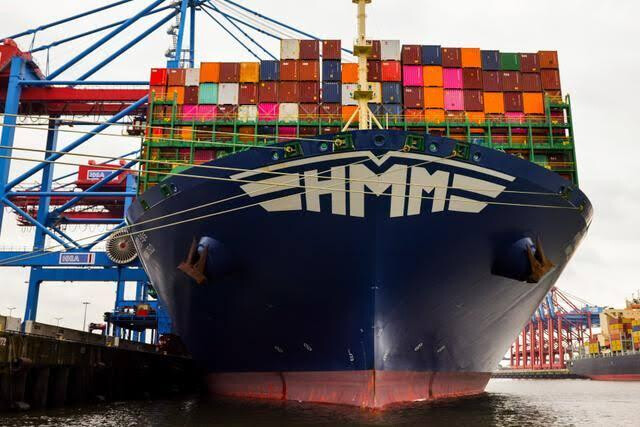
HMM is accelerating the expansion of its global maritime transport network by simultaneously securing large container ships and small-to-medium feeder ships (small-scale container carriers). In particular, the company plans to strengthen its route competitiveness centered on emerging markets with high growth potential, such as India and Africa. According to the shipping industry on the 21st, HMM is investing KRW 2.1 trillion to secure a total of 12 vessels, including eight 13,000-TEU (1 TEU = one 20-foot container) container ships and four small-to-medium feeder ships.
First, the eight large container ships will be sequentially delivered starting in 2029 and deployed on the Far East-India-Mediterranean (FIM) route. A notable aspect of this investment is that HMM has secured not only large vessels but also small-to-medium feeder ships. Feeder ships are vessels that connect small-to-medium ports—which are difficult for large container ships to directly call at—with major hub ports. While large vessels handle long-distance transport connecting countries and continents, feeder ships take on the role of gathering cargo from surrounding regions or transporting it to the final destination.
HMM's "hub-and-spoke" strategy is also based on this structure. It is a method of connecting major hub ports with large vessels while transporting cargo from surrounding ports via feeder ships, thereby enhancing the overall efficiency of the routes. In particular, HMM is pursuing the expansion of its feeder network centering on emerging markets like India and Africa. The strategy is to expand its sales base into regions with high growth potential while maintaining the competitiveness of its existing deep-sea routes.
In fact, HMM's scale of feeder ships is growing rapidly. The number of operated and ordered feeder ships, which stood at 12 in March of last year, has expanded 3.5-fold to 42 this year. Industry experts explain that this movement holds significant meaning in competition with global shipping companies. In the container shipping industry, key competitive edges include not only vessel capacity (fleet size) but also route diversity, operation frequency, and connectivity between ports. This is because even if a company secures sufficient large vessels, it faces limitations in securing cargo demand if the feeder network connecting to surrounding ports is lacking. Conversely, organically connecting deep-sea routes and feeder networks increases the transport routes that can be offered to customers and can prove advantageous in securing cargo to load onto large vessels.
HMM plans to invest a total of KRW 29 trillion by 2030 to expand its fleet to 166 container ships (1.47 million TEUs) and 110 bulk carriers (13.52 million DWT). However, concerns over oversupply in the global shipping market remain a variable. Industry observers note that securing stable cargo demand must underpin these expansions of vessels and routes if they are to translate into profitability improvements.
An HMM official stated, "Investments in the shipping industry, such as vessels and ports, have the characteristic of being carried out with a long-term perspective spanning several years," adding, "We plan to continuously pursue mid-to-long-term investments to secure the capability to compete with global shipping lines."
[Copyright (c) Global Economic Times. All Rights Reserved.]