![[등록] 2026-09-01 15:48:31](/support/_updata/banner2/tl181982910_6749.png)


SEOUL — The South Korean government has announced a massive 1,000 trillion won ($700+ billion) funding and policy package through 2035 to overhaul high-emission industries like steel and petrochemicals and foster green technology as a new growth engine. Private sector players will simultaneously drive 220 trillion won worth of investment projects to pioneer next-generation technologies and expand production facilities.
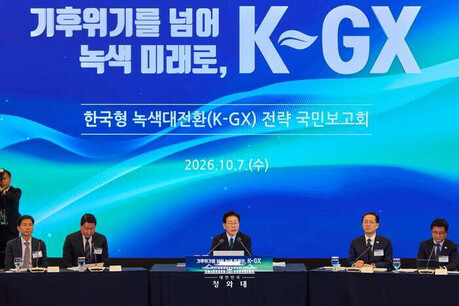
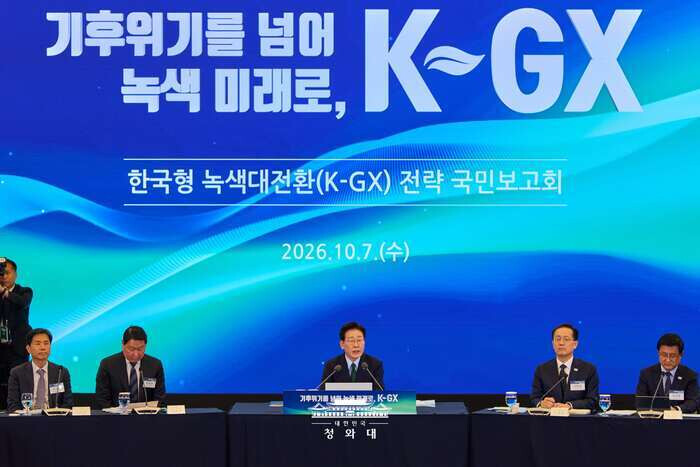
On October 7, the government held a National Reporting Session at the Korea Chamber of Commerce and Industry in Jung-gu, Seoul, with the President in attendance, officially unveiling the "Korean Green Transformation (K-GX) Strategy."
The strategy rests on three core pillars: strengthening industrial competitiveness, fostering balanced regional and corporate growth, and establishing a sustainable investment foundation. Public-private cooperative "Signature Projects" will focus on four key sectors:
-Securing clean energy supply chains
-Decarbonizing core industries
-Electrifying mobility
-Transitioning residential spaces to green environments
Massive Financial Backing and Regional Distribution
The 1,000 trillion won initiative will be funded through 200 trillion won in government fiscal support and over 790 trillion won in climate finance between 2026 and 2035. Fiscal funds will directly support technology R&D and facility investments, while policy-driven financial institutions will offer loans and guarantees to alleviate the financial burden of corporate transition.
Notably, over 50% of the climate finance supply will be allocated to regional areas outside the capital region, and over 70% will target small and medium-sized enterprises (SMEs).
Sector-Specific Roadmaps
-Steel: The government aims to demonstrate a 300,000-ton-class hydrogen-reduction steelmaking plant by 2030, with commercialization targeted for 2037.
-Petrochemicals: Core technologies for electrically heated naphtha cracking furnaces are set to be secured by 2028.
-Solar Power: Commercialization of next-generation tandem solar cells is scheduled for 2028, alongside the introduction of domestic production tax credits for solar, wind, and battery technologies. Detailed sectoral roadmaps for emission-heavy industries will be released by the end of the year.
Alongside funding, the government plans to ease regulations to improve the investment climate. Deputy Prime Minister and Minister of Economy and Finance Lee Hyung-il stated, "We will create an environment where businesses can focus on investment and innovation by speeding up administrative approvals for companies holding core GX technologies and expanding regulatory sandboxes." He added, "As the climate crisis accelerates, combining Artificial Intelligence Transformation (AX) with Green Transformation (GX) is essential for sustainable growth and quality job creation."
Green Living Spaces
The green transition extends beyond factories to residential heating and cooling. Climate, Energy and Environment Minister Kim Sung-hwan announced, "Following the rollout of heat pumps in general housing this year, we plan to pilot gas-pipe-free apartment complexes next year. Led by Samsung Electronics and LG Electronics, energy-independent eco-friendly homes combining heat pumps, solar power, and energy storage systems (ESS) will fundamentally reshape future living environments."
Challenges Ahead: Performance Tracking and Corporate Incentives
Despite the grand scale of the strategy, experts point out that current performance indicators remain overly focused on the volume of financial supply. While the strategy introduces information-sharing platforms and performance review systems, it lacks concrete methods and timelines for aggregating overall emission reductions from financial support and evaluating their contribution to the National Determined Contribution (NDC) goals.
Civil society organizations emphasize that financial support must be paired with stronger incentives for corporate emission cuts. Critics argue that the government should expand paid allocations for emission allowances and publicly disclose carbon intensity by sector, company, and product, linking them directly to support targets and compliance checks.
[Copyright (c) Global Economic Times. All Rights Reserved.]