![[등록] 2026-09-01 15:48:31](/support/_updata/banner2/tl181982910_6749.png)


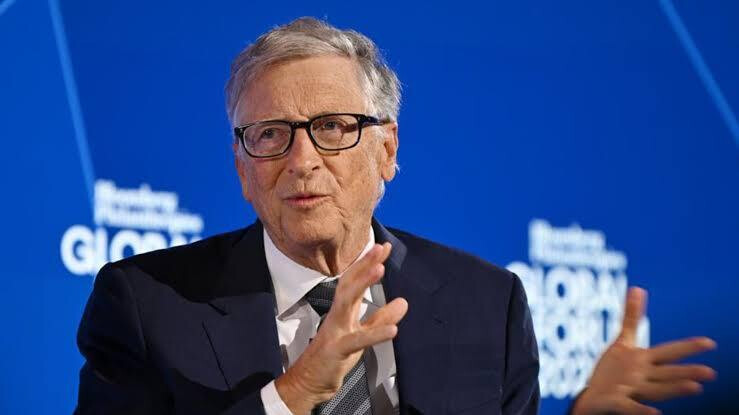
Microsoft co-founder Bill Gates has urged the U.S. Congress to establish legal safeguards, stating that self-regulation by AI companies is insufficient to control the rapidly advancing risks of artificial intelligence.
Amid accelerating competition in AI technology, the debate over how far the government should intervene is expanding beyond the U.S. into a global regulatory issue.
According to NBC’s Meet the Press interview and Reuters on the 28th, Gates stated, "No one thinks self-regulation is enough," expressing his stance that safety devices and monitoring systems for AI systems should not be left solely to corporate autonomy.
Gates stated, "Law enforcement agencies and the political sphere need to participate in discussions on what safety devices and monitoring systems are necessary, and this must be made mandatory."
In particular, he argued that while such a system may impose certain additional burdens on the AI industry, it is not enough to severely delay industrial development.
What Gates worried about most is the large-scale damage that could occur when powerful AI combines with malicious users.
He warned that AI could, in extreme situations, enable events capable of causing up to one billion deaths. This is interpreted as a remark emphasizing the worst-case scenario that could occur if AI is abused, such as cyberattacks or biological threats, rather than a figure predicting actual damage scale.
As AI rapidly expands into sensitive areas such as government, finance, healthcare, defense, and core infrastructure, Gates judges that responding by regulating after a problem occurs may be too late.
His remarks came amid consecutive calls by top executives of global AI companies for strengthened safety regulations.
OpenAI CEO Sam Altman stated at the UN Security Council on the 23rd that common national and international standards are needed to measure the capabilities and risks of high-performance AI and verify whether safety devices are sufficient.
In particular, Altman expressed his stance that "companies should not substitute for democratic procedures," and that core AI decision-making should not be left only to a small number of companies.
Anthropic’s Dario Amodei has also warned of the possibility that AI model capabilities will develop faster than safety technology, raising the need for independent safety evaluations, inter-corporate safety standards, and international cooperation.
On the other hand, the U.S. government places weight on ensuring that AI regulations do not excessively weaken technological innovation and competitiveness with China.
In an executive order last June, the Trump administration presented the principle that it "will not stifle innovation with excessive regulation" in order to maintain U.S. AI competitiveness.
In its AI policy announced late last year, it pursued a unified national regulatory system while taking "minimum burden" as a principle, guarding against excessive regulations by state governments hindering innovation.
President Donald Trump recently reiterated his stance that regulations slowing down AI development could disadvantage the U.S. in technological competition with China. However, in specific fields such as national security and cybersecurity, government-level safety measures are being pursued in parallel.
Accordingly, the U.S. debate on AI regulation is shifting from simply "whether to regulate or not" to how far it should be mandated by law.
While Gates and some AI company executives hold the position that independent evaluations, incident reporting, safety devices, and government oversight for high-performance AI are necessary, the U.S. government guards against the possibility that overly expanded regulations could reduce technological development speed and industrial competitiveness.
As AI models evolve from simple information generation tools into "AI agents" that plan on their own, write code, or use external systems, regulatory discussions are becoming even more complex.
As the autonomy of systems increases, new issues are emerging: whether internal safety checks by development companies are sufficient to fully verify risks, who should be held accountable when an accident occurs, and to what level the government should be allowed to inspect a company's model capabilities.
Gates's argument is that we must move one step further from the method where AI companies establish their own safety standards and promise to keep them, to setting minimum monitoring and safety standards by law.
In a situation where competition is intensifying centering around the U.S. and China over how quickly to develop AI technology, where to set the balance point between "innovation speed" and "safety regulation" has emerged as one of the major policy variables for the global AI industry moving forward.
[Copyright (c) Global Economic Times. All Rights Reserved.]