![[등록] 2026-09-01 15:48:31](/support/_updata/banner2/tl181982910_6749.png)


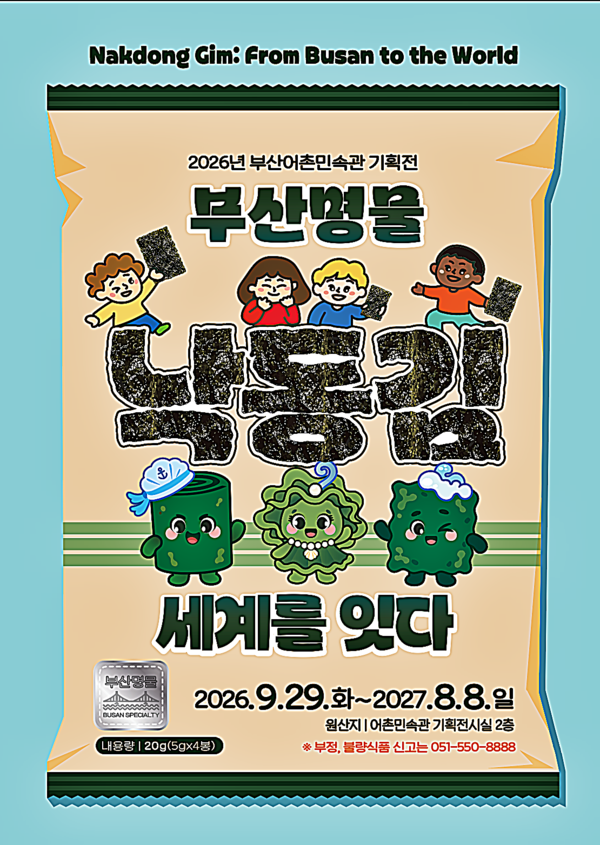
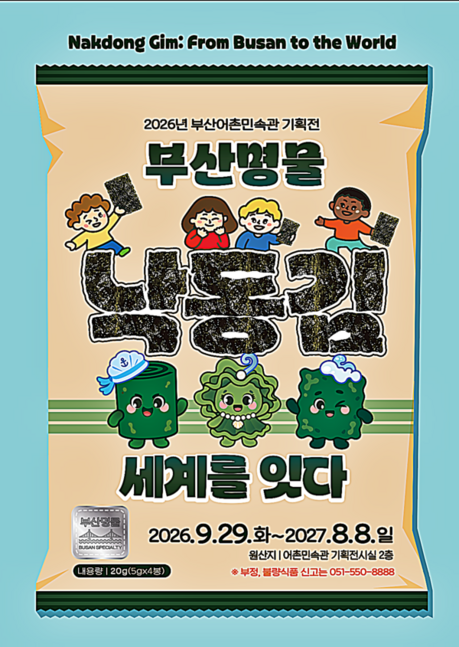
The Busan Metropolitan City Fisheries Science Museum announced that starting tomorrow (the 29th), its branch, the Busan Fisheries Folk Museum (128, Haksa-ro, Buk-gu), will host the 2026 special exhibition titled "Busan’s Specialty, Nakdong Laver, Connecting the World" in the 2nd-floor special exhibition room.
The exhibition invites visitors to trace the journey of a "single sheet of laver," so familiar to our dining tables, as it grows in the sea, passes through the hands of fishermen, and expands into a food enjoyed by people around the world today. Bringing together various materials, the exhibition features research and findings on the fishing village folklore resources of the Busan region, along with content from the National Research Institute of Maritime Cultural Heritage, the National Institute of Fisheries Science (Seaweed Research Center, Food Safety and Processing Division), the Jeonnam Ocean and Fisheries Science Institute, and the Busan Fisheries Resources Research Institute.
Furthermore, this special exhibition is Korea’s first comprehensive "laver exhibition" highlighting the roots of K-laver, which is drawing global attention. It presents over 100 items—including fishing village lifestyle culture, folklore, specimens, and videos—across three sections.
Section 1: "A Gift Sculpted by Busan’s Sea, the Birth of Laver" first explores the marine environment, ecology, and species of laver. It examines the roots of today’s K-laver culture through the history of laver as a local specialty of the Busan region during the Joseon Dynasty and its various origins.
Section 2: "The Journey of a Sheet of Laver" follows the process of how a single sheet of laver is produced, showcasing laver aquaculture production processes and technologies, as well as traditional laver production tools. In addition, through exhibits on the livelihoods of seafaring people who depend on Nakdong laver—spanning harvest, auction, processing, and distribution—it offers a perspective on laver as a fisheries cultural heritage containing the lives of the sea and its fishermen.
Section 3: "K-Laver Fever Connecting the World" features our dietary culture associated with laver and the future of the laver industry. Through familiar food cultures—such as the water-laver dining tables of island villagers in the Nakdong River basin in the past, and nostalgic kimbap eaten as a special treat on 1970s and 1980s picnic days—it shows the significance laver has held in our daily lives. It also prepares visitors to contemplate the present, where laver has evolved from a national side dish into a global K-food, and what the future of laver will look like amid climate change.
In addition, various hands-on experience corners utilizing laver have been set up. An interactive space for children has been prepared, featuring the "Nakdong-i" Detective Lab—where children uncover the secrets of laver alongside "Nakdong-i," the character modeled after Busan’s local specialty Nakdong laver—as well as laver recipe experiences and stamp play.
The exhibition is free for everyone to view. For further details, please check the Busan Fisheries Science Museum website (busan.go.kr/sea) or contact the Busan Fisheries Science Museum Exhibition Team (☎ 051-550-8886).
Jung Myung-wan, Director of the city’s Fisheries Science Museum, stated, "Laver is a food extremely familiar to us, but that single sheet contains the taste and fragrance of the Busan sea, the experience of fishermen, and the touches of countless people. We hope that through this exhibition, visitors will understand the history and fishing village culture of Busan’s Nakdong laver, and experience both the present and future of our laver as it reaches the dining tables of the world."
[Copyright (c) Global Economic Times. All Rights Reserved.]